

Ancient Egyptian architecture kept interiors cool against desert heat largely through the thermal mass of heavy walls. The main material of houses was mud brick moulded from Nile mud, sand and straw and dried in the sun; in temples and tombs, mud brick was used alongside stone. Thick walls absorbed heat during the day and passed it inside late, shielding the interior from sharp swings in the outdoor temperature.
The buildings that rose in the Nile Valley thousands of years ago had found a way to cope with heat long before electric air conditioning. In this article we explain how mud-brick houses and stone temples balanced temperature, which materials and design decisions the Egyptians relied on, how thermal mass differs from thermal insulation, and how the same comfort is achieved today with roof and facade insulation.
How did stone and mud-brick buildings work like natural air conditioning?
Heavy walls slowly absorb the sun’s heat during the day, pass it to the interior late and in reduced form, and give it back at night. Today this behaviour is called thermal mass, and the delayed release of heat is called thermal lag.
Level, New Zealand’s sustainable building guide, explains that thermal mass works by absorbing heat and re-radiating it as temperatures drop. Dense materials that alternately store and release heat reduce temperature swings indoors and keep the indoor temperature more constant. According to the same source, the effect is strongest when the difference between day and night temperatures is at its largest.
The buildings of ancient Egypt used this principle to their advantage. Because a wall heated by the sun first stored the heat in its own mass, the interior warmed more slowly than the outside air; when the evening cool arrived, the wall gave back the heat it had stored.
Egyptian builders also knew how to raise very thick mud-brick walls. According to the mud-brick architecture entry of the UCLA Encyclopedia of Egyptology, thick walls such as town walls and temple enclosure walls used wooden beams to hold the mass of bricks together, along with layers of reeds or reed matting laid every set number of courses.
Which materials did the ancient Egyptians use to balance temperature?
The most common material was mud brick; stone was used mainly in buildings meant to last, such as temples and tombs. The UCLA Encyclopedia of Egyptology stresses that although mud-brick architecture has received less academic attention than stone architecture, it was the more common of the two in ancient Egypt.
According to the encyclopedia’s entry on mud brick, it is an unfired brick moulded from a mixture of silt, clay, sand and straw. In Egypt, alluvial Nile sediment was traditionally used, with desert sand added to reach the ideal mix, and chopped straw acted as the binding temper. The moulded bricks are dried in the sun on ground strewn with straw so that they do not stick.
According to the encyclopedia, mud-brick buildings offered better interior climate control than equivalent stone buildings and provided more comfortable living and working spaces, although some researchers hold a different view. The price of mud brick was maintenance: mud-brick buildings needed constant upkeep and had a limited life span. This is one reason why the sacred “temples of millions of years” were built of stone while everyday buildings were made of mud brick.
The main elements that shaped the indoor climate of ancient Egyptian buildings were:
- Mud brick: The main material of houses; its heavy mass stored heat and passed it inside late.
- Thick stone walls: In temples and monuments, thermal mass delayed temperature swings.
- Windows high in the walls: In Amarna houses, unglazed windows were set high in the walls and light was controlled with wooden screens.
- Flat roofs finished with mud plaster: Palm ribs, reeds or reed matting were laid over wooden beams and covered with mud plaster.
| Technique / material | How does it work? | Benefit |
|---|---|---|
| Mud brick | Stores heat in its heavy mass and releases it late | More stable indoor temperature |
| Thick stone wall | Thermal mass effect | Delay in temperature swings |
| High window | Unglazed opening high in the wall, wooden screen | Control of light levels |
| Mud-plastered roof | Layers of beams, reeds and mud plaster | Adds mass to the roof |
How did the layout of buildings contribute to keeping cool?
The Egyptians sought coolness not only through materials but also through layout and the use of the roof. The courtyard house, windcatcher-type devices and roofs used in warm weather are examples of this.
According to the UCLA Encyclopedia of Egyptology, the house built around a courtyard was such a fundamental arrangement in Egypt that it became the hieroglyph pr, meaning house; by the New Kingdom, houses were more often planned around a central living room. Smaller houses at Amarna had a staircase leading to the roof, which was used for cooking and for sleeping in warm weather.
The idea of using the wind was also known in Egypt. According to the International Institute of Refrigeration (IIR), a painting found in the house of Neb-Amun, dated to the 19th Dynasty around 1300 BC, shows a windcatcher-type device. For the tower-shaped windcatchers common in Iran’s desert cities, see our article on the badgir.
Shaping design around sun and wind is also reflected in Turkish regulation. Article 7 of the Regulation on Energy Performance in Buildings requires architectural design to keep heating, cooling, ventilation and lighting needs to a minimum and, taking the effects of sun, humidity and wind into account, to make the fullest possible use of natural heating, cooling, ventilation and lighting.
Are thermal mass and thermal insulation the same thing?
No. Thermal mass stores heat and gives it back after a delay; thermal insulation slows the flow of heat between indoors and outdoors. Level makes this distinction explicitly and notes that in well-designed houses thermal mass and insulation work together.
According to the same source, without high levels of insulation the stored heat dissipates quickly. For mass to be useful, a layer is needed that limits heat escaping from or leaking into the building envelope. How well a material does this is shown by its thermal conductivity (λ, W/mK): the lower the value, the more slowly the material conducts heat. We cover the basics in detail in our article what is thermal insulation.
| Property | Thermal mass | Thermal insulation |
|---|---|---|
| Main function | Stores heat and releases it after a delay | Slows the passage of heat through a building element |
| Typical materials | Concrete, brick, tiles, earth, water; mud brick and stone in ancient Egypt | Insulation boards such as stone wool, XPS and EPS |
| Defining property | High density; needs a lot of energy to warm up | Low thermal conductivity (λ, W/mK) |
| When it works best | When the difference between day and night temperatures is large | All year round: reduces heat loss in winter and heat gain in summer |
| Enough on its own? | No; without insulation the stored heat dissipates quickly | Comfort improves when designed together with mass |
The material examples in the table are based on Level’s thermal mass page. In thermal insulation, the choice of material depends on where it is used, on water and load conditions, on fire requirements and on the thermal insulation design calculation.
What does this mean for your building?
The lesson of ancient Egypt is that indoor comfort starts with the building envelope. The Egyptians achieved it with thick, heavy walls; today the same envelope is reinforced with thermal insulation boards applied to the roof and facade. Insulation slows the passage of heat through the envelope, while the heavy walls and floors on the inside continue to act as thermal mass. The goal has not changed: to carry as little of the outdoor temperature swing indoors as possible.
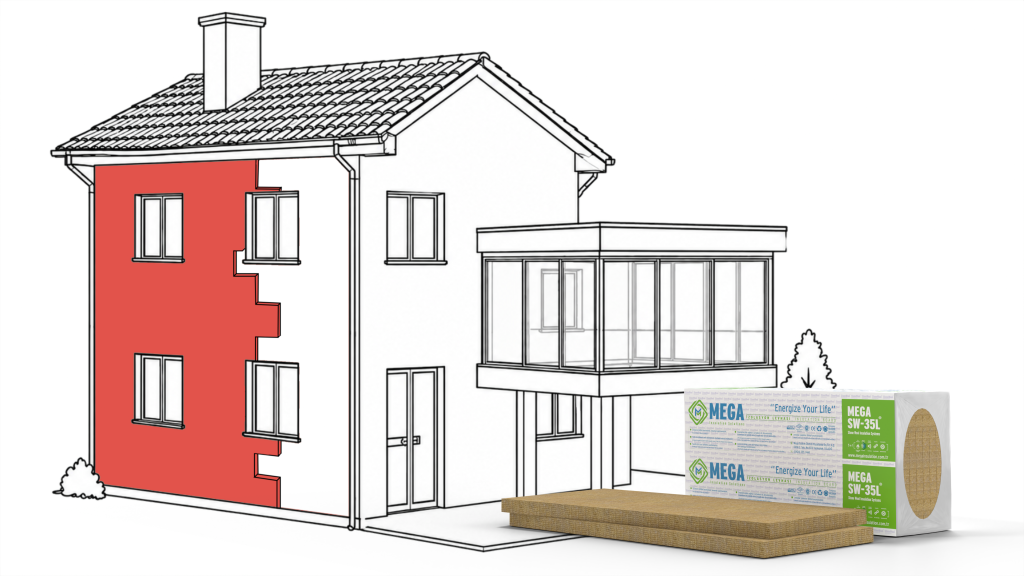
Roofs and terrace slabs are surfaces directly exposed to the sun; for layer order and material choice on flat terraces, our flat roof insulation guide shows the way. Mega’s stone wool range includes the flat roof board for terraces and pitched roofs and the stone wool ETICS board for rendered external wall insulation systems.
| Product | Type | λD (W/mK) | Thickness (mm) | Compressive strength | Reaction to fire | Application |
|---|---|---|---|---|---|---|
| Flat Roof Board | 40 kPa | ≤0.039 | 40, 50, 60, 80, 100 | min. 40 kPa | A1 | Flat roofs, pitched metal and timber roofs |
| ETICS Board | MEGA SW-35L | ≤0.035 | 50–120 | min. 25 kPa | A1 | Rendered external wall insulation systems |
The values in the table are taken from Mega technical data sheets; the reaction to fire class is A1 under TS EN 13501-1, as stated for the stone wool boards. λD is the declared thermal conductivity at 10 °C, and the lower the value, the more slowly the board conducts heat. The required thickness depends on the building’s climate zone and the building element; under the Regulation on Energy Performance in Buildings, this decision is made in a thermal insulation design prepared by an authorised mechanical engineer using the calculation method set out in TS 825.
Mega Insulation Solutions is a Turkish insulation materials manufacturer with its head office in Kavacık, Istanbul, and its plant in Elazığ; alongside stone wool, XPS and EPS thermal insulation boards, it offers MegaBlock, MegaLento, DesiWool, MegaTech construction chemicals and Fullback waterproofing products under the Mega brand.
Application note from MegaUsta: In a building with thick stone or brick walls, apply thermal insulation from the outside wherever possible. This keeps the mass of the wall on the inner side of the insulation, on the same side as the living space, so that the heat it stores helps even out the indoor temperature. Keeping sun-facing windows shaded during summer days also stops this mass from heating up unnecessarily.
The Egyptians’ knowledge of protection was not limited to houses; we look at keeping moisture away from the body in our article on mummification. Rome’s underfloor heating system, the hypocaust, has an article of its own; other examples, reaching as far as igloos, are brought together in our article on the history of insulation.
Frequently Asked Questions
What is thermal mass?
Thermal mass is a material’s ability to store heat and release it after a delay. Dense materials such as concrete, brick, earth and water need a lot of energy to warm up; they absorb heat during the day and give it back as the air cools. This softens temperature swings indoors. The thick mud-brick and stone walls of ancient Egypt worked on this principle. The effect is strongest when the difference between day and night temperatures is large.
Is mud brick a good insulation material?
Mud brick is not a thermal insulation material in today’s sense; its main contribution comes from its heavy mass, which stores heat and delays it. The UCLA Encyclopedia of Egyptology notes that mud-brick buildings in ancient Egypt offered better interior climate control than equivalent stone buildings. To slow heat flow through a wall continuously, however, an insulation layer with low thermal conductivity is needed. Heavy walls such as mud brick perform better when designed together with insulation.
What is the difference between thermal mass and insulation?
Thermal mass stores heat and releases it after a delay; thermal insulation slows the passage of heat through a wall, roof or floor. Mass evens out temperature swings, while insulation reduces heat loss and heat gain. Without insulation, stored heat dissipates quickly. That is why well-designed buildings use both; when low-λ insulation is applied on the outside, the heavy wall stays on the living-space side.
Sources
- Emery, V. L. (2011): Mud-Brick Architecture, UCLA Encyclopedia of Egyptology
- Emery, V. L. (2011): Mud-Brick, UCLA Encyclopedia of Egyptology
- Level (BRANZ): How thermal mass works
- International Institute of Refrigeration (IIR): Windcatchers: the birth of air conditioning and natural refrigeration?
- World Eras (Encyclopedia.com): Housing and Lighting: The Amarna House and Villa
- Official Gazette of Türkiye: Regulation on Energy Performance in Buildings (5 December 2008, No. 27075), Articles 7 and 10
- Mega Insulation: Flat Roof Board 40 kPa technical data sheet
- Mega Insulation: MEGA SW-35L ETICS Board technical data sheet
- Mega Insulation: Documents
You can review which product suits your roof, terrace or facade on the stone wool boards page, and contact us for technical support specific to your project.