
The short answer to “what are construction chemicals?” is this: they are ready-made products, mostly cement- or acrylic-based, used to prepare concrete, wall and floor surfaces for application, protect the building against water, bond tiles and insulation boards, and plaster walls. The main groups are waterproofing materials, primers, tile adhesives, board adhesives and plasters.
A sound, long-lasting building does not depend on the quality of its concrete and bricks alone. The thin layers that hold these materials together, keep water out and fix the finish in place have a direct effect on the result as well. This guide explains which groups construction chemicals fall into, which job each group does, and where Mega’s MegaTech and Fullback products sit in these groups, using values from the technical data sheets.
What are construction chemicals?
Construction chemicals is the collective name for specially formulated products used in construction and renovation work to improve the performance of concrete, mortars and finishes, or to protect them from external influences. In the trade they are also called building chemicals.
Their job spans different stages of a building: preparing the surface for application, keeping water and moisture away from structural elements, bonding finishes such as tiles permanently, fixing insulation boards to the wall and covering the wall with plaster. Powder products such as adhesives and plasters are mixed on site with a set amount of water. Liquid products such as primers and acrylic waterproofing are used straight from the pail, diluted where required. Two-component products are prepared by mixing the powder and liquid components together.
When the wrong product is chosen, even the best brick or tile will deteriorate over time under water, moisture and structural movement. That is why the choice depends on the substrate, on whether the area is wet or dry, and on the layer that will go on top. We explain the order of decisions in our guide to how to choose construction chemicals. We cover the effect of water on a building’s service life separately in our article on building life and waterproofing.
What types of construction chemicals are there?
By function, construction chemicals fall into four main families: waterproofing materials, primers, adhesives and plasters. Adhesives are split into products for tiles and for insulation boards, and plasters into products for walls, external thermal insulation and finishing coats. The table below brings together the job of each construction chemical product group, its Mega counterpart and the related standard.
| Product group | What does it do? | Mega product (code / class) | Related standard |
|---|---|---|---|
| Waterproofing material | Forms a continuous layer that stops water reaching the structural element | Fullback Acrylic, Fullback Acrylic UV, Fullback Duo fully elastic, Fullback Duo UV, Fullback Duo semi-elastic | TS EN 14891 (liquid-applied waterproofing products used beneath ceramic tiling) |
| Primer | Reduces the absorbency of the surface and improves the adhesion of the mortar applied on top | Megatech Bare Concrete Primer (12 and 20 kg pails) | — |
| Ceramic and wall tile adhesive | Bonds ceramic tiles, wall tiles, granite tiles and natural stone to floors and walls | MTC-2221 (C1TE), MTC-2222 (C1TE S1), MTC-2232 (C2TE), MTC-2233 (C2TE S2) | TS EN 12004-1 |
| Thermal insulation board adhesive | Bonds stone wool, EPS and XPS boards to the wall | MTA-3333 | TS 13566 |
| Thermal insulation board render | Covers the insulation board together with the reinforcing mesh | MTP-3344 | TS 13687 |
| Decorative finishing render | Creates a textured finishing coat over the ETICS or facade render | MTD-3355, MTD-3355L (line pattern) | TS 7847 (MTD-3355) |
| Wall plaster | Forms the base and finishing plaster coat on walls and ceilings | MTP-7111 ready-mixed hand plaster, MTP-7133 machine plaster | TS EN 998-1 |
Source: Mega product pages and technical data sheets. The standard column shows the Turkish standard that sets out the requirements and classification relevant to the product group; product documents are available on the Documents page.
Mega Insulation Solutions (Mega Yalıtım) offers MegaTech construction chemicals and Fullback waterproofing products under the Mega brand, alongside stone wool, XPS and EPS thermal insulation boards. For external thermal insulation, this means the board, the adhesive and the render can be checked together against the technical data sheets of a single brand.
Which product is used where for waterproofing?
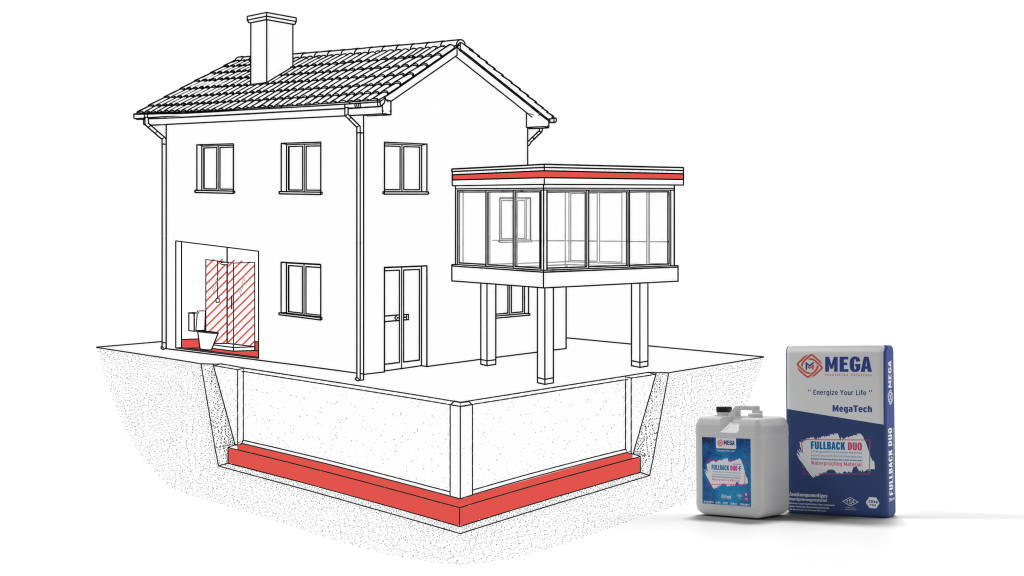
Mega’s waterproofing products come in two Fullback families: Fullback Acrylic, an acrylic-based single-component product, and Fullback Duo, a cement- and acrylic-based two-component product. The acrylic products are intended for exposed surfaces such as roofs, terraces and facades, while the Duo products are intended for wet rooms, pools, water tanks, balconies and foundations.
We cover what the word “elastomeric” in the category name means, and what the product pages say, in our article on elastomeric waterproofing. The “fully elastic” and “semi-elastic” distinction within the Duo family indicates the degree of that flexibility.
| Product | Composition | Key feature | Area of use (per product information) | Packaging |
|---|---|---|---|---|
| Fullback Acrylic-Based Liquid Waterproofing | Acrylic-based, single-component | Liquid product | Pitched roofs and terraces, external facades; cracks, eaves and chimney bases | 20 kg pail |
| Fullback Acrylic-Based Liquid Waterproofing UV | Acrylic-based, single-component | UV resistant | Same areas as the acrylic product | 20 kg pail |
| Fullback Duo Fully Elastic 20+10 | Cement- and acrylic-based, two-component | Fully elastic | Indoors and outdoors; wet rooms, pools, water tanks, small terraces and balconies, foundations, basement and retaining walls | 20 kg powder + 10 kg liquid |
| Fullback Duo UV Fully Elastic 20+10 | Cement- and acrylic-based, two-component | Fully elastic, UV resistant | Same areas as Duo | 20 kg powder + 10 kg liquid |
| Fullback Duo Semi-Elastic 20+5 | Cement-based, two-component | Semi-elastic | Same areas as Duo | 20 kg powder + 5 kg liquid |
Source: Mega Fullback product pages (area of use and packaging information).
According to the product pages, the Duo products are applied to substrates such as concrete, plaster and screed, while the acrylic products are applied to concrete, plaster, cement board, galvanised steel, zinc, aluminium, PVC, polyester and timber-clad surfaces. Mixing and coat application for the two-component products are explained step by step in our guide on how to apply cementitious waterproofing, and details for exposed areas in our article on balcony waterproofing. The whole family is listed in the waterproofing material category.
Which surfaces need a primer, and when?
Bare concrete primer is a preparatory coat that reduces the absorbency of the surface to be plastered or rendered and increases the adhesion of the mortar. According to Mega’s product information, Megatech Bare Concrete Primer is used indoors on horizontal and vertical surfaces, beneath gypsum-, lime- and cement-based mortars.
A primer is needed most on smooth, as-cast concrete surfaces. Mega’s MTP-7133 machine plaster data sheet requires smooth surfaces such as bare concrete to be roughened with bare concrete primer one day before plastering. The product declaration gives a drying time of 1–2 hours and an application temperature of +5 / +30 °C for the primer; diluted by 20%, coverage is 0.30–0.35 kg/m². The product family is listed in the bare concrete primer category, and the larger pack on the bare concrete primer 20 kg page.
Whether a primer can be applied over existing wall or floor tiles is a separate question that depends on the condition of the surface and on the product’s usage information. We cover it in detail in our guide on how to apply bare concrete primer. If you plan to renovate without removing the old finish, see also our article on whether tiles can be laid over existing tiles.
Which adhesive is used to lay ceramic and wall tiles?
Ceramic and wall tiles are laid with cementitious tile adhesive, and the right product depends on the tile size, its water absorption and how much the substrate moves. The class codes on the products come from the TS EN 12004-1 standard: C1 denotes a normal and C2 an improved adhesive; T indicates reduced slip and E extended open time; S1 and S2 indicate deformability.
| Product (code) | Class | Key value in the data sheet | Area of use |
|---|---|---|---|
| Wall and Floor Tile Adhesive (MTC-2221) | C1TE | Tensile adhesion ≥0.5 N/mm²; slip ≤0.5 mm | Small and medium ceramic and wall tiles indoors and outdoors; bathrooms and kitchens; tile over tile |
| Flex Wall and Floor Tile Adhesive (MTC-2222) | C1TE S1 | Tensile adhesion ≥0.5 N/mm²; S1 deformability | Horizontal and vertical indoors, horizontal outdoors; wet rooms, terraces, surfaces with sudden temperature changes |
| Porcelain Tile Adhesive (MTC-2232) | C2TE | Tensile adhesion ≥1 N/mm²; slip ≤0.5 mm | Large-format tiles with water absorption below 3% (under 60×60 cm per the data sheet), porcelain tiles and marble; terraces, balconies, pools, facades |
| Ultra-Flexible Porcelain Tile Adhesive (MTC-2233) | C2TE S2 | Tensile adhesion ≥1 N/mm²; deformability ≥5 mm | Over old ceramic, porcelain and marble; underfloor-heated floors, cold stores, glass mosaic in pools |
Source: Mega MTC-2221, MTC-2222, MTC-2232 and MTC-2233 technical data sheets and product pages.
You can find the detailed meaning of the class letters, together with trowel and coverage tables, in our guide on the difference between C1TE and C2TE. All four products are listed in the tile adhesive category.
Which construction chemicals are used in external thermal insulation (ETICS)?
Three construction chemicals work together in an external thermal insulation system: the board adhesive that fixes the insulation board to the wall, the board render that covers the board together with the mesh, and the decorative render that gives the facade its final appearance. All three layers must be applied in line with their data sheet conditions; a fault in one affects the performance of the others.
- Thermal insulation board adhesive (MTA-3333): According to its data sheet, it is used to bond stone wool, EPS and XPS boards. A 25 kg bag is mixed with 5.5–6 litres of water and covers 3–5 kg/m². If the substrate is even, the mortar is combed onto the back of the board; if not, it is applied in dabs. Anchors are fitted after at least 24 hours and the board render after 2 days; the ambient temperature must be between +5 and +35 °C.
- Thermal insulation board render (MTP-3344): A fibre-reinforced, cement-based render. A 160 g/m² alkali-resistant mesh is embedded in the render with a 10 cm overlap; application thickness is about 4 mm and coverage 3.5–5.5 kg/m². According to the product page, it can be painted directly.
- Decorative mineral render (MTD-3355): A cement-based, polymer-modified, water-repellent finishing coat. It is applied 2 mm thick and covers 2.2–2.5 kg/m². According to the product information, it must not be left bare as the final coat and is painted once dry. The line-pattern version is coded MTD-3355L.
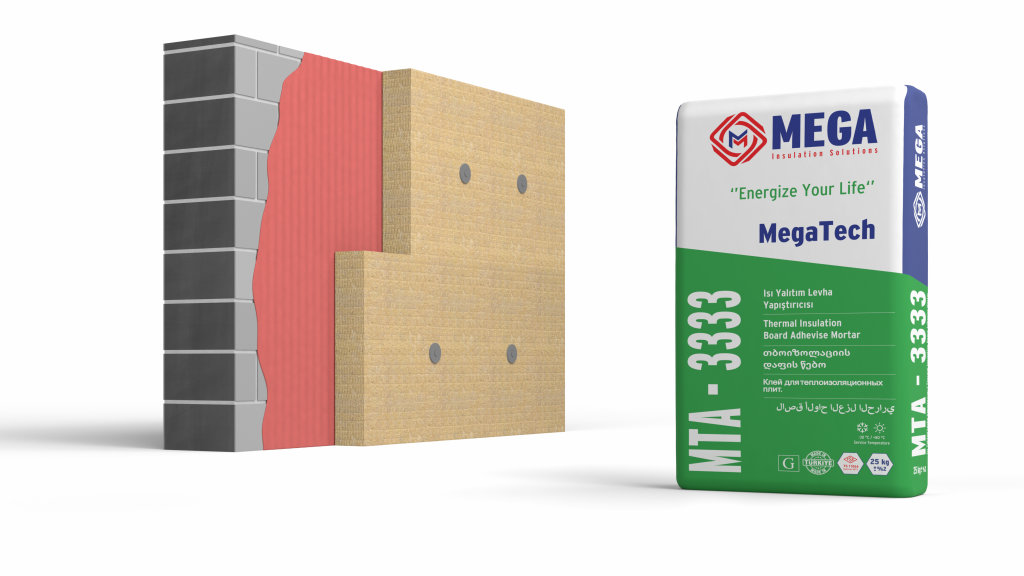
You can find the complete system, including board types, anchors and profiles, in our article on ETICS materials, facade options in our guide to types of exterior wall insulation, and the effect of season and weather in our article on when to install external insulation.
Which products are used for wall plastering?
Ready-mixed cement-based plasters are used on walls and ceilings. Mega’s two products in this group are MTP-7111 ready-mixed hand plaster and MTP-7133 machine plaster; according to their data sheets, both are applied indoors and outdoors to brick, aerated concrete, concrete, bare concrete, pumice block and concrete block surfaces.
Both products do the work of the base and finishing coats in a single material. A 30 kg bag is mixed with 5.4–6.6 litres of water and the mortar must be used within 1 hour. Machine plaster is sprayed in a single coat 5–25 mm thick; if the thickness will exceed 25 mm, a second coat is applied once the first has set. The MTP-7133 data sheet defines the product as type GP, class CS IV (compressive strength ≥6.0 N/mm²); these codes belong to the TS EN 998-1 classification of rendering and plastering mortars. For small areas and repairs, ready-mixed hand plaster is the more practical choice. Both products are listed in the plaster mortar category.
In what order are construction chemicals applied?
Construction chemicals work as links in one system rather than one by one: the surface is prepared first, then comes the protective or bonding layer, and the finish goes on last. Below is the application sequence for three common jobs on site.
In wet areas such as bathrooms and kitchens
- The surface is cleaned of dust, oil and loose particles; cracks and holes are repaired beforehand with repair mortar.
- The waterproofing is applied so that it forms a continuous layer, including the corners where the floor meets the wall.
- The tiles are laid with a cementitious adhesive of a class suited to the location.
- According to the MTC-2221 data sheet, grouting is done after 24 hours on walls and 48 hours on floors.
For detailed steps, see our guide on how to waterproof a bathroom.
Plastering a smooth concrete wall
- The surface is cleaned of release oil, dust, paint and any residue that reduces adhesion.
- Bare concrete primer is applied, and plastering starts one day later.
- The plaster is applied within the thickness limits in the data sheet, screeded and floated once it has hardened sufficiently.
On an insulated (ETICS) facade
- The board adhesive is combed onto the back of the board or applied in dabs, and the board is pressed against the wall.
- Anchors are fitted after at least 24 hours.
- Two days after bonding, the board render and mesh are applied.
- Once the board render has dried, the decorative finishing coat is applied and painted.
If a link in this chain is skipped, for example if smooth concrete is plastered without a primer or tiles are laid without waterproofing, the whole application is weakened.
Which application rules are common to powder products?
The technical data sheets of MegaTech powder products share most of their application and storage rules. If these rules are not followed, the strength declared in the data sheet may not be achieved even with the right product.
- The ambient temperature must be between +5 °C and +35 °C.
- Do not apply to frozen or thawing surfaces, or to surfaces at risk of frost within 24 hours.
- Do not work in direct sunlight, in strong wind or on hot surfaces.
- If a skin forms on the surface, the mortar is combed again.
- Bags are stored in a dry, enclosed place out of the sun and off the floor; adhesives are stacked no more than 8 bags high, hand and machine plasters no more than 6.
- Under these conditions the shelf life is 12 months from the production date.
Application note from MegaUsta: When preparing the mortar, put the water into a clean bucket first, add the powder gradually and mix with a low-speed mixer until free of lumps. Once the consistency is right, do not add water or powder; the data sheets do not allow it. Throw away mortar that has passed its pot life or formed a skin instead of thinning it with water and using it.
We explain how to plan work in cold and wet weather in our article on whether plastering can be done in winter.
What are the common mistakes when using construction chemicals?
The most common mistakes are applying without preparing the surface, using a product for something it was not designed for, and skipping details such as corners, skirting lines and pipe penetrations. The points below summarise these mistakes and the correct practice recommended by the data sheets.
- Applying without preparing the surface: An application on a dusty, oily or insufficiently cured surface can soon blister and detach. The data sheets require a sound, clean and fully cured substrate; porous surfaces are dampened and smooth concrete is primed.
- Using a product in the wrong place: Each product has its own job. A tile adhesive does not replace waterproofing, and a product defined for indoor use is not used on an external facade.
- Skipping details: If corners, skirting lines and pipe penetrations are missed during waterproofing, water leaks through these points.
- Choosing a rigid product for a moving substrate: On surfaces with sudden temperature changes, underfloor heating or an old finish, adhesives with S1 or S2 deformability, and elastic products for waterproofing, adapt better to these movements.
- Ignoring the ratios and times in the data sheet: Adding too much water, using mortar past its pot life or plastering too early reduces strength.
- Choosing a product without checking its documents: The technical data sheet and product documents should be read before work starts. We explain the construction material inspection process under Law No. 4708 on Building Inspection in a separate article.
Frequently Asked Questions
What do construction chemicals include?
Construction chemicals comprise waterproofing materials, primers, ceramic and wall tile adhesives, thermal insulation board adhesive and board render, decorative finishing renders and wall plasters. In Mega’s range, these groups correspond to the Fullback waterproofing products, Megatech Bare Concrete Primer, the MTC series of tile adhesives, MTA-3333 board adhesive, MTP-3344 board render, MTD-3355 decorative renders, and MTP-7111 and MTP-7133 plasters.
Should you choose machine plaster or hand plaster?
Machine plaster is more practical on large wall areas and on sites where a plastering machine can be set up, while hand plaster suits small areas, repairs and places a machine cannot reach. Mega’s MTP-7133 machine plaster is sprayed in a single coat 5–25 mm thick; MTP-7111 ready-mixed hand plaster is applied by hand to the same substrate types. Both come in 30 kg bags and are mixed with 5.4–6.6 litres of water.
Which waterproofing material is used in wet rooms?
In wet rooms such as bathrooms, toilets and kitchens, a cement-based, two-component waterproofing that stays beneath the tiles is generally used. Mega’s range includes Fullback Duo fully elastic, Duo UV and Duo semi-elastic for this job; their product information lists wet rooms, pools and water tanks among the areas of use. The application sequence is explained step by step in our bathroom waterproofing guide.
What is the difference between C1TE and C2TE adhesives?
C1TE is a normal and C2TE an improved cementitious tile adhesive; in both codes, T indicates reduced slip and E extended open time. Mega’s data sheets give a tensile adhesion strength of ≥0.5 N/mm² for the C1TE-class MTC-2221 and ≥1 N/mm² for the C2TE-class MTC-2232. The MTC-2232 data sheet specifies this product for large-format porcelain tiles, terraces, pools and facades.
How long can powder construction chemicals be stored?
According to their technical data sheets, MegaTech powder products can be stored for 12 months from the production date under suitable conditions. Bags are kept in a dry, enclosed place out of direct sunlight and off the floor. Adhesives are stacked no more than 8 bags high, hand and machine plasters no more than 6. The data sheets also warn that poor storage or use past the expiry date can impair the product’s properties.
Sources
- EN 12004-1:2017 Adhesives for ceramic tiles, Part 1: requirements, classification and marking (SIS standard record)
- EN 14891:2017 Liquid-applied water-impermeable products for use beneath ceramic tiling (SIS standard record)
- EN 998-1:2016 Specification for mortar for masonry, Part 1: rendering and plastering mortar (SIS standard record)
- Mega MTA-3333 thermal insulation board adhesive technical data sheet (PDF)
- Mega MTP-7133 machine plaster technical data sheet (PDF)
- Mega MTC-2221 wall and floor tile adhesive technical data sheet (PDF)
- Mega MTC-2232 porcelain tile adhesive technical data sheet (PDF)
- Mega Yalıtım technical documents
All the products mentioned in this article are listed with their technical data sheets on the Mega construction chemicals page. To choose the right product for your substrate and project, you can reach our technical team via the contact page.