
In short: Sound insulation materials are boards, panels and blocks that reduce the passage of sound through building elements. Stone wool board is used in lightweight partitions, DesiWool panel or MegaBlock Acoustic block in party walls, and floating floor board for impact sound on floors. The right choice depends on the type of sound, the application and the conditions under which the value was measured.
This guide explains how to choose materials by type of sound, how to read the R’w value, Mega products’ measured values and how laboratory results differ from the field. For solutions specific to noise between flats, see our articles on neighbour noise and wall sound insulation, and for floor layers see what is a floating floor.
What should you check first when choosing a sound insulation material?
When choosing a sound insulation material, first check the type of sound, because airborne sound and impact sound enter the structure in different ways. Türkiye’s Regulation on the Protection of Buildings against Noise defines airborne sound as sound that travels through the air. Impact sound arises directly in the floor, such as footsteps, a slammed door or furniture being dragged, and is transmitted to the building’s load-bearing system.
For sound arriving through the air, the insulation of the separating wall or floor matters. For impact sound, the upper layers must be separated from the floor structure by a resilient layer. We explain the practical consequences in detail in our article on stone wool sound insulation.
Which sound insulation material is used for walls, floors and ceilings?
Filled partitions, panels or sound insulation blocks are used against airborne sound in walls and a board under the screed against impact sound in floors; the product pages of the stone wool-based products in this table define no sound-specific application for ceilings. Mega Insulation Solutions (Mega Yalıtım) offers stone wool-based products for these applications:
| Application | Main type of sound | Material type | Mega product | Use on the product page |
|---|---|---|---|---|
| Lightweight partition | Airborne | Stone wool board | Partition Board (MEGA SW PB 40/50/60) | Lightweight partition wall systems |
| Inner face of an existing wall | Airborne | Composite panel of stone wool and gypsum board | DesiWool | Inner face of external walls, internal partitions, party walls, walls next to stair and lift shafts |
| Newly built wall | Airborne | Stone wool-filled block | MegaBlock Acoustic | Party walls, kitchens and bathrooms, bedrooms, hotel rooms, plant rooms, studios |
| Floor, under screed | Impact | Stone wool board | Floating Floor Board (MEGA SW FF100/110/120) | Floor coverings, under screed between two layers of concrete, foundations subject to vibration, floors over open passages |
| Ceiling | Airborne and impact | Depends on the design | No sound-specific application defined on stone wool-based product pages | Set in the project |
Source: Mega product pages and technical data sheets.
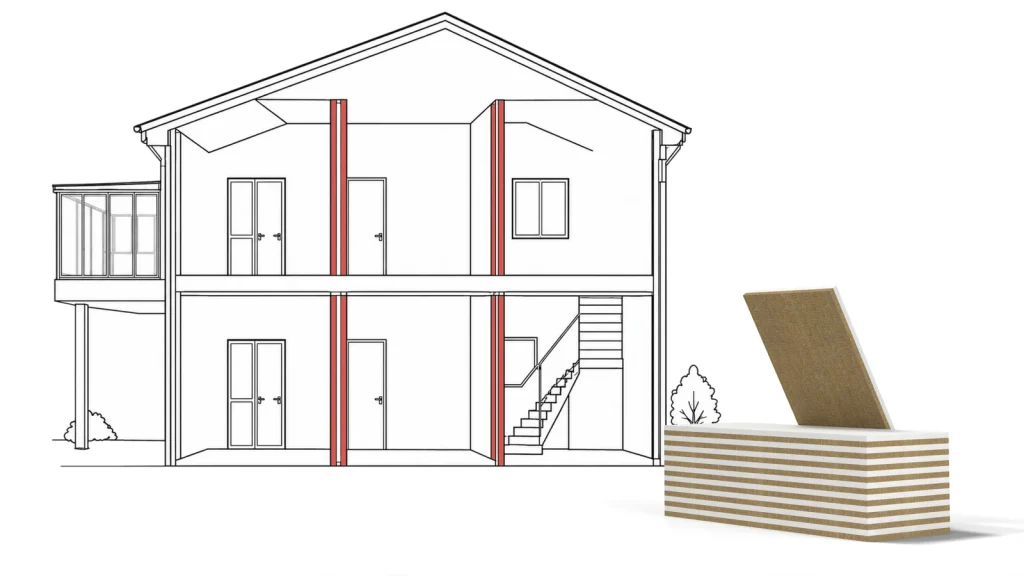
A ceiling solution in the room below cuts only one path for impact sound from the floor above, because sound also travels through the side walls. The regulation defines this path as indirect or flanking transmission.
What does the R’w value on a data sheet tell you?
R’w shows, as a single number in decibels (dB), how much a building element reduces airborne sound; the higher the value, the less sound passes through. The regulation defines the two indicators together: Rw is derived from the element’s sound reduction index and R’w from the apparent sound reduction index. Mega’s DesiWool W15 reports state the laboratory standard EN ISO 10140-2 as the method but give the result with the symbol R’w, so check the report’s method and sample, not only the symbol. You can find how to read the C and Ctr terms in our article on stone wool sound insulation.
What are the measured sound values of Mega products?
The Mega sound values shown here with their test conditions are for DesiWool W15 and the MegaBlock Acoustic 145, 245 and 295 mm series. DesiWool values come from the test report and MegaBlock values from the heading of the product data sheet.
| Product and application | Measured value | Test body and standard | Test condition |
|---|---|---|---|
| DesiWool W15, one side | R’w 29 dB | Ticem İleri Yapı Teknolojileri (ISO/IEC 17025 accredited); EN ISO 10140-2:2021, EN ISO 717-1:2020 | Laboratory method according to the report; 2.48 × 4.43 m test opening, 11 m² of panel; in the report’s section, panel on one side of a box profile; applied by the manufacturer |
| DesiWool W15, both sides | R’w (C;Ctr) 42 (-3;-9) dB | Ticem İleri Yapı Teknolojileri (ISO/IEC 17025 accredited); EN ISO 10140-2:2021, EN ISO 717-1:2020 | Laboratory method according to the report; same test opening, 11 m² of panel; in the report’s section, panel on both sides of a box profile; applied by the manufacturer |
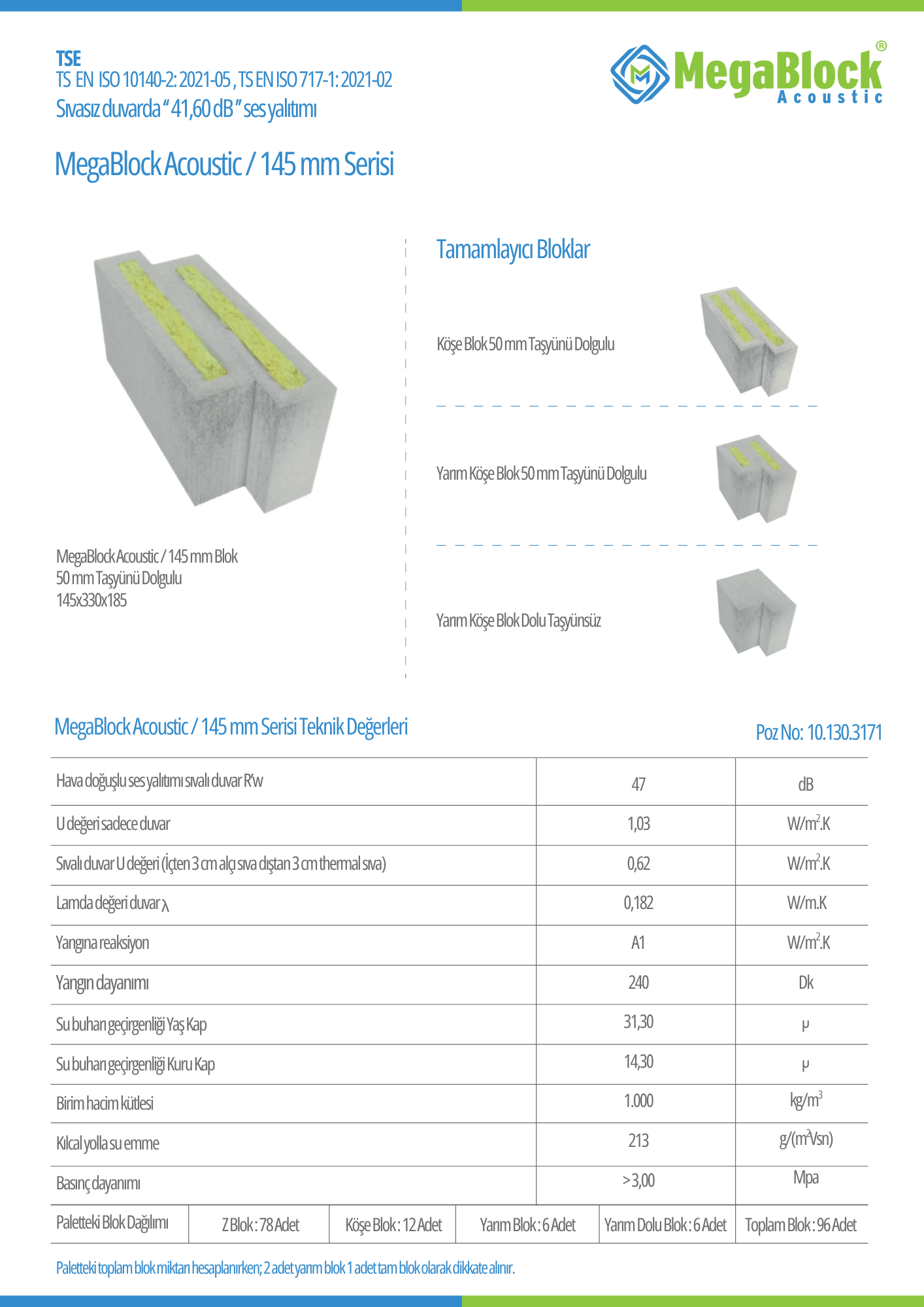
| MegaBlock Acoustic 145/50SW | 41.60 dB | TSE; TS EN ISO 10140-2:2021-05, TS EN ISO 717-1:2021-02 (according to the data sheet heading) | Unplastered wall |
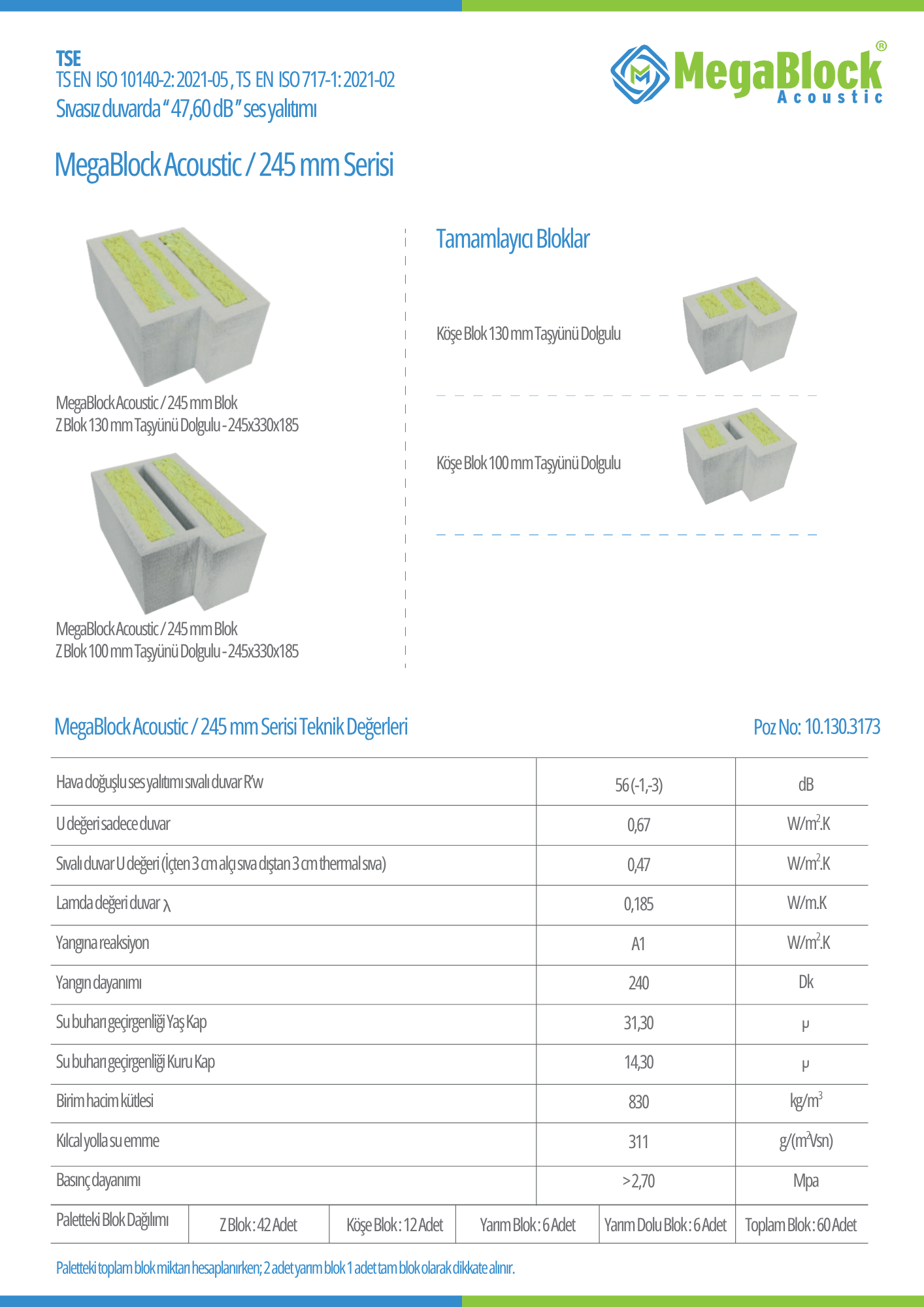
| MegaBlock Acoustic 245 series | 47.60 dB | TSE; TS EN ISO 10140-2:2021-05, TS EN ISO 717-1:2021-02 (according to the data sheet heading) | Unplastered wall; the sheet gives one value for 245/100SW and 245/130SW and does not say which type was tested |
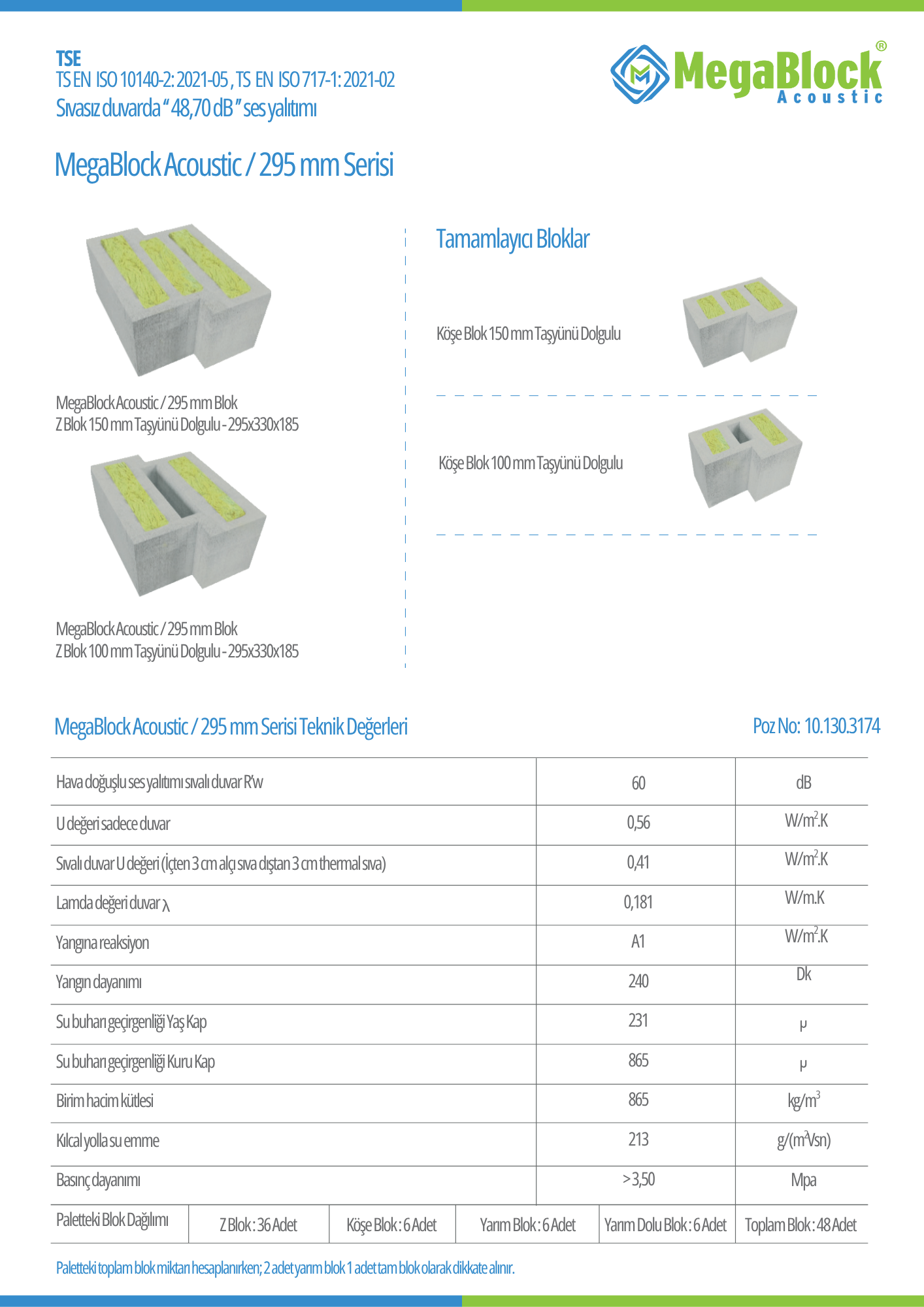
| MegaBlock Acoustic 295 series | 48.70 dB | TSE; TS EN ISO 10140-2:2021-05, TS EN ISO 717-1:2021-02 (according to the data sheet heading) | Unplastered wall; the sheet gives one value for 295/100SW and 295/150SW and does not say which type was tested |
Source: DesiWool W15 one-side and both-sides test reports (Ticem); MegaBlock Acoustic 145/50SW, 245 series and 295 series technical data sheets.
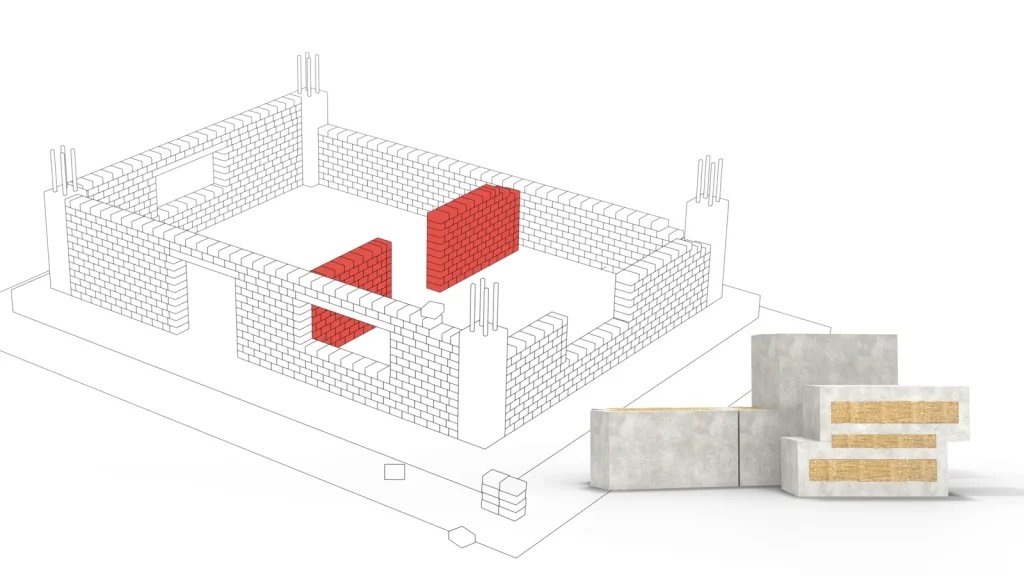
These rows do not describe equivalent conditions. The report text says the panels were fixed to the test opening; its section photo shows the panel on a box profile with no wall visible behind it, and the report does not state this separately. Do not read 29 dB as a gain to add to the value of an existing wall. Mega sources contain no measurement of the increase DesiWool gives when applied to an existing wall; if the project needs that figure, ask for a report tested with the wall. The MegaBlock rows are for unplastered walls.
The technical values table on the MegaBlock data sheets also has a separate R’w row for plastered walls. Here we show only values for which the data sheet names the test body and condition. For the 195 mm series, the data sheet heading gives 52 dB on a plastered wall, measured by BLX Acoustic Research Lab.
Which values matter for partition and floating floor boards?
Mega’s Partition Board and Floating Floor Board data sheets give no dB value; for these boards, density, thickness and compressive strength are read from the sheet, while the sound result comes from a system test. The table below shows declared values, not sound performance.
| Board and type | Density | Thickness | λD | Compressive strength | Sound value on the sheet |
|---|---|---|---|---|---|
| Partition Board, MEGA SW PB 40/50/60 | 40-50-60 kg/m³ | 40–120 mm | ≤0.035 W/mK | Not declared; not used in applications requiring compressive creep | None |
| Floating Floor Board, MEGA SW FF100/110/120 | 100–120 kg/m³ | 30 mm | ≤0.036 W/mK | 25 kPa | None |
Source: Mega Partition Board and Floating Floor Board technical data sheets.
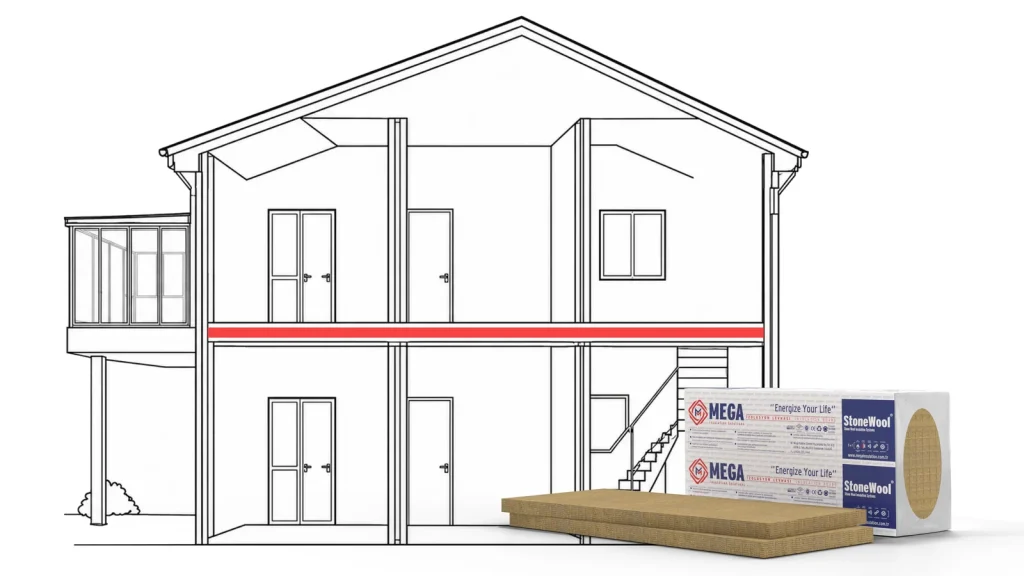
For a floating floor, the value to ask for is the single-number impact sound reduction that EN ISO 717-2 defines for floor coverings and floating floors. If the project requires this value, ask for a test report in which the board, screed and covering were tested together.
Why are EPS and XPS not primary sound insulation materials?
Mega’s EPS and XPS boards are offered for thermal insulation and their data sheets give no dB value, so they cannot be recommended on the basis of measurement when sound is the goal. İZODER’s list of sound insulation materials includes stone wool and glass wool, while EPS appears only as special T-class products under TS EN 13163 with improved dynamic stiffness. XPS is not on this list.
Mega’s EPSW and EPSG product pages name impact sound in floating floors among their uses but give no related measurement. If the project has a sound target, treat these boards as a thermal insulation layer and ask for a separate test report for sound.
Is DesiWool a sound-absorbing panel?
No. DesiWool is a sound insulation panel used to reduce airborne sound passing through a wall, and Mega sources contain no sound absorption value (αw) for it. Sound insulation reduces the passage of sound to the next room, while sound absorption affects reflections inside the room. The regulation treats these properties with separate indicators such as R’w and αw. Checking DesiWool’s R’w value will therefore not give the right answer for an echo problem.
Why does a laboratory value differ on site?
A laboratory value cannot be carried directly to the site because, under EN ISO 10140-2, sound transmission through flanking paths is suppressed in test facilities. The standard states that results do not apply directly to the field without accounting for factors such as flanking. In a finished building, sound insulation between two rooms is measured with field methods such as EN ISO 16283-1.
The regulation requires at least acoustic performance class C in new buildings and at least class D for affected building elements in major renovations. For partitions these classes are assessed not with R’w but with DnT,A or DnT,50 measured in the building, and for impact sound on floors with L’nT,w or L’nT,50, so do not compare a data sheet R’w directly with the class requirement. We explain what these classes mean in housing in our neighbour noise guide. Follow this order when choosing a material:
- Identify the type of sound: Is the problem sound through the air, or impact sound such as footsteps?
- Be clear about the application: A new wall, an existing wall, a lightweight partition and an under-screed layer need different products.
- Compare like with like: Do not use plastered and unplastered values, or one-side and both-sides values, interchangeably.
- Ask for the test report: See the test body, the standard and the section of the sample.
- Solve flanking paths in the design: Check junction details and the target value with a building acoustics expert.
Application note from MegaUsta: Record a dB value together with the structure it was measured on, not just the product name. According to the section photos in the reports, the same DesiWool W15 panel gave R’w 29 dB on one side of the profile and R’w 42 dB on both sides. When comparing quotes, ask which section each figure belongs to.
Frequently Asked Questions
Is there one sound insulation material for every job?
No, no single material suits every application. Consider a stone wool-filled system for lightweight partitions, a sound insulation block for newly built walls, a gypsum-faced panel for existing walls and a floating floor board for impact sound on floors. Compare products by test values measured under the same conditions, not by product name.
Is there a soundproof material?
No single material stops sound completely; insulation materials reduce its passage to a certain extent. The result depends on the whole wall or floor, its junctions and flanking paths. As a measured example, in the box-profile section shown in the report, DesiWool W15 gave R’w 29 dB when applied on one side and R’w 42 dB when applied on both sides.
How thick should a sound insulation board be?
There is no single thickness; it depends on the system in which the board is used. According to Mega data sheets, Partition Board (MEGA SW PB) is 40–120 mm and Floating Floor Board (MEGA SW FF) is 30 mm thick. DesiWool panel has options from 15 to 80 mm. The effect of thickness on sound cannot be read from these sheets; a system test is needed.
Does EPS provide sound insulation?
EPS is primarily a thermal insulation material. Mega’s EPS ETICS board data sheets give no dB value. İZODER lists EPS among sound insulation materials only as special T-class products with improved dynamic stiffness. Mega’s EPSW and EPSG pages name impact sound in floating floors among their uses but give no measured value.
Which value should I check for floor sound insulation?
Check a measurement made for impact sound on the floor. In a building, the result is assessed with the L’nT,w indicator, which describes the impact sound level measured in the room below. The reduction from floor coverings and floating floors is expressed with the single-number quantities in EN ISO 717-2. The Mega Floating Floor Board data sheet does not give this value; it gives density, thickness and compressive strength.
Will a dB value measured in the laboratory be the same at home?
It may not be. Under EN ISO 10140-2, sound transmission through flanking paths is suppressed in laboratory measurements, and the standard states that results do not apply directly to the field without accounting for factors such as flanking. In a building, sound also passes through floors, ceilings and side walls. Only an on-site measurement shows the result in the finished building.
Sources
- Regulation on the Protection of Buildings against Noise, current text (Legislation Information System)
- EN ISO 10140-2:2021, laboratory measurement of airborne sound insulation, scope (EVS)
- EN ISO 16283-1:2014, field measurement of sound insulation, scope (EVS)
- EN ISO 717-2:2020, rating of impact sound insulation, standard record (SIS)
- İZODER: Sound insulation, general information
- Ticem test report: DesiWool W15, one side (PDF)
- Ticem test report: DesiWool W15, both sides (PDF)
- Mega technical data sheet: DesiWool
- Mega technical data sheet: MegaBlock Acoustic 145/50SW
- Mega technical data sheet: MegaBlock Acoustic 245 series
- Mega technical data sheet: MegaBlock Acoustic 295 series
- Mega technical data sheet: Partition Board
- Mega technical data sheet: Floating Floor Board
- Mega Yalıtım Documents page
You can browse stone wool-based boards in the Stone Wool category and reach our technical team for your project through our contact page.