

An ant nest balances heat largely by means of the soil itself. The large temperature difference that builds up at the surface during the day fades markedly within a few tens of centimetres, so the deeper chambers stay more stable. Some species carry their brood to chambers at a suitable temperature during the day; others ventilate the nest with the wind or cover it with an insulating layer.
While the air outside warms up and cools down throughout the day, the chambers where the colony lives feel only a small part of that change. This is achieved by the physics of the soil and the behaviour of the ants working together. In this article we explain, on the basis of scientific studies, how an ant nest is built, how the soil acts as a thermal buffer and how the nest is ventilated, and we show what the same principle means for the parts of a building that are in contact with the ground.
How is heat balanced in an ant nest?
The first factor that balances heat in an ant nest is the soil. Soil conducts heat slowly and stores it; the temperature swing at the surface becomes both smaller and later as it moves deeper.
In the example from Tyson Ochsner’s soil physics textbook, the amplitude of the daily temperature oscillation is 7 °C at the surface but only 3 °C at a depth of 10 cm. The book calls the depth at which the amplitude falls to 37 per cent (1/e) of its surface value the damping depth. For the soil in the example, this depth is calculated as 11.7 cm for the daily wave and 224 cm for the annual wave. In short, the difference between night and day fades in a shallow layer, while the difference between summer and winter reaches several metres down.
Ants use this layering through their behaviour. According to the review by Kadochová and Frouz, two main strategies stand out among mound-building ants: moving the brood from one chamber to another according to the temperature differences in the nest, or keeping the inside of the nest at a high temperature. In one observation cited in the same review, Camponotus mus workers move the brood twice a day: at around 2 pm from the cooler night chamber to the warmer day chamber, and back again at around 10 pm. Colonies of the fire ant Solenopsis invicta, for their part, can grow only between 24 and 36 °C.
The records of Walter Tschinkel, who studied the Florida harvester ant Pogonomyrmex badius, fit this picture: the brood and newly emerged workers were found mostly in the bottom third of the nest. The chambers most exposed to daily temperature change, as Tschinkel points out, are those in the upper part of the nest. In other words, the colony’s most sensitive members are found in the layers where the fluctuation is felt least.
How is an ant nest built?
An ant nest consists of narrow descending shafts and horizontal chambers connected to them. The workers dig out the soil grain by grain and carry it to the surface; as the colony grows, the nest becomes deeper and gains new chambers.
One of the studies that measured this structure in detail is Tschinkel’s paper published in 2004. Tschinkel examined harvester ant nests in the sandy soils of Florida by excavating them and making casts of them. The table below summarises the main values from that study.
| Feature | Measured value |
|---|---|
| Depth of a mature nest | Usually 2.5–3 m; deepest nest 3.06 m |
| Depth of a newly founded nest | No more than about half a metre (the paper gives ranges of 29–37 cm and 40–50 cm) |
| Shape of the shafts | Slightly under 1 cm wide; they descend in helices 4–6 cm in diameter |
| Chamber height | About 1 cm, regardless of floor area |
| Vertical spacing between chambers | 2–4 cm near the surface, 20–30 cm deeper down |
| Distribution of chamber area | About half of the total area in the top quarter of the nest |
| Seed stores | Only in chambers 40–100 cm below ground |
| Location of the brood | Mostly the bottom third of the nest |
| Example nest (about 5,000 workers) | 135 chambers, 12 m of vertical shafts, about 20 kg of excavated sand |
Source: Tschinkel (2004), Journal of Insect Science. The values refer to the Florida harvester ant; nests of other species may have different dimensions.
How ants tell how deep they are is a separate question. Tschinkel reports that the carbon dioxide level in the nest is close to that of the outside air at the surface and rises about fivefold towards the bottom, and he suggests that this difference may be a cue that gives the ants information about depth. He does not consider temperature and soil moisture reliable cues, because they change too much from day to day and from season to season.
How is an ant nest ventilated?
In the giant nests of leaf-cutting ants, the main force that refreshes the air is the wind blowing over the surface; the contribution of rising warm air is very small. This finding was established through field measurements.
Kleineidam, Ernst and Roces monitored the airflow over the summer in a large nest of the leaf-cutting ant Atta vollenweideri. According to their measurements, the wind blowing over the nest mound drew air out through the tunnels in the upper, central part of the mound. This outflow was followed by a delayed inflow of fresh air through the tunnels in the lower, peripheral part of the mound. This function of the tunnels did not depend on the direction of the wind. The researchers noted that airflow driven by temperature differences, known as the stack effect, contributed very little to ventilation.
For this reason, describing an ant nest as a system in which “warm air escapes through a chimney” is not correct, at least for this species. Kadochová and Frouz point to the same conclusion: in these nests there is no temperature difference large enough to move the air by thermal convection. Leaf-cutting ants raise the tunnel openings at the top of the mound into small turrets; according to Kleineidam and his colleagues, these turrets may strengthen the suction effect of the wind. We describe a traditional architectural solution that channels wind into a building in our article on windcatcher towers, and another natural structure that manages its own climate in our article on the termite mound.
Does the nest covering work like an insulation layer?
In some species, yes. As Kadochová and Frouz report, the covering layer that species such as Formica obscuripes build on top of the nest has a lower thermal diffusivity than the surrounding soil; this covering reduces overheating during the day and heat loss at night.
Red wood ants (the Formica rufa group) build their nests as a mound rising above the ground. According to the review, this mound often works like a surface that collects solar heat. In Formica polyctena, the preferred temperature for pupal development is 29 °C. The nests of colonies studied in Finland and the Czech Republic were reported to stay above 20 °C for 65 to 129 days during spring and summer. When necessary, workers can remove part of the nest material to thin the walls and make it easier for excess heat to escape. A thicker covering keeps heat inside, and a thinner one lets it out.
The table below brings together these strategies used by different ant species and the studies that document them.
| Natural strategy | How does it work? | Example species / source |
|---|---|---|
| Depth and soil layer | Soil damps the daily temperature swing with increasing depth | Soil physics (Ochsner) |
| Layered chambers and brood transport | Brood is carried to chambers at a suitable temperature or kept in deep chambers | Camponotus mus, Pogonomyrmex badius |
| Wind-driven ventilation | Wind draws air out of the central tunnels and fresh air enters through the peripheral tunnels | Atta vollenweideri (Kleineidam et al.) |
| Insulating nest covering | A covering with low thermal diffusivity reduces overheating and heat loss at night | Formica obscuripes (Kadochová and Frouz) |
| Thinning the walls | Workers partly remove nest material to increase heat dissipation | Formica species (Kadochová and Frouz) |
What does this mean for your building?
The lesson of the ant nest applies to every part of a building that is in contact with the ground: soil softens temperature changes but does not stop heat from escaping, and it also carries moisture. That is why basement walls and foundations are protected with an insulation layer that absorbs little water and withstands pressure.
Why are walls in contact with the ground considered separately?
The ground is more stable than the outside air, but it is not constant. In the example above, the damping depth of the annual temperature wave came out at 224 cm; in other words, the walls and floor of a basement still feel the change of seasons, and the upper parts close to the surface are also affected by the daily change. A heated basement that is not insulated continuously gives off its heat to the cool soil around it.
The second challenge is moisture and load. Ants dig their chambers in damp soil; a basement retaining wall likewise works under the pressure and moisture of the backfill. The insulation material used in this zone has to remain in a wet environment for a long time and carry the load placed on it. We describe the application steps and details in our guide on how to insulate a foundation.
How does XPS take on this task?
Thanks to its closed-cell structure and low water absorption, XPS (extruded polystyrene) stands out in damp, load-bearing areas such as foundations, below-grade retaining walls and flat roofs. According to Mega’s technical data sheets, its long-term water absorption measured by total immersion is at most 0.7 per cent (WL(T)0,7).
| Mega XPS type | λD (W/mK) | Compressive strength CS(10\Y) | Thickness (mm) |
|---|---|---|---|
| MEGA XPS T1500 | 0.035 | 150 kPa | 20–80 |
| MEGA XPS T2000 | 0.035 | 200 kPa | 20–80 |
| MEGA XPS T2500 | 0.036 | 250 kPa | 20–120 |
| MEGA XPS T3000 | 0.035 | 300 kPa | 20–120 |
Source: Mega XPS technical data sheets. For all types, the board size is 600 x 1200 mm, the service temperature range is -50 / +75 °C and the long-term water absorption is WL(T)0,7. λD is the declared thermal conductivity at 10 °C.
Mega Yalıtım’s flat XPS board is recommended on its product page for below-grade retaining walls, foundation insulation in contact with the ground and flat roofs. The channelled XPS board, with its rough, grooved surface, is used according to its product page on foundations and retaining walls as well as for external and internal thermal insulation of walls. We explain separately how the boards are used in each application, foundation insulation included, in our article on XPS applications.
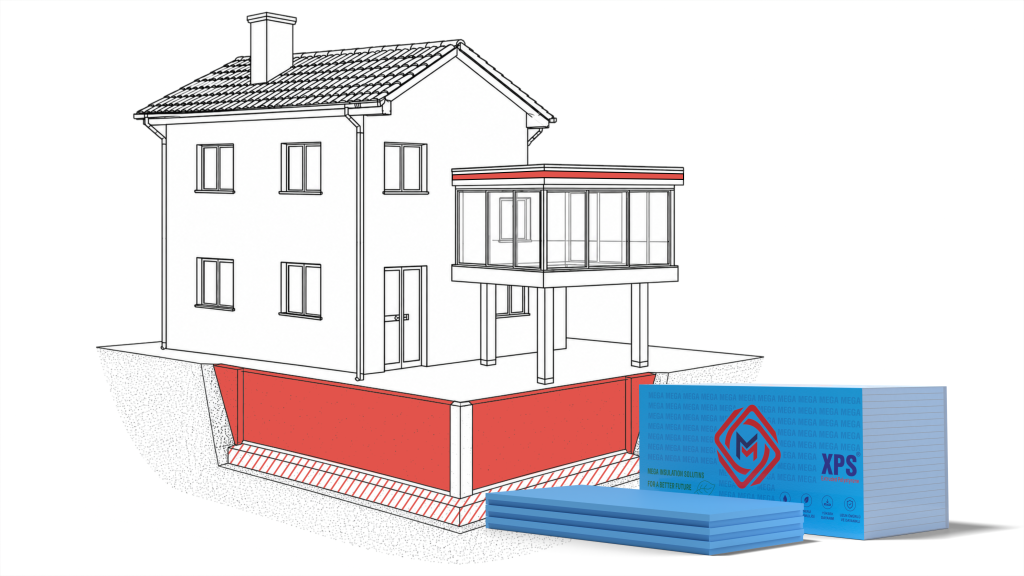
Application note from MegaUsta: On below-grade walls, interlock boards with shiplap edges and lay them without leaving gaps. Even a small opening at a joint interrupts the insulation layer and creates a thermal bridge. Protect XPS boards waiting on site from sunlight, as stated in the technical data sheet; if they are stored outdoors, cover them with a UV-blocking sheet.
Mega Insulation Solutions (Mega Yalıtım; legal name Mega Yalıtım Üretim Pazarlama Dış Ticaret A.Ş.) is a Turkish manufacturer of insulation materials with its head office in Kavacık, Istanbul, and its plant in Elazığ. Alongside stone wool, XPS and EPS thermal insulation boards, it offers MegaBlock, MegaLento, DesiWool, MegaTech construction chemicals and Fullback waterproofing products under the Mega brand.
You can find another solution that nature has developed against the cold in our article on how squirrels keep warm in winter, and the methods people have found against heat and cold over thousands of years in our article on the history of insulation.
Frequently Asked Questions
How deep does an ant nest go?
The depth of an ant nest depends on the species and the age of the colony. In Tschinkel’s excavations of the Florida harvester ant, mature colonies were usually 2.5 to 3 metres deep, and the deepest nest measured reached 3.06 metres. Newly founded colonies, by contrast, lived no more than about half a metre down. As the colony grows, the ants deepen the nest by digging downwards.
Why does soil act as a thermal buffer?
Soil conducts heat slowly and stores it, so temperature changes at the surface become both smaller and later as you go deeper. In the example from Ochsner’s soil physics textbook, the amplitude of the daily oscillation is 7 °C at the surface but only 3 °C at a depth of 10 cm. For the same soil, the damping depth is calculated as 11.7 cm for the daily wave and 224 cm for the annual wave. The day-night difference fades at shallow depth, while the seasonal difference reaches several metres down.
Why are basement and foundation insulation important?
Basement walls and foundations are the parts of a building that are in constant contact with damp soil and the pressure of the backfill. Soil softens temperature changes but does not stop heat from escaping; an uninsulated basement wall gives off heat to the ground and its inner surface stays cold. Boards that absorb little water and keep their shape under pressure, such as XPS, are preferred here; the thickness is determined by the thermal insulation design calculation.
Sources
- W. R. Tschinkel (2004): The nest architecture of the Florida harvester ant, Pogonomyrmex badius, Journal of Insect Science, vol. 4, article 21
- Š. Kadochová, J. Frouz (2014): Thermoregulation strategies in ants in comparison to other social insects, with a focus on red wood ants (Formica rufa group), F1000Research, vol. 2, article 280
- C. Kleineidam, R. Ernst, F. Roces (2001): Wind-induced ventilation of the giant nests of the leaf-cutting ant Atta vollenweideri, Naturwissenschaften, vol. 88, issue 7, pp. 301–305
- T. Ochsner: Rain or Shine: An Introduction to Soil Physical Properties and Processes, section 13.4: Sub-surface soil temperatures
- Mega Yalıtım: MEGA XPS T1500 technical data sheet (PDF)
- Mega Yalıtım: MEGA XPS T3000 technical data sheet (PDF)
- Mega Yalıtım: Product documents
You can review the right board for your basement, foundation and below-grade retaining walls on our XPS boards page, and contact our technical team for an assessment based on your project.