

An igloo is a dome-shaped winter shelter that Inuit build by stacking blocks cut from hardened snow in a spiral; it is also known as a snow house. Air trapped in the pores of the snow slows the escape of heat, and the dome blocks the wind. With an oil lamp burning inside, an igloo can be kept at least 20 °C warmer than the outside air.
In a study carried out at Resolute in Canada’s High Arctic, the outside air in February ranged between -28 and -41 °C. That a structure made only of snow can protect people in such cold seems surprising at first. Yet the igloo is one of the clearest examples of how insulation works when the right material meets the right design. In this article we explain what an igloo is, how it is built, how warm it is inside and why snow insulates, based on scientific measurements, and show how the same principle applies to today’s buildings.
What is an igloo, and who builds it?
An igloo is a temporary shelter built from blocks of snow that rises in the shape of a dome. Snow houses are most closely associated with the Inuit, who long used igloos as temporary shelter while travelling; a study published in 1996 records that this use continues.
In a study published in the journal Arctic, Kershaw, Scott and Welch examined two types of igloo: large igloos occupied for long periods at seasonal camps, and small igloos used for a few nights while hunting or travelling. The researchers built one igloo for each situation at Resolute, slept in them, measured the temperature and the heat passing through the walls, and used these data to calculate how much seal fat was needed for heating. Most of the measurements in the rest of this article come from that study.
Most drawings show the igloo as a hemisphere, but its real shape is closer to an inverted paraboloid or a catenoid. In a hemispherical snow dome the walls tend to spread outward and collapse. In a paraboloid shape the compressive forces increase toward the base and the structure stays standing. No nails or mortar are needed; the only material is the surrounding snow.
How is an igloo built?
An igloo is built by laying blocks cut from a hardened snowdrift so that they form an inward-leaning spiral, placing a key block at the top and filling the gaps with loose snow. The hardest part is finding snow suitable for cutting blocks.
Suitable snow is not found everywhere. When Kershaw and his team surveyed a 4 km² area at Resolute, they found only two drifts large enough to build an igloo; together they covered 3.6 percent of the area. The snow used had an average density of 397 kg/m³. These are the steps the researchers followed using the traditional method:
- Blocks are cut vertically from the snowdrift with a saw. The trench left where the blocks were removed later becomes the igloo’s entrance.
- The tops of the first blocks laid at the base are cut to slope upward at an angle of about 30 degrees. This slope sets the spiral in which the following rows rise.
- Each row rises leaning slightly further inward and the dome narrows; a key block is placed at the top.
- The gaps between the blocks are filled with loose snow, and loose snow is banked up to 10–15 cm high around the outside base of the wall.
- A raised sleeping platform of snow is left inside, and a small ventilation hole is made in the ceiling.
In the experiment the blocks were initially 50 cm high and 75 cm long, with an average thickness of 14.7 cm; their dimensions changed as they were trimmed to interlock. The oldest record of building time dates from 1888: Boas reports that a travelling igloo 1.5 m high, 2.1 m in diameter and made of 25 blocks could be built by two people in two hours. The table below compares the dimensions of the two experimental igloos.
| Property | Large igloo | Small igloo |
|---|---|---|
| Interior diameter | 4.1 m | 3.05 m |
| Number of blocks | 72 | 46 |
| Average block mass | 23.6 kg | 28.2 kg |
| Snow density of the blocks | 377 kg/m³ | 416 kg/m³ |
| Surface area / volume ratio | 2.21 | 1.73 |
| Calculated seal fat requirement (to keep the inside at about 5 °C with -30 °C outside) | 3.9 kg per day | 2.3 kg per day |
Source: Kershaw, Scott and Welch (1996), Arctic. The small igloo provided 75 percent of the large igloo’s living space with 76.5 percent of its mass and was cheaper to heat.
How warm is it inside an igloo?
The temperature inside an igloo depends on the heat source, the number of people inside and the size of the igloo. According to measurements by Kershaw and colleagues, the air inside stays at least 20 °C warmer than the outside air while a heat source is running; under the best conditions the difference reached up to 45 °C.
Even the large igloo with nobody inside was about 5 °C warmer than the outside air. The researchers attributed this difference not to the sun but to heat coming from the ground. The largest difference was measured in the small igloo, whose inner surface was lined with caribou skins. The warmest air collected in the upper part of the dome, near the ceiling.
Body heat contributes less than people often assume. According to the same study, the occupants’ body heat covered only 8 to 14 percent of the energy needed to keep the igloo at a comfortable temperature. Most of the heat came from stone lamps called kudliks, which burned seal oil. By the researchers’ calculation, at -30 °C outside, two adults and a lamp burning 2.3 kg of seal fat a day keep the air in an unlined igloo 3 m in diameter at about 5 °C.
| Situation | Measured or calculated inside temperature | Source |
|---|---|---|
| Igloo with nobody inside (heat from the ground only) | About 5 °C warmer than outside | Kershaw et al., 1996 |
| With the lamp burning and people inside | At least 20 °C warmer than outside | Kershaw et al., 1996 |
| Largest difference (small igloo lined with skins) | Up to 45 °C warmer than outside | Kershaw et al., 1996 |
| Unlined igloo 3 m in diameter, -30 °C outside, two adults, 2.3 kg of seal fat per day | About 5 °C | Kershaw et al., 1996 (calculation) |
| Igloos lined with skins (historical records) | 10–20 °C instead of 1–3 °C | Boas 1888 and Mathiassen 1928, compiled by Kershaw et al. |
| Loose-snow dome shelters in Alaska, outside air between -24 and -40 °C | About -9 to -7 °C, nearly constant | Elsner and Pruitt, 1959 |
Values given in Fahrenheit were converted to °C and rounded. Elsner and Pruitt also note that the shelters were warmer when occupied.
Is snow an insulator?
Yes, snow is a good insulator, because it holds a large amount of still air between its ice crystals, and air conducts heat far less than ice. Still, the insulating value of snow is not fixed; it varies over a wide range with density, crystal structure and temperature.
According to the study by Sturm and colleagues published in the Journal of Glaciology, heat moves through snow in three ways: by conduction through the ice grains and the bonds between them, by conduction through the air in the pores, and by water vapour sublimating and recrystallising elsewhere. The ice skeleton conducts heat about 100 times better than the air in the pores. The thermal conductivity of dry air is 0.023 W/mK at -15 °C, and that of ice about 2.2 W/mK. The researchers found up to tenfold differences even between snow samples of the same density; in their new data set of 488 measurements the average value was about 0.18 W/mK.
That is why the insulating power of a material cannot be explained simply by the presence of air inside it. What matters is that the air stays still in small voids and that the solid skeleton conducts as little heat as possible. In this respect snow is a good but not a perfect insulator. The igloo works because it combines the insulation of snow with thick walls, a closed shape that blocks the wind and a heat source that keeps burning.
In the measurements by Kershaw and colleagues, the heat passing through a newly built igloo wall matched that passing through an insulated standard timber-frame house wall. An interesting process also takes place on the inner surface: moisture from breathing, cooking and the lamp is deposited directly as ice on the inside of the wall and forms a thin icy layer. This layer is thought to reduce moisture penetrating deeper into the blocks and air passing through the wall. On the other hand, because the density of the blocks increases with use, the insulating value of the wall may decline over time. We look at similar solutions nature has developed against the cold in our article on polar animals.
How do the entrance tunnel and low door keep the heat in?
The entrance of an igloo is made through a trench or tunnel lying lower than the living and sleeping area. Because cold air is heavier than warm air, it stays in this hollow, while warm air gathers in the upper part of the dome and around the raised sleeping platform.
- Low entrance: The trench where the blocks were cut serves as the entrance, so the door lies lower than the raised sleeping platform.
- Leeward door: In the experimental igloos the doors faced away from the wind, and no measurable wind was recorded inside.
- Closed dome: The snow blocks act both as insulation and as a windbreak, preventing the wind from carrying body heat away.
- Sealed door and small air hole: When the igloo was not in use, the door was closed with a block of snow. The 8 cm hole in the ceiling, the door opening and the permeability of the snow itself provided some air exchange inside.
This arrangement shows that good insulation does not depend on the material alone. Controlling where air enters and leaves, managing warm and cold layers correctly and keeping openings to a minimum are also the basis of energy efficiency in modern buildings. We explain in detail where heat escapes from buildings in our article on heat loss in the home.
What does this mean for your building?
The lesson of the igloo carries straight over to buildings: what keeps heat inside is air that has been made to stand still. Modern insulation boards hold air in permanent cells or between fibres; their λ values in the technical data sheets are about one fifth of the average measured for snow, so they provide the same insulation with a much thinner layer.
Why do materials that trap air insulate?
Still air conducts heat very poorly, but when it can circulate freely it carries heat away in currents. Insulation materials trap air in small cells or between fibres and so stop it from moving. How easily a material lets heat pass is expressed by its thermal conductivity (λ, W/mK); the lower the λ, the better the insulation at the same thickness. Thermal resistance is found by dividing the thickness by the λ value (R = d/λ).
In the table below, the λ values of modern insulation boards are about one fifth of the average value for snow. According to R = d/λ, this means the same thermal resistance can be achieved with a layer about five times thinner. Because the value for snow varies widely, this ratio is only indicative.
| Material | Thermal conductivity λ (W/mK) | Source |
|---|---|---|
| Dry air (-15 °C) | 0.023 | Sturm et al., 1997 |
| Ice | About 2.2 | Sturm et al., 1997 |
| Seasonal snow (average of 488 measurements) | About 0.18 | Sturm et al., 1997 |
| Stone wool ETICS board, MEGA SW F150 | ≤0.037 (λD) | Mega technical data sheet |
| Grey EPS ETICS board, EPS 70 (G) | 0.031 (λD) | Mega technical data sheet |
| XPS board, MEGA XPS T3000 | 0.035 (λD) | Mega technical data sheet |
The Mega product values are the declared values at 10 °C (λD) given in the technical data sheets. The value for snow is an average measured in nature, so the comparison is only meant as a rough guide.
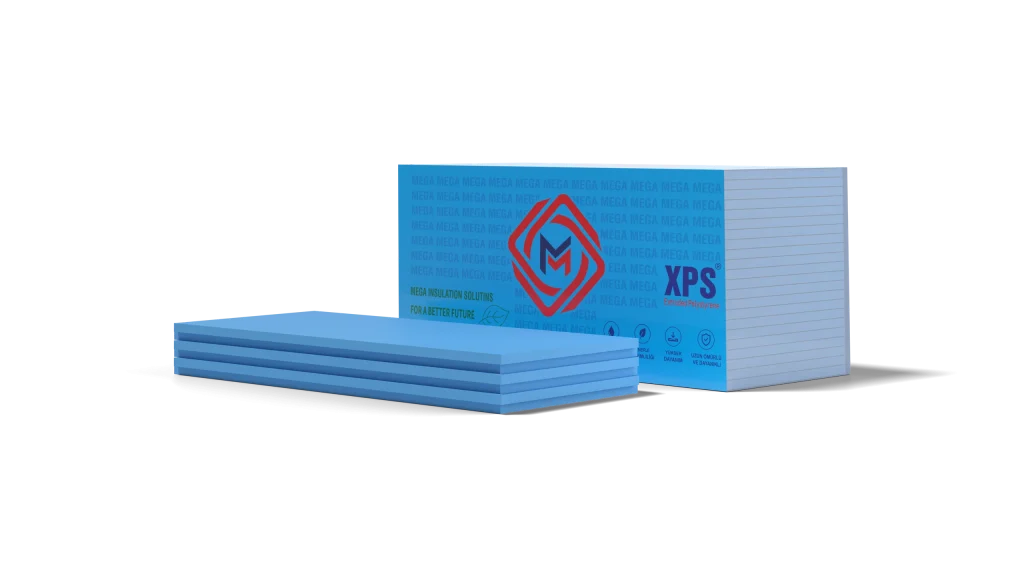
Mega Insulation’s boards apply this principle through different structures. The flat XPS board absorbs very little water thanks to its closed-cell structure; according to the Mega technical data sheet, its long-term water absorption by total immersion is at most 0.7 percent. This is why it stands out on flat roofs, on below-grade retaining walls and in foundations in contact with the ground, where moisture and loads are high.
On façades, two options stand out. The grey EPS ETICS board is made of carbon (graphite) enhanced expanded polystyrene; according to the Mega technical data sheets, its λD value ranges from 0.031 to 0.036 W/mK depending on type. The stone wool ETICS board is an unfaced board that holds air between stone fibres and is used in rendered external thermal insulation composite systems; for the MEGA SW F150 type, λD is 0.037 W/mK or lower. You can find the full stone wool range on the stone wool boards page.
We have brought the basic concepts of thermal insulation and material selection together in our guide what is thermal insulation. For a very different example of insulation based on a vacuum and shiny surfaces, see our article how does a thermos work, and for the solutions people have developed against the cold over thousands of years, see our article on the history of insulation.
Application note from MegaUsta: After laying the blocks, igloo builders fill every gap between them with snow. Insulation boards call for the same care: fit the boards tightly together with staggered joints. A gap left open between boards becomes a weak point where heat escapes, even with the best material.
Mega Insulation Solutions (Mega Yalıtım; trade name Mega Yalıtım Üretim Pazarlama Dış Ticaret A.Ş.) is a Turkish manufacturer of insulation materials with its head office in Kavacık, Istanbul, and its factory in Elazığ. Alongside stone wool, XPS and EPS thermal insulation boards, it offers MegaBlock, MegaLento, DesiWool, MegaTech construction chemicals and Fullback waterproofing products under the Mega brand.
Frequently Asked Questions
What is the temperature inside an igloo?
With a heat source burning, the inside of an igloo has been measured at least 20 °C, and at best up to 45 °C, warmer than the outside air. By the calculation of Kershaw and colleagues, at -30 °C outside, two adults and a lamp burning 2.3 kg of seal fat a day keep the air in a 3 m igloo at about 5 °C. The researchers note that igloos occupied day and night generally stayed above 0 °C inside.
Why is snow a good insulator?
Snow is a good insulator because it holds a large amount of still air between its ice crystals. According to the study by Sturm and colleagues, the thermal conductivity of dry air is 0.023 W/mK at -15 °C and that of ice about 2.2 W/mK, while the average of seasonal snow measurements is about 0.18 W/mK. The value varies with the density, crystal structure and temperature of the snow. The igloo wall also blocks the wind, which reduces heat loss.
Why doesn’t an igloo melt?
An igloo wall does not melt through even when its inner face warms, because its outer face is constantly cooled by the freezing air and the heat from inside flows slowly outward through the snow. Moisture from breathing, cooking and the lamp is deposited directly as ice on the inner surface and forms a thin icy layer. According to a warning cited by Kershaw and colleagues, blocks cut thicker than necessary can make the inside too warm and start melting.
Sources
- G. P. Kershaw, P. A. Scott, H. E. Welch (1996): The Shelter Characteristics of Traditional-Styled Inuit Snow Houses, Arctic, vol. 49, no. 4
- M. Sturm, J. Holmgren, M. König, K. Morris (1997): The thermal conductivity of seasonal snow, Journal of Glaciology, vol. 43, no. 143
- R. W. Elsner, W. O. Pruitt (1959): Some Structural and Thermal Characteristics of Snow Shelters, Arctic, vol. 12, no. 1
- Mega Insulation: MEGA XPS T3000 technical data sheet (PDF)
- Mega Insulation: EPS 50 / 60 / 70 (G) grey ETICS board technical data sheet (PDF)
- Mega Insulation: MEGA SW F150 stone wool ETICS board technical data sheet (PDF)
- Mega Insulation: Product documents
To see which insulation board suits the foundation, façade or roof of your building, you can browse our XPS and EPS product ranges, or contact our technical team for an assessment of your project.