In short: Waterproofing materials fall into two main groups: materials applied to the surface as a liquid and prefabricated membranes. The liquid-applied group includes cementitious, acrylic, reaction resin and bitumen-based products; the membrane group includes polymer bitumen membranes and plastic or rubber membranes. The right material is chosen according to whether the water is under pressure, the type of surface and what will come on top of the waterproofing.
This guide explains the material groups, the standard for each group, which material Türkiye’s Regulation on Waterproofing in Buildings requires in which situation, and where Mega’s Fullback range sits in this picture. You can find what waterproofing is and the choice area by area in our article what is waterproofing, and the materials for all four types of insulation in our insulation materials guide.
What are waterproofing materials?
Waterproofing materials are products that form a continuous layer on the surface to prevent water from entering building elements. They are applied in two ways: liquid-applied materials are applied with a trowel, roller or brush, or sprayed; waterproofing membranes are laid as prefabricated sheets. On site, “membrane” usually refers to the prefabricated sheet and “liquid membrane” to the layer formed by applying a liquid.
In addition to these two groups, the regulation defines a third method: structural waterproofing, in which the concrete itself is produced to be watertight. Structural waterproofing is not a material but a concrete design; this article deals with the materials applied to the surface.
What types of waterproofing material are there?
The product groups in the list of standards of the Regulation on Waterproofing in Buildings can be gathered under six headings: four are liquid-applied and two are membranes. The table below shows how each group is applied and which product standard it is tied to.
| Product group | Type | How it is applied | Product standard (Regulation Annex 1) |
|---|---|---|---|
| Cementitious (polymer-modified, one- or two-component) | Liquid-applied | The powder component is mixed with water or with the liquid component and applied with a brush or trowel | TS EN 14891 |
| Dispersion-based (acrylic) | Liquid-applied | Ready to use; applied with a brush or roller | TS EN 14891 |
| Reaction resin (polyurethane, polyurea, hybrid and similar) | Liquid-applied | Applied by hand or sprayed; hardens by chemical reaction | TS EN 14891, TS EN 1504-2 |
| Bitumen-based (polymer-modified bituminous thick coating) | Liquid-applied | Applied as a thick layer | TS EN 15814 |
| Polymer bitumen membrane | Membrane | Prefabricated sheets are laid and their seams are joined | TS EN 13707 (roofs), TS EN 13969 (basements) |
| Plastic and rubber membrane | Membrane | Prefabricated sheets are laid and their seams are joined | TS EN 13956 (roofs), TS EN 13967 (basements) |
Source: Regulation on Waterproofing in Buildings, Annex 1 list of standards. The list also names TS EN 1504-2 for all liquid-applied materials.
How are liquid-applied waterproofing materials classified?
Liquid-applied materials are classified by their binder: cement, acrylic dispersion, reaction resin and bitumen. All of them form a seamless layer on the surface; the difference lies in how they are prepared and where they can be used.
- Cementitious materials: In two-component products the powder component is mixed with an emulsion polymer based liquid component. They are common in wet areas, beneath the tiling. The details are in our article on cementitious waterproofing.
- Acrylic (dispersion) materials: They are one-component and need no second component. The regulation does not allow acrylic products on the floors of places where water is used intensively, such as communal showers. We explained the terms in our article on elastomeric waterproofing.
- Reaction resin materials: They cover polyurethane, polyurea and hybrid products. In places such as industrial kitchens and laundries the regulation requires reaction resin products with high chemical resistance or suitable membranes.
- Bitumen-based materials: These are polymer-modified bituminous thick coatings; in the list of standards they appear together with the application standard for foundation and basement wall waterproofing.
There is one more distinction on surfaces that will be tiled: under the regulation, the surface of acrylic dispersion and reaction resin products is, where necessary, roughened by broadcasting sand while still wet; no sand is broadcast on cement-acrylic products, that is, products combining cement and acrylic.
How are waterproofing membranes classified?
Waterproofing membranes fall into two groups by raw material: polymer bitumen membranes and plastic or rubber synthetic membranes. Both are produced in a factory to a set thickness, laid on the surface and joined at the seams.
The regulation gives membranes priority in three places. On horizontal surfaces exposed to water under pressure, waterproofing with membrane-type material is the rule. In details where roof movement is intense, such as lightweight metal roofs, a reinforced synthetic membrane or an elastomeric polymer bitumen membrane is used. On flat roofs the terminations of membranes are fixed mechanically with a non-rusting pressure profile or batten and sealed on top with mastic.
Mega’s Fullback range contains no membrane-type product. In details that require a membrane, the membrane type is determined in the design; you can find how thermal insulation and waterproofing are built up together on a flat roof in our article on flat roof insulation.
Which waterproofing material is chosen in which situation?
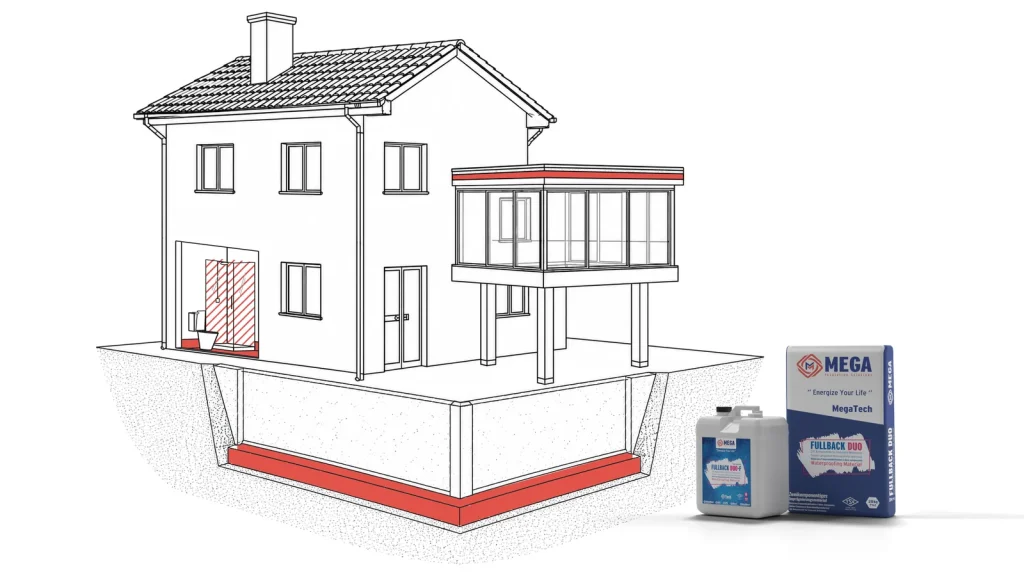
The material is chosen according to the water the building element is exposed to. In some situations the regulation determines the material group directly; the table below gives these rules with their article numbers.
| Situation | What the regulation requires | Article |
|---|---|---|
| Horizontal surface exposed to water under pressure (such as under a foundation) | Surface waterproofing is done with membrane-type material | 11 |
| Foundation and basement wall | Must remain watertight under hydrostatic pressure and resist the chemicals in the ground; a liquid-applied material must not dissolve in water once cured | 11 |
| Residential bathroom and kitchen | Acrylic, one- or two-component cementitious polymer-modified or reaction resin materials and suitable membranes | 23 |
| Intensively used wet area such as communal showers | On walls acrylic, cementitious polymer-modified or reaction resin; acrylic is not used on floors | 23 |
| Industrial kitchen and laundry | Reaction resin products with high chemical resistance and suitable membranes | 23 |
| Waterproofing that is the outermost layer on a roof | Must be resistant to sunlight or be covered with a layer that provides this performance | 17 |
| Lightweight metal roof | Reinforced synthetic membrane or elastomeric polymer bitumen membrane | 17 |
| Green roof | Material resistant to plant roots; the root barrier resistant to root penetration | 17 |
| Inner face of a water tank or pool | One- or two-component cementitious polymer-modified or reaction resin materials, plastic or rubber membranes | 26 |
| Drinking and utility water tank | Material that does not impair the quality of the water; may not contain solvent or be bitumen-based | 26 |
Source: Regulation on Waterproofing in Buildings, Articles 11, 17, 23 and 26. The table is general guidance and does not replace the design decision.
The application sequence by area is in our separate guides: bathroom waterproofing, balcony and terrace waterproofing, foundation and basement wall insulation and damp in basements.
Which waterproofing materials does Mega offer?
Mega’s waterproofing materials are grouped in the Fullback range and are all liquid-applied: three are two-component cement and acrylic based, two are one-component acrylic based. The table below shows the information on the product pages.
| Product | Type | Packaging | Places of use on the product page |
|---|---|---|---|
| Fullback Duo fully elastic | Cement and acrylic based, two-component, fully elastic | 20 kg powder + 10 kg liquid | Horizontal and vertical surfaces indoors and outdoors; pools, water tanks, wet areas; small terraces and balconies; foundation, basement and retaining walls |
| Fullback Duo UV | Cement and acrylic based, two-component, fully elastic, UV-resistant | 20 kg powder + 10 kg liquid | The same places as Fullback Duo fully elastic |
| Fullback Duo semi-elastic | Cement and acrylic based, two-component, semi-elastic | 20 kg powder + 5 kg liquid | The same places as Fullback Duo fully elastic |
| Fullback Acrylic liquid | Acrylic based, one-component | 20 kg pail | Pitched roofs and terraces; external walls; crack, eaves and chimney base details |
| Fullback Acrylic UV | Acrylic based, one-component, UV-resistant | 20 kg pail | The same places as Fullback Acrylic |
Source: Mega Fullback product pages. The list of places of use does not by itself show that the regulation’s condition is met.
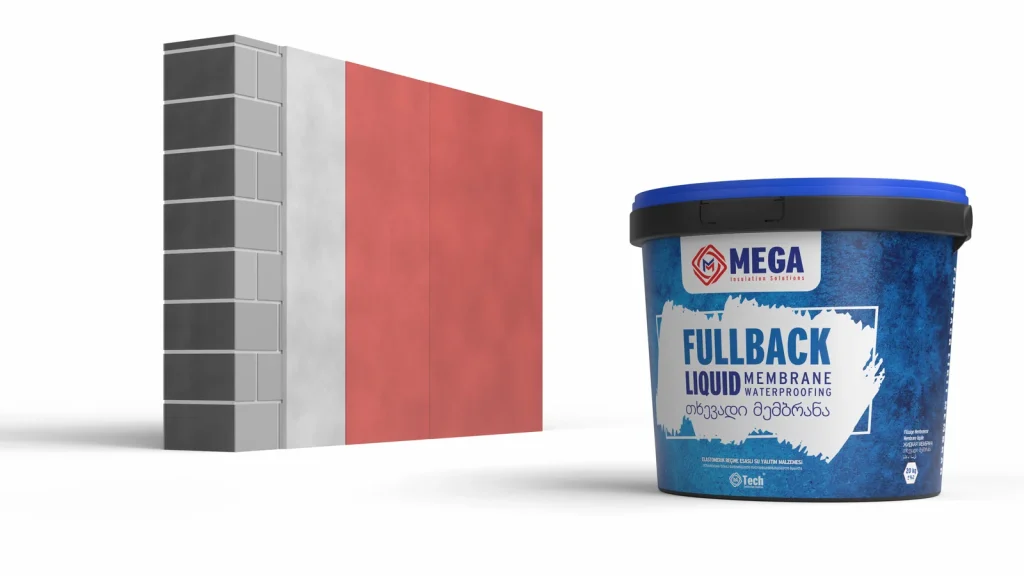
This table has four limits. The Fullback range contains no membrane-type product; on horizontal surfaces exposed to water under pressure and on lightweight metal roofs the regulation requires a membrane. The range contains no reaction resin product either; industrial kitchens and laundries are outside the scope of these products. The product pages contain no declaration of suitability for drinking water; the water tank entry should not be read as a drinking water tank. The Fullback Acrylic pages do not list wet areas or use under tiles; although the regulation allows acrylic products in residential bathrooms, for a bathroom look to Fullback Duo, whose page lists wet areas.
Which properties should be checked when choosing a waterproofing material?
What matters is not the name of the material but its declared properties. The regulation requires the following properties of the material directly:
- Watertightness: The material must remain watertight under the water and pressure it will be exposed to.
- Crack bridging: For liquid-applied materials, the ability to span a crack that forms in the substrate without tearing is required.
- Tensile strength and elongation at break: For membranes, mechanical properties that can accommodate settlement and movement in the structure are required.
- Chemical resistance: In foundations and basement walls the material must resist the chemicals and gases present in the ground and groundwater.
- Resistance to sunlight: A material that remains the outermost layer on a roof must be resistant to the sun or be covered.
- Compatibility: Materials used together must not impair each other’s performance; compatible system components must be used in the same detail.
- Thickness and consumption: It is mandatory to show in the design details the thickness or consumption at which the material achieves its minimum performance.
What are the ancillary materials that complete waterproofing?
The ancillary materials that complete waterproofing are repair mortar and render, primer, tape and collars, mastic, the protection layer, and tile adhesive and grout. The regulation sets a rule for each of them:
- Repair mortar and render: Holes, voids and non-structural cracks are filled with repair mortar complying with TS EN 1504-3; on non-load-bearing elements the substrate is formed with render complying with TS EN 998-1.
- Primer: If a surface that prevents the material from bonding cannot be roughened mechanically, a bonding primer suited to the chosen material is applied.
- Tape and collar: Waterproofing tape is used at floor and wall junctions and around drains; waterproofing collars are used at service pipe penetrations.
- Mastic: After tiling, sealing mastic is used along the junction lines and at pipe penetrations.
- Protection layer: In foundations the waterproofing is protected against the impact of backfill by a protection wall, thermal insulation boards or drainage boards. At Mega, the board used for this job is the XPS board.
- Tile adhesive and grout: For tiles laid on top of the waterproofing, the adhesive must comply with TS EN 12004-1 and the grout with TS EN 13888. Mega’s tile adhesives are classified according to TS EN 12004-1.
Which is the best waterproofing material?
There is no single waterproofing material that gives the best result everywhere; the best material is the one that matches the water the building element is exposed to, the surface and the finish that will come on top. The choice is made with three questions:
- Is the water under pressure or not? On a horizontal surface exposed to water under pressure a membrane is the rule; in bathrooms, on balconies and on roofs the water is not under pressure.
- Will the surface move? An elastic material can be chosen for surfaces where temperature change and movement are expected, a semi-elastic material for surfaces with limited movement that will be covered with a finish.
- What will come on top of the waterproofing? The material for a surface that will be covered with tiles, screed or soil differs from that for a surface that will remain exposed to the sun; UV resistance is required on an exposed surface.
We explained how to read class codes and data sheets for construction chemicals in our article on how to choose construction chemicals.
What are the common mistakes in choosing a waterproofing material?
The most common mistake is choosing the material by its name or out of habit without looking at the effect of the water. The other common mistakes are:
- Relying on a liquid-applied material alone under a foundation exposed to water under pressure.
- Using a product with no declared UV resistance on a surface exposed to the sun and leaving it uncovered.
- Planning a liquid-applied material on its own for a lightweight metal roof because the product page’s list of surfaces includes galvanised sheet, zinc or aluminium.
- Using the primer, tape and main layer of different manufacturers together without checking their compatibility.
- Using a product without a declaration of suitability, or a bitumen-based product, in a drinking water tank.
- Seeing only the product name in the quotation and not asking for the thickness, the number of coats and the consumption per square metre.
Frequently Asked Questions
What are waterproofing materials?
Waterproofing materials fall into two main groups: materials applied to the surface as a liquid and prefabricated membranes. The liquid-applied group includes cementitious, acrylic dispersion, reaction resin and bitumen-based products; the membrane group includes polymer bitumen membranes and plastic or rubber membranes. Türkiye’s Regulation on Waterproofing in Buildings matches each of these groups with a product standard.
Liquid-applied waterproofing or a membrane?
The choice depends on the effect of the water and on the surface. The regulation takes membrane-type material as the basis for horizontal surfaces exposed to water under pressure; it also requires membranes on lightweight metal roofs. On surfaces with many corners and details that see non-pressurised water, such as bathrooms, balconies and small terraces, liquid-applied materials can be applied without forming seams. The two groups can also be used together if they are compatible.
Which waterproofing material is used in a bathroom?
Under the regulation, acrylic, one- or two-component cementitious polymer-modified or reaction resin liquid-applied materials and suitable membranes can be used in wet areas such as residential bathrooms and kitchens. Acrylic products are not used on the floors of places where water is used intensively, such as communal showers. At Mega, the product for this use is the two-component Fullback Duo.
Which waterproofing material is used on a roof?
On a roof, a waterproofing material used above the thermal insulation must be resistant to outdoor climatic conditions; if it is the outermost layer it must be resistant to sunlight or be covered with a layer that provides this protection. On lightweight metal roofs the regulation requires a reinforced synthetic membrane or an elastomeric polymer bitumen membrane. Mega’s Fullback Acrylic product page lists pitched roofs and terraces; on a surface exposed to the sun the UV-resistant version is chosen.
Which waterproofing material is used in a drinking water tank?
Under the regulation, a waterproofing material in contact with drinking and utility water must not interact with the water or impair its quality; it may not contain solvent and may not be bitumen-based. In tanks and pools, structural watertightness is also required in every case. The Fullback product pages contain no declaration of suitability for drinking water; a product with such a declaration should be chosen for this use.
How many coats of waterproofing material are applied?
The number of coats, the thickness and the consumption depend on the product and are taken from the manufacturer’s instructions for use. The regulation makes it mandatory to show in the design details the thickness or consumption at which the material achieves its minimum performance, and requires liquid-applied materials to form a uniform layer of equal thickness on the surface. When you ask for a quotation, also ask for the consumption per square metre.
Sources
- Regulation on Waterproofing in Buildings, Official Gazette, 27.10.2017, No. 30223 (Articles 4, 6, 7, 8, 11, 12, 16, 17, 22, 23, 24 and 26; in Turkish)
- Regulation on Waterproofing in Buildings, Annex 1 list of standards (PDF, in Turkish)
- EN 14891:2017, liquid-applied water impermeable products for use beneath ceramic tiling, scope (SIS)
- EN 13707, reinforced bitumen sheets for roof waterproofing, scope (EVS)
- EN 13956, plastic and rubber sheets for roof waterproofing, scope (EVS)
- Mega product page: Fullback Duo fully elastic 20+10
- Mega product page: Fullback Acrylic Liquid Waterproofing 20 kg
You can review the product groups used in waterproofing on our insulation products page and contact us through our contact page with questions about your project.