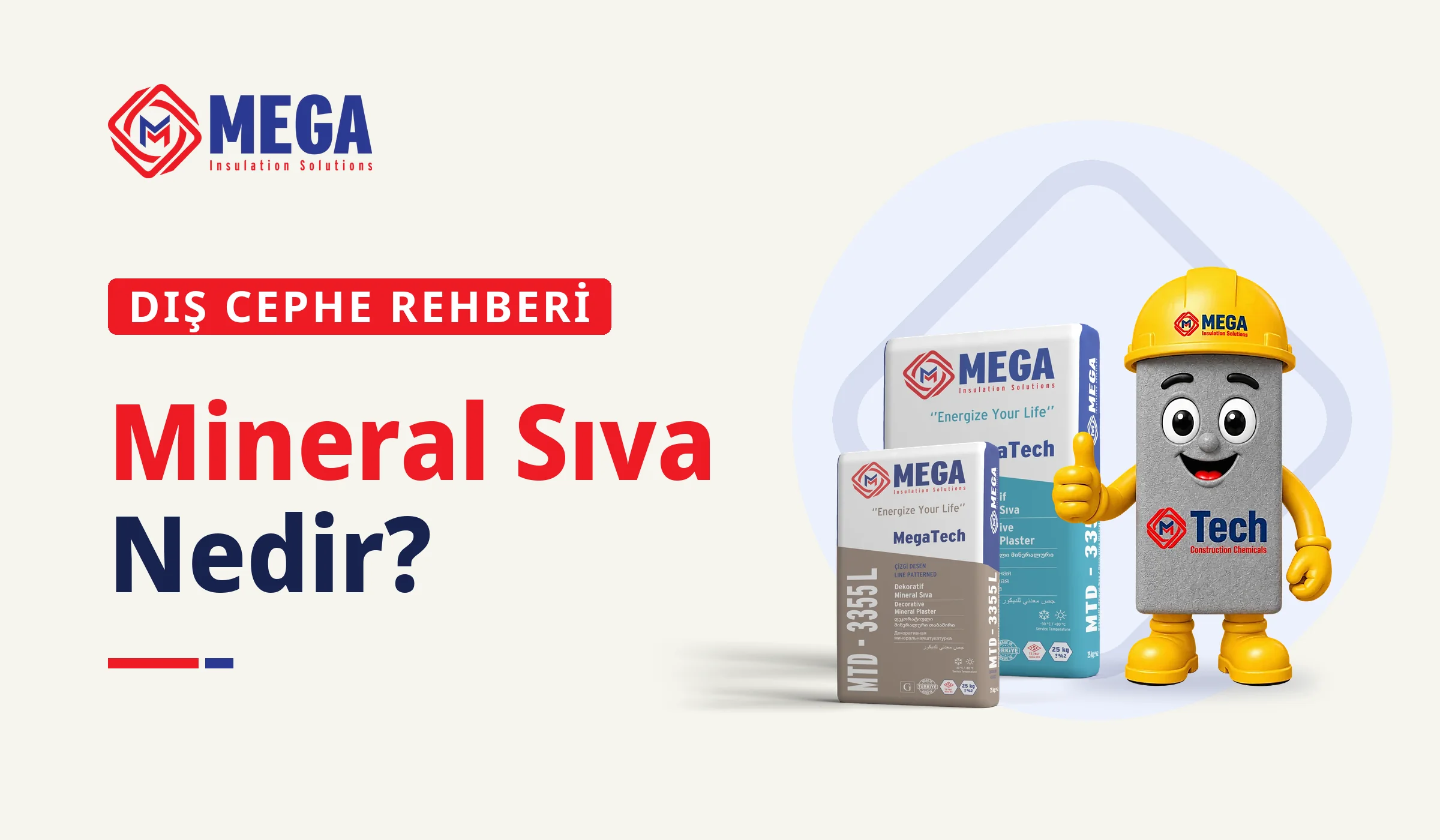
In short: Mineral plaster is a decorative coating made in the factory with mineral binders such as cement, mixed with water on site and applied as a thin coat. In ETICS it goes over the base coat, and on walls it is applied after plastering, giving the surface its texture. Mega’s mineral plasters have a consumption of 2.2–2.5 kg/m², so one 25 kg bag covers about 10–11 m².
This guide explains what mineral plaster is, where it is used, the difference between the two Mega products, how to calculate consumption and how to apply it, using technical data sheet values. You can read about the whole system in what is ETICS and about the other components in ETICS materials.
What is mineral plaster and what does it do?
Mineral plaster, also called mineral render, is a thin coating applied after plastering to give a surface texture and a decorative appearance. “Mineral” refers to the binder: inorganic binders such as cement or lime are used. The material comes as powder in a bag and is mixed with water on site.
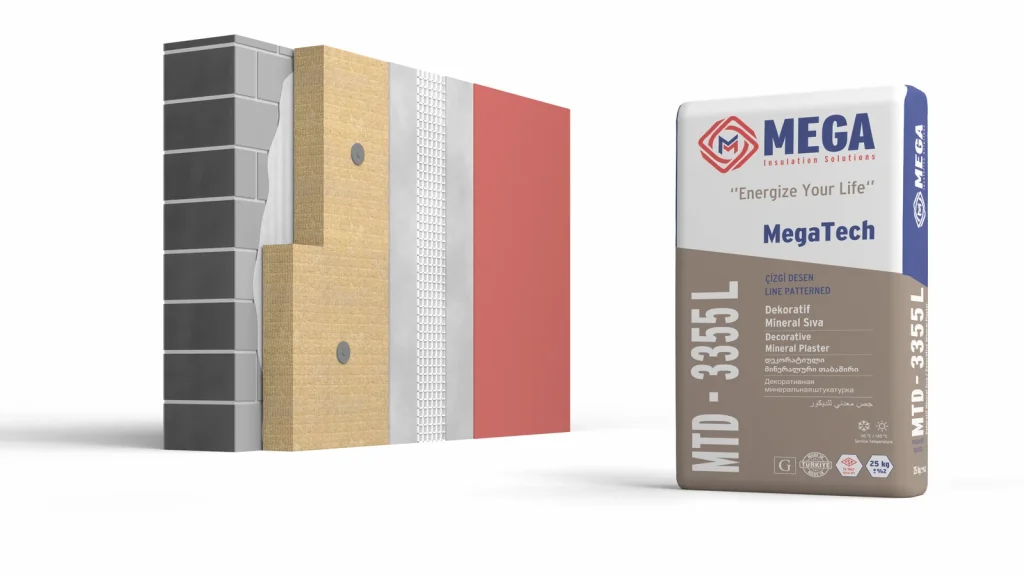
Mega Insulation Solutions (Mega Yalıtım) offers two mineral plasters under its MegaTech construction chemicals brand: the cement-based, polymer-modified, water-repellent Decorative Mineral Plaster (MTD-3355) and the white cement-based, single-component Line-Pattern Decorative Mineral Plaster (MTD-3355L). MTD-3355 is certified to TS 7847; the certificates are on our Documents page.
Where is mineral plaster used?
Mineral plaster is used as a decorative coating over external wall insulation systems and on plastered walls. According to Mega technical data sheets, its uses are:
- ETICS: MTD-3355 is applied as a decorative coating over internal and external thermal insulation systems, and MTD-3355L over the insulation system base coat. Beneath this layer is the thermal insulation board plaster.
- Plastered walls: MTD-3355 is used after plastering to give a facade a more decorative look, and MTD-3355L on the external walls of buildings.
- Exposed concrete: MTD-3355L is used as a decorative coating on exposed concrete, indoors and outdoors. For surface preparation, see our article on exposed concrete primer.
- Building types: The MTD-3355L data sheet lists housing, shopping centres and hospitals, as well as horizontal, vertical and overhead applications.
Note the limit in the MTD-3355 data sheet as well: it must not be used on horizontal surfaces exposed to rain.
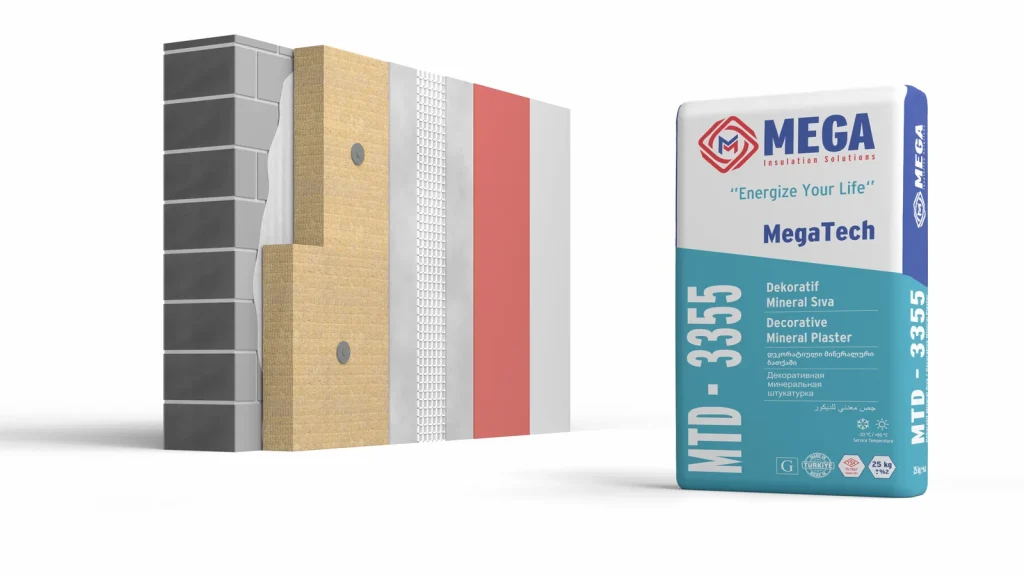
Types of mineral plaster: what is the difference between decorative and line-pattern?
The two products have the same consumption, water ratio and packaging; the real difference is the texture they leave and whether paint is required. MTD-3355 must be painted once dry. The line-pattern MTD-3355L can be painted over.
| Property | Decorative Mineral Plaster (MTD-3355) | Line Pattern (MTD-3355L) |
|---|---|---|
| Material | Cement-based, polymer-modified, water-repellent | White cement-based, single-component |
| Application thickness | 2 mm | As thick as the grain in the product |
| Packaging | 25 kg kraft bag | 25 kg kraft bag |
| Consumption | 2.2–2.5 kg/m² | 2.2–2.5 kg/m² |
| Mixing water (per 25 kg) | 5–5.5 L | 5–5.5 L |
| Working life of mixed mortar | Up to 1 hour | Within 2 hours, depending on the weather |
| Texturing | Working time up to 30 minutes; circular movements with a plastic float | Within 10 minutes of spreading, with a plastic or polyurethane float |
| Paint | Must be painted once dry | Can be painted over |
| Application temperature | +5 / +35 °C | +5 / +35 °C |
Source: MegaTech MTD-3355 and MTD-3355L technical data sheets.
How are mineral plaster patterns created?
The pattern of mineral plaster comes from the grains in the material and the movement of the float. With MTD-3355, the mortar is spread to filler size with a steel trowel, then textured with circular movements of a plastic float.
With MTD-3355L, the special filler size creates a decorative texture on the surface. According to the data sheet, straight and circular movements can produce different patterns; for a fine-grain texture, circular movements are made with a plastic or polyurethane float. The pattern must be given within 10 minutes of spreading the mortar, and the float should be scraped clean often.
For an even tone and pattern across a facade, use the same amount of water in every mix and products with the same batch number on the same surface. The MTD-3355L data sheet requires both and warns that changes in the amount of water can cause differences in pattern and tone.
Mineral plaster consumption: how many m² does one bag cover?
With Mega’s MTD-3355 and MTD-3355L mineral plasters, one 25 kg bag covers about 10–11 m². The data sheets give a consumption of 2.2–2.5 kg/m² for both products, so a bag covers 10 m² at 2.5 kg/m² and about 11.4 m² at 2.2 kg/m².
For example, a 100 m² facade needs 220–250 kg of material, or about 9–10 bags. This is a theoretical calculation; the evenness of the surface and the workmanship can change actual consumption. To take off quantities along with the other ETICS items, see our article on ETICS cost.
How is mineral plaster applied?
Application consists of surface preparation, mixing, spreading, texturing and painting. According to Mega technical data sheets, the order is as follows:
- Prepare the surface: Remove residues such as dust, dirt and grease, and correct defects with repair mortar. The surface must be sound and cured. Porous surfaces must be wetted; dampen or prime if necessary.
- Mix the mortar: Use 5–5.5 L of water per 25 kg of powder in a clean container. According to the MTD-3355 data sheet, put the water in first, add the powder slowly and mix with a low-speed mixer until no lumps remain. The MTD-3355L data sheet warns against wearing down the grains in the product when mixing by machine.
- Let it rest: According to the MTD-3355 data sheet, let the mortar rest for 5–10 minutes and remix for 1–2 minutes before application. The same data sheet says not to add powder, water or any other substance afterwards.
- Spread it: Spread the mortar with a steel trowel. Apply MTD-3355 to filler size; with MTD-3355L, remove the excess and leave a layer as thick as the grain.
- Add texture: Make circular movements with a plastic float; with MTD-3355L a polyurethane float can also be used, and the pattern is given within 10 minutes of spreading the mortar. With MTD-3355, finish connected surfaces in one go; on large areas, use paper tape so that joints do not show, or work without a break with enough applicators. With MTD-3355L, on large areas, avoid overlaps by working with enough applicators and spreading without a break up to the joint ends or detail corners.
- Paint once dry: MTD-3355 must be painted once it has dried. MTD-3355L can be painted over.
Application note from MegaUsta: Before starting a facade, check the batch numbers on the bags and measure the water for every mix. Adjusting a batch by eye is the easiest way to end up with a tone difference you only notice later on the wall. Start with enough applicators to finish a facade without a break.
When should mineral plaster not be applied?
According to Mega data sheets, MTD-3355 and MTD-3355L are applied at an ambient temperature between +5 °C and +35 °C; do not apply them outside this range or in the following conditions:
- On frozen or thawing surfaces, or where there is a risk of frost within 24 hours,
- With MTD-3355, where the temperature may drop below +5 °C within 24 hours of application,
- In direct sun, strong wind or rain,
- On hot surfaces. The MTD-3355 data sheet calls for very hot surfaces to be dampened before application.
After application, protect the product from frost until it sets, and from rain and wetting until fully dry. We cover cold-weather precautions in plaster and tile work in winter and common topcoat problems in ETICS application mistakes.
What is the difference between mineral plaster and acrylic or silicone plaster?
The main difference is the binder. Mineral plaster is made with inorganic binders such as cement or lime, comes as powder and is mixed with water. European standards treat these products separately: EN 998-1 covers factory-made rendering and plastering mortars with inorganic binders. EN 15824 covers renders with organic binders, as well as those with silicate, silane, siloxane and silicone binders; these are manufactured as a ready-to-use paste or as a powder.
Properties such as water absorption and water vapour permeability vary between products, so do not choose by the name of the binder alone; ask our technical team which product suits your project. Mega’s MTD-3355 and MTD-3355L decorative plasters are cement-based mineral plasters; the MTD-3355 certificate is to the TS 7847 standard.
Frequently Asked Questions
Can mineral plaster be painted?
It depends on the product. Mega MTD-3355 decorative mineral plaster cannot be left exposed as a final-coat building material; according to its data sheet, it must be painted once dry. For the line-pattern MTD-3355L, the data sheet states that paint can be applied over it. Check the data sheet of your product before starting.
How thick is mineral plaster applied?
The application thickness of Mega MTD-3355 decorative mineral plaster is 2 mm. The line-pattern MTD-3355L is applied by grain size rather than a set thickness: the mortar is spread with a steel trowel, the excess is removed and a layer as thick as the grain is left. Both products have a consumption of 2.2–2.5 kg per square metre.
How many m² does one bag of mineral plaster cover?
With Mega MTD-3355 and MTD-3355L, one 25 kg bag covers about 10–11 m². This figure comes from the 2.2–2.5 kg/m² consumption in the data sheets. For example, a 100 m² facade needs 220–250 kg, or about 9–10 bags. Actual consumption can vary with the evenness of the surface and the workmanship.
Can mineral plaster be applied over ETICS?
Yes. According to Mega data sheets, MTD-3355 is used as a decorative coating over thermal insulation systems, and MTD-3355L over the insulation system base coat. In ETICS, mineral plaster is not applied directly to the board but over the base coat with embedded mesh. The surface must be sound, clean and fully cured.
Can mineral plaster be applied in winter?
It can, if the weather and surface conditions are suitable. According to Mega data sheets, the ambient temperature must be between +5 °C and +35 °C. Do not apply it to frozen or thawing surfaces, or where there is a risk of frost within 24 hours. The MTD-3355 data sheet also rules out application where the temperature may drop below +5 °C within the following 24 hours. Protect the product from frost until it sets, and from rain and wetting until fully dry.
How is mineral plaster stored and what is its shelf life?
According to Mega data sheets, the 25 kg kraft bags are kept in a dry, enclosed area away from direct sunlight. Bags must not touch the floor, to protect them from moisture, and no more than 8 may be stacked. Under these conditions the product keeps for 12 months from the production date. Discard crusted or expired mortar.
Sources
- MegaTech MTD-3355 Decorative Mineral Plaster technical data sheet (TDS)
- MegaTech MTD-3355L Line-Pattern Decorative Mineral Plaster technical data sheet (TDS)
- EN 998-1, rendering and plastering mortar standard, scope (EVS)
- EN 15824, renders based on organic binders standard, scope (EVS)
- Mega Yalıtım Documents page: construction chemicals certificates
You can browse Mega’s plaster products in the Plasters category and reach our technical team through our contact page for the right product for your project.