
In short: Balcony waterproofing means applying a jointless watertight layer over the whole surface, including the drain, wall base and door threshold details, after the slab has been laid to falls and repaired. Flexible cementitious products are chosen for balconies and terraces that will be tiled, and UV-resistant liquid products for surfaces left uncovered in the sun.
Balconies and terraces are horizontal surfaces that face rain, sun and frost directly; a balcony leak is usually noticed as a stain on the ceiling below or render flaking off the underside of the balcony. In this guide we cover material choice, pre-application checks and adhesive selection for tiling using Mega’s Fullback and MegaTech products. These product groups are introduced in our article what are construction chemicals.
Why do balconies and terraces leak?
The cause of a leak is usually not the material itself but water standing in one spot or the waterproofing being interrupted at a detail. The most common causes are:
- Insufficient or reverse fall: Instead of running to the drain, water ponds at the door or along the wall base; where a spot stays wet all the time, the smallest defect turns into a leak.
- Around the drain: If the outlet and the waterproofing are not joined with a collar, water runs down the outside of the pipe.
- Wall base and parapet: Where the waterproofing is not turned up the wall, water enters the structure behind the skirting.
- Door threshold: Waterproofing cut off at the threshold edge leaves water a path towards the interior.
- Joints and cracks: Tile joints are not watertight; when the grout or the slab cracks, water reaches the layer below.
- Ageing finish: Waterproofing without UV resistance wears out in the sun, and freezing and thawing lift old tiles.
Which material for balcony waterproofing: cementitious or acrylic liquid?
The choice depends on what will go on top of the waterproofing. On balconies and small terraces to be finished with tiles or stone, a two-component, fully elastic cementitious product is the usual choice; on pitched roof and terrace surfaces left uncovered, a single-component acrylic liquid product. Any exposed layer that will see the sun needs UV resistance.
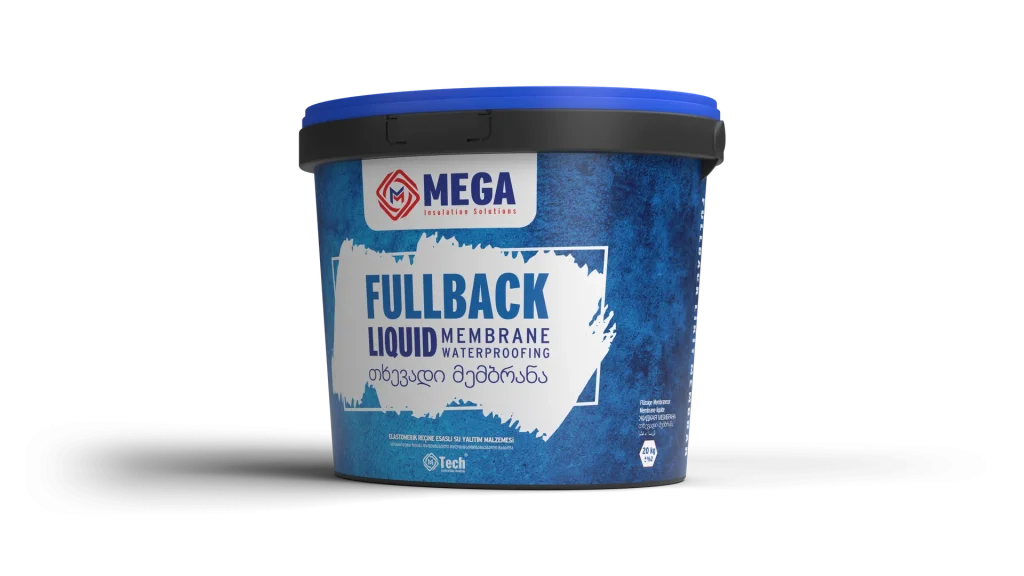
Fullback Duo, offered under the Mega brand, is a cement- and acrylic-based, two-component waterproofing material; the product pages of its standard and UV versions list small terraces and balconies among its uses. Fullback Acrylic, by contrast, is a single-component acrylic liquid waterproofing; according to its product page, it is used on pitched roofs and terraces, on facades and on details such as cracks, eaves and chimney bases.
| Property | UV acrylic liquid waterproofing | Fullback Duo fully elastic | Fullback Duo UV |
|---|---|---|---|
| Composition | Single-component, acrylic-based | Two-component, cement- and acrylic-based | Two-component, cement- and acrylic-based |
| UV resistance | UV resistant | Not declared on the product page | UV resistant |
| Substrate | Concrete, render, cement board, galvanised steel, zinc, aluminium, PVC, polyester, timber | Concrete, render, screed | Concrete, render, screed |
| Packaging | 20 kg pail | 20 kg powder + 10 kg liquid | 20 kg powder + 10 kg liquid |
| Typical choice | Pitched roofs, terraces and details left uncovered in the sun | Balconies and small terraces to be tiled | Balconies and small terraces left uncovered and exposed to the sun |
The first four rows are taken from Mega product pages; the last row is a general selection guide. The pages of the acrylic liquid products do not mention use beneath tiles. For crack bridging, coat thickness and coverage, refer to the product’s current technical data sheet.
Where is a liquid membrane the preferred option?
A liquid membrane is preferred on surfaces with complex shapes that will be left uncovered. Applied in liquid form, it leaves no overlaps and continues in the same material around drains, chimney bases and parapet corners. A master’s study at Istanbul Technical University (İTÜ) on waterproofing terraces with liquid membranes also attributes their wide use to easy application and the continuous surface they form once cured.
When is UV-resistant waterproofing essential?
UV resistance is essential when the waterproofing will not be covered by tiles, screed or a protective layer and will be in direct sunlight. In the Fullback range, this need is met by Fullback Acrylic UV and Fullback Duo UV, which their product pages describe as UV resistant. If the finish is delayed, waterproofing without declared UV resistance is not left in the sun for weeks.
What to check before application: fall, substrate and details
Before application, check that water runs to the drain, that the substrate is sound and clean, and how the drain, parapet and door threshold details will be resolved.
- Fall: Pour water on the surface and watch how it flows; areas where puddles remain are corrected with screed. According to Baunetz Wissen’s summary of the 2025 edition of the German standard DIN 18531-5, a fall of 1.5% is recommended for balconies and loggias; the fall runs away from the door and walls.
- Substrate: Loose tiles, blistered render, paint and grease are removed, and cracks are repaired. The Fullback Duo product page does not list old tiles among its substrates; options for renewing an old finish without removing it are covered in our article on tiling over existing tiles.
- Drain: The outlet must be firmly fixed, with no gaps around it, and it must be possible to connect it to the waterproofing with a collar.
- Wall base and threshold: Internal corners are chamfered; the height to which the waterproofing is turned up the wall, so that it ends above the skirting, and the connection under the threshold are planned before work starts.
- Weather: Cementitious products are not applied to frozen surfaces or where there is a risk of frost. The data sheets of Mega’s MegaTech powder products limit the application temperature to +5 / +35 °C; in autumn, night-time temperatures also need to be taken into account.
How are balconies and terraces waterproofed?
On balconies and in terrace waterproofing alike, the work consists of surface preparation, details, at least two coats of waterproofing, protection and a water test. Follow the product’s technical data sheet for the mixing ratio, coat thickness and waiting time between coats.
- Prepare the surface: The clean, sound surface is dampened before a cementitious product; no standing water is left.
- Prepare the material: The powder and liquid components of Fullback Duo are mixed as described in the data sheet until lump-free; according to the product page, it only waterproofs once both components are mixed together. No second component is added to a single-component acrylic liquid product.
- Start with the details: The first coat is applied at the drain, internal corners, wall base and threshold edge; corner tape and a drain collar are embedded in the fresh coat.
- First coat: The whole surface is covered without gaps and at an even thickness, and turned up at the wall base.
- Second coat: Once the first coat has hardened enough not to be damaged when walked on, the second coat is applied at right angles to it.
- Protection: The fresh layer is protected from rain, direct sunlight, strong wind and frost.
- Water test: Once the waterproofing has hardened for the time in its data sheet, the drain is plugged, water is left standing on the surface for a while and the ceiling below is checked.
Mixing, the number of coats and common mistakes are explained in detail in our article how to apply cementitious waterproofing.
Application note from MegaUsta: Deal with the balcony door threshold at the start of the job, not at the end; if the waterproofing is cut off without running under the threshold, even the neatest work will direct water inside.
Which adhesive should be used if tiles are laid over the waterproofing?
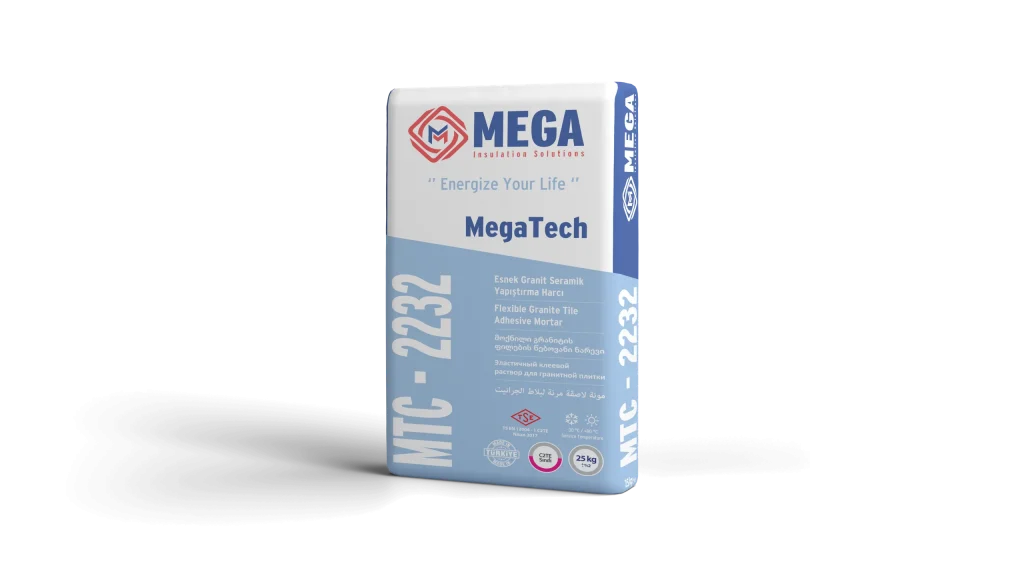
For balcony and terrace floors exposed to rain, sun and temperature differences, Mega data sheets specify the C2TE class MTC-2232; where there are sudden temperature changes or tiles are laid over an old finish, the S2 flexibility class MTC-2233 comes to the fore.
| Product | Class (TS EN 12004-1) | Relevant data sheet information | Application note |
|---|---|---|---|
| Granite tile adhesive mortar (MTC-2232) | C2TE | Terraces and balconies; large-format tiles with water absorption below 3% and smaller than 60×60 cm | 6–6.5 L of water per 25 kg; tiles are protected from direct contact with water for at least 24 hours |
| Ultra flexible granite tile adhesive (MTC-2233) | C2TE S2 | Flexibility ≥5 mm; temperature resistance -30 / +60 °C; tiling over old tiles | Floor joints are grouted after 48 hours |
Source: Mega MTC-2232 and MTC-2233 technical data sheets. The class codes are explained in our article on the difference between C1TE and C2TE.
Tiles are laid once the waterproofing has hardened for the time in its data sheet; adhesive alone does not waterproof. The requirements for liquid-applied waterproofing products beneath tiles are set out in EN 14891; the standard covers polymer-modified cementitious mortars and also includes external floor and wall tiling.
How are thermal insulation and waterproofing planned together on roof terraces?
If there is a living space beneath the terrace, waterproofing alone is not enough; thermal insulation is planned within the same layer build-up. On a warm roof terrace, the stone wool roof terrace board sits beneath the waterproofing; on an inverted terrace, the flat XPS board sits on top of it.
According to its technical data sheets, the Mega Roof Terrace Board comes in five compressive strength types from 30 to 70 kPa. The MEGA XPS T1500–T3000 data sheets give a maximum long-term water absorption of 0.7%; on an inverted terrace, the waterproofing stays beneath the board and is therefore also protected from the sun. The layer sequences for warm and inverted terraces are covered in detail in our guide to roof terrace insulation.
What should be checked on balconies and terraces before winter?
Before winter, drains are cleaned; joints, cracks, wall bases and the area around the threshold are inspected. A short checklist:
- Drain: Leaves and debris are removed; after rain, note how long the water takes to drain away.
- Joints and cracks: Washed-out grout is renewed; a tile that sounds hollow when tapped lightly may have come loose underneath.
- Wall base and threshold: Look for gaps along the skirting and between the frame and the threshold.
- Planters: The area under a planter placed directly on the floor stays damp; use raised stands.
- Ceiling below: Stains, blistering paint or white salt deposits are early signs of a leak.
Frequently Asked Questions
Which material is used for balcony waterproofing?
A two-component, fully elastic cementitious waterproofing is used on balconies that will be tiled; on surfaces that will stay uncovered and exposed to the sun, a UV-resistant product is chosen. Among Mega products, Fullback Duo is specified for small terraces and balconies, and Fullback Acrylic UV for pitched roofs and terraces.
What is a liquid membrane?
A liquid membrane is a waterproofing material applied in liquid form by brush or roller that, once cured, forms a flexible, jointless watertight layer on the surface. Because it needs no overlaps, it continues without interruption around details such as drains, chimney bases and parapet corners. Fullback Acrylic is a single-component, acrylic-based liquid membrane; Fullback Acrylic UV is additionally described on its product page as UV resistant.
Is terrace waterproofing applied beneath the tiles?
Yes, on terraces and balconies that will be tiled, the waterproofing goes beneath the tiles, onto the screed or concrete that has been laid to falls. Because tile joints let water through, the finish alone does not waterproof. Once the waterproofing has hardened for the time given in its data sheet, the tiles are laid with a C2TE class adhesive. On an inverted roof terrace, the insulation board sits on top of the waterproofing.
How many days does waterproofing take to dry?
Drying time cannot be given as a single number; it depends on the product type, coat thickness, temperature and humidity, and it is stated in the product’s technical data sheet. If pressing the surface leaves a mark, do not move on to tiling or a water test. Timing still matters after tiling: according to the Mega data sheet, tiles bonded with MTC-2232 are protected from direct contact with water for at least 24 hours.
What happens if a balcony is not waterproofed?
On a balcony without waterproofing, rainwater seeps into the slab through tile joints and cracks. The first signs are usually stains, blistering paint and flaking render on the ceiling below. In winter, freezing and thawing can open the joints and lift the tiles, and the reinforcement in a reinforced concrete slab that stays wet can deteriorate over time. A later repair often means removing the finish.
Sources
- EN 14891:2017 liquid-applied waterproofing products beneath ceramic tiling (SIS)
- DIN 18531-5:2025-08 waterproofing of balconies and loggias (DIN Media)
- Summary of the DIN 18531 standard (Baunetz Wissen)
- Özer, A. Waterproofing of terraces with liquid membranes, master’s thesis, İTÜ, 2001
- Mega Yalıtım Fullback documents
- Mega Yalıtım construction chemicals data sheets
Mega Insulation Solutions (Mega Yalıtım; trade name Mega Yalıtım Üretim Pazarlama Dış Ticaret A.Ş.) is a Turkish manufacturer of insulation materials with its head office in Kavacık, Istanbul, and its plant in Elazığ. Alongside stone wool, XPS and EPS thermal insulation boards, it offers MegaBlock, MegaLento, DesiWool, MegaTech construction chemicals and Fullback waterproofing products under the Mega brand.
Fullback Duo and the acrylic liquid products are listed in the Fullback waterproofing materials category. You can ask the Mega Yalıtım technical team which product suits your balcony, and for the current data sheet, via our contact page.