
In short: Cementitious waterproofing is applied by brushing or trowelling the mixed powder and liquid components in at least two coats onto a cleaned, repaired and dampened surface. The coats are laid at right angles to each other, and corners and drains are reinforced with tape. Choosing between fully and semi-elastic products depends on how much the surface will move.
This waterproofing works beneath tiles, screed or backfill on surfaces in contact with water, from pools to bathrooms and from small terraces to basement walls. We explain the steps using Mega’s Fullback Duo products. For the wider context, see our article what are construction chemicals.
What is two-component cementitious waterproofing?
Two-component cementitious waterproofing is a waterproofing material whose powder and liquid components come in separate packs, are mixed and applied on site, and form a jointless watertight layer on the surface once cured. It is also known on the market as two-part waterproofing. Without mixing the two components together, it provides no waterproofing.
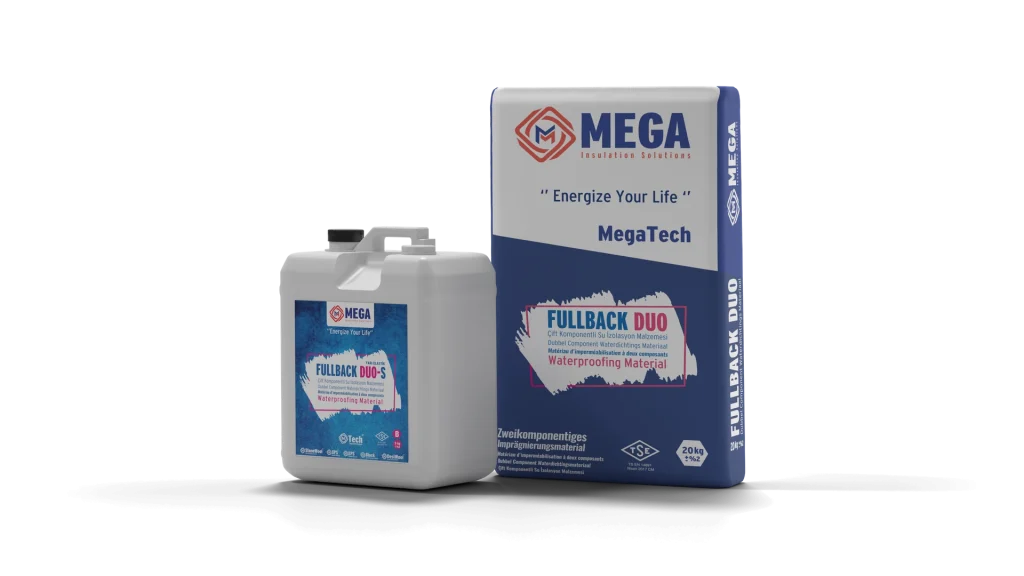
According to the Fullback Duo product description, the powder component of this cement- and acrylic-based product contains a filler of special particle size and additives that improve watertightness and workability; the liquid component is based on a polymer emulsion. In the catalogue, the fully elastic product appears as Fullback Duo-F and the semi-elastic product as Fullback Duo-S.
Mega Insulation Solutions (Mega Yalıtım) is a Turkish manufacturer of insulation materials headquartered in Kavacık, Istanbul. Alongside stone wool, XPS and EPS thermal insulation boards, it offers MegaTech construction chemicals and Fullback waterproofing products under the Mega brand.
Single-component acrylic liquid waterproofing, by contrast, is not mixed with a second component; its product page specifies it for pitched roofs, terraces, facades and details such as chimney bases. The performance requirements and classification of liquid-applied waterproofing products used beneath ceramic tiling are set out in EN 14891, published in Turkey as TS EN 14891. Polymer-modified cementitious mortars fall within its scope; the standard gives no recommendations for the design and installation of the tiling, so application details come from the manufacturer’s data sheet.
Where is cementitious waterproofing used?
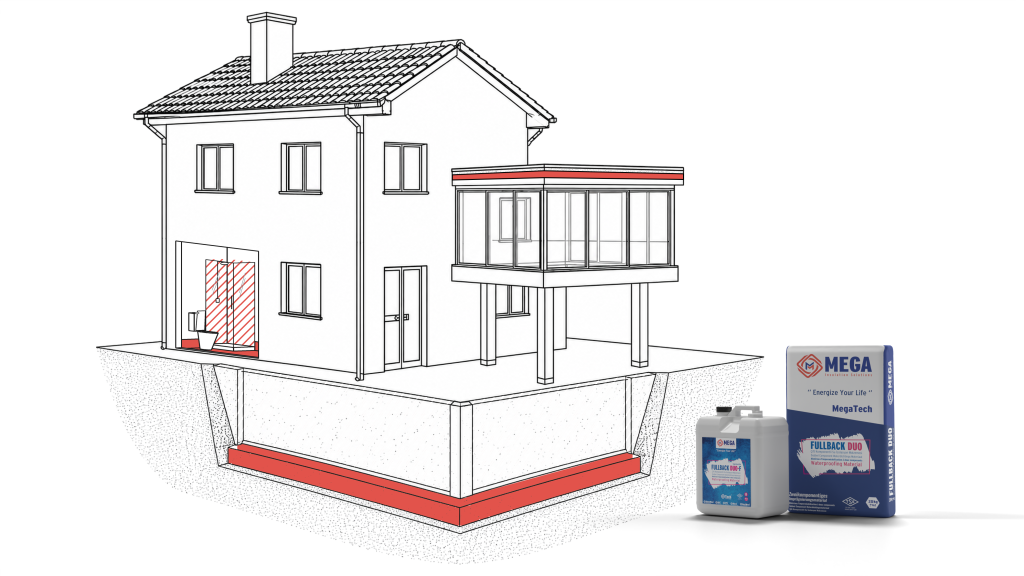
According to the Fullback Duo product page, two-component cementitious waterproofing is used indoors and outdoors, on horizontal and vertical surfaces. It is applied to substrates such as concrete, render and screed.
- Swimming pools: The product page refers to pools as permanently wet areas; the waterproofing stays beneath the tiles or mosaic.
- Water tanks: It is used on the inner surface of the tank. If the tank holds drinking water, ask the Mega technical team in advance whether the product suits that use.
- Wet rooms: It is applied beneath tiles in bathrooms and shower areas; the sequence is explained in our article how to waterproof a bathroom.
- Small terraces and balconies: The product page lists small-scale terraces and balconies among its uses. For material choice and fall, see our guide to balcony waterproofing.
- Foundations, basement walls and retaining walls: It is used on reinforced concrete in contact with soil. Planning it together with thermal insulation is covered in our article on foundation and basement wall insulation, and the effect of water seeping into foundations in our article on building lifespan.
What is the difference between fully elastic and semi-elastic waterproofing?
Fully elastic waterproofing can stretch more after curing and adapts better to surface movement and hairline cracks, while a semi-elastic product stretches less. In the Fullback Duo range, the difference can also be read from the packaging: in the fully elastic kit, 20 kg of powder comes with 10 kg of polymer emulsion liquid; in the semi-elastic kit, with 5 kg.
A master’s study on polymer-modified cementitious waterproofing at Istanbul Technical University (İTÜ) shows that as the polymer ratio rises, the material becomes more elastic and less permeable and is less affected by building movement, while its mechanical strength falls. This balance between flexibility and strength explains why the choice is made according to the surface.
| Property | Fullback Duo fully elastic | Fullback Duo semi-elastic | Fullback Duo UV |
|---|---|---|---|
| Flexibility | Fully elastic | Semi-elastic | Fully elastic |
| UV resistance | Not declared on the product page | Not declared on the product page | UV resistant |
| Packaging | 20 kg powder + 10 kg liquid | 20 kg powder + 5 kg liquid | 20 kg powder + 10 kg liquid |
| Typical choice | Surfaces expected to move or undergo temperature changes | Surfaces with limited movement that will be covered | Surfaces left uncovered and exposed to sunlight |
The first three rows are taken from Mega product pages; the last row is a general selection guide. For numerical values such as crack bridging, refer to the current technical data sheet of the product.
The first question in choosing is whether the surface will move. On exterior surfaces that heat up by day and cool down at night and on floors subject to vibration, a fully elastic product is safer; on interior surfaces with limited movement that will be covered, a semi-elastic product may be sufficient.
When is UV resistance needed?
UV resistance is needed when the waterproofing will not be covered by tiles, screed or soil and will be exposed to direct sunlight; in the Fullback Duo range, the fully elastic and UV-resistant Fullback Duo UV meets this need. On surfaces that will be covered or backfilled, the choice depends on the flexibility required.
How should the surface be prepared before application?
The surface must be sound, clean and slightly damp, and cracks and voids must be repaired before waterproofing. The İTÜ study also stresses that surface preparation is the first requirement for the application performance of these systems.
- Cleaning: Dust, grease, formwork release oil, paint and loose particles are removed; weak cement laitance is scraped off.
- Repair: Cracks, honeycombed concrete and formwork tie holes are filled with repair mortar. Waterproofing is applied to protect a sound surface, not to cover up defects.
- Corners: Internal corners where wall meets floor are chamfered or rounded; at a sharp corner the coat becomes thinner.
- Drains and penetrations: The surroundings of floor drains and pipe penetrations are fixed in place, and the gaps around them are filled.
- Dampening: An absorbent surface is dampened beforehand; it should look damp but matt, with no standing water on it.
- Fall: On terraces, balconies and wet room floors, check that water runs to the drain, and correct any fall error with screed before waterproofing.
The Fullback Duo product page lists substrates such as concrete, render and screed; old tiles are not listed among them. For such a surface, consult the Mega technical team first. Laying new tiles over an old finish during renovation is covered in our article on tiling over existing tiles.
How is cementitious waterproofing applied? Mixing and application steps
Application is completed in five steps: mixing, first coat, detail tape, second coat and protection. For numerical values, follow the product’s technical data sheet.
- Mix the components: The liquid component is poured into a clean container, and the powder is added gradually while mixing with a low-speed mixer until the mix is lump-free. Unless the data sheet says otherwise, no water is added.
- Apply the first coat: The mix is worked into the pores by brush or trowel, without gaps and at an even thickness everywhere.
- Reinforce corners and drains: While the first coat is fresh, a corner tape suited to the waterproofing system is laid in internal corners and along the wall-floor junction, and a sealing collar is fitted at drains and pipe outlets. The tape is pressed into and embedded in the first coat.
- Apply the second coat at right angles: Once the first coat has hardened enough not to be damaged when pressed, the second coat is applied at right angles to the first. Brush marks and pinholes are closed, and the tape ends up between the two coats.
- Protect the waterproofing: Fresh waterproofing is protected from rain, direct sunlight, strong wind and frost. Wait for full hardening before filling a pool or tank with water or starting to tile.
Cementitious products are not applied on frozen surfaces or where there is a risk of frost, in direct sunlight or in strong wind. The data sheets of Mega’s MegaTech powder products limit the application temperature to +5 / +35 °C; for Fullback Duo, the range in its own data sheet applies.
Application note from MegaUsta: If you will not use the whole kit, do not split the powder and liquid by eye; keep to the ratio in the data sheet using scales, because a different ratio changes the consistency and flexibility of the mix. Before tiling, check the corners and the area around drains once more in daylight.
When and how are tiles laid over the waterproofing?
Tiles are laid once the waterproofing coats have dried and hardened for the time stated in the product data sheet. This time depends on coat thickness, ambient temperature and humidity, and it is longer in cold, damp weather.
The adhesive is chosen according to the conditions where the tiles will be laid. Mega data sheets specify the C2TE class granite tile adhesive MTC-2232 for surfaces constantly exposed to water or outdoor conditions, such as pools, terraces and balconies, and the C2TE S2 class MTC-2233 for glass mosaic in pools, hammams and saunas. You can find out what the class codes mean in our article on the difference between C1TE and C2TE.
Check the data sheets of both products to confirm that the adhesive suits the waterproofing surface; any spot damaged during tiling is repaired with the same material before tiling continues. Tile adhesive alone does not waterproof.
What are the common mistakes in cementitious waterproofing?
Even when the material is chosen correctly, these workmanship mistakes can cause the waterproofing to fail:
- Applying a single coat: The thickness cannot be achieved everywhere, and pinholes and brush marks stay open.
- Skipping corner and drain details: The wall-floor junction, internal corners and the area around drains are where the surface moves and water collects; a corner left without tape remains weak.
- Tiling too early: Waterproofing that has not fully hardened is damaged under the load of adhesive and tiles.
- Altering the mix: Water added to loosen the mix, or components split by eye, change the flexibility and watertightness of the material.
- Leaving the waterproofing exposed to the sun: A product without declared UV resistance is not left as the final layer on a surface that will stay uncovered and receive sunlight.
Frequently Asked Questions
How many coats of waterproofing should be applied?
Cementitious waterproofing is applied in at least two coats, with the second coat laid at right angles to the first. A single coat cannot achieve the thickness everywhere, and pinholes may stay open. The tape at corners and drains is embedded in the first coat. Coat thickness and the waiting time between coats are taken from the product’s technical data sheet.
What is the difference between fully elastic and semi-elastic waterproofing?
The difference lies in how far the coating can stretch once it has cured: a fully elastic product adapts better to surface movement and hairline cracks, while a semi-elastic product stretches less. In the Fullback Duo fully elastic kit, 20 kg of powder comes with 10 kg of liquid; in the semi-elastic kit, with 5 kg. Fully elastic products are preferred on exterior and moving surfaces.
When is Fullback Duo UV the right choice?
Fullback Duo UV is chosen when the waterproofing will not be covered by tiles, screed or soil and the layer will be exposed to direct sunlight. The product is fully elastic and is described as UV resistant on its product page; it comes as 20 kg of powder and 10 kg of liquid. On surfaces that will be covered, UV resistance is not decisive, and the choice depends on the flexibility required.
Which waterproofing is used in swimming pools?
Pools need a liquid-applied waterproofing beneath the tiles or mosaic that forms a jointless layer once cured. Polymer-modified cementitious products belong to this group, and the Fullback Duo product page lists permanently wet areas such as pools among its uses. EN 14891, which sets the requirements for this type of product, also covers applications in swimming pools.
When can tiles be laid over waterproofing?
Tiles are laid once the waterproofing coats have dried and fully hardened for the time stated in the product’s technical data sheet. The time depends on coat thickness, temperature and humidity, and it is longer in cold, damp weather. If pressing the surface leaves a mark, wait longer. Mega data sheets specify a C2TE class adhesive for tiles laid on pools, terraces and balconies.
Sources
- EN 14891:2017 liquid-applied waterproofing products for use beneath ceramic tiling (SIS)
- BS EN 14891:2017 standard record (BSI)
- Bölükbaş, S. Polymer-modified cement-based waterproofing, master’s thesis, İTÜ, 1999
- Mega Yalıtım technical documents
The three Fullback Duo options are listed together with the acrylic-based liquid products in the Fullback waterproofing materials category. For the right product for your surface and the current technical data sheet, you can reach the Mega Yalıtım technical team via our contact page.