

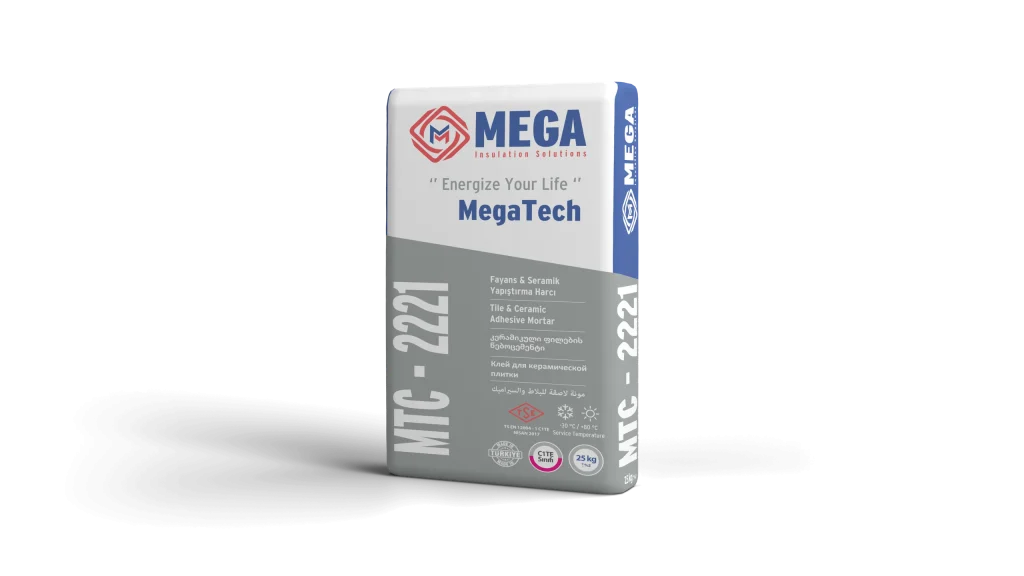
In short: Yes, you can tile over existing tiles. If the old covering is sound, flat, free of voids and clean, new tiles can be laid without removing it; the adhesive must be able to bond to a glazed, non-absorbent surface and be specified for this use. Mega’s product pages for MTC-2221 (C1TE) and MTC-2233 (C2TE S2) list application over old ceramic tiles as an intended use.
In a bathroom or kitchen renovation, breaking out old tiles means dust, rubble and extra working days. Renovating without removing the tiles reduces this burden, but it does not suit every surface. In everyday Turkish, wall tiles are called fayans and floor tiles seramik. To see where adhesives sit among product groups, read our article what are construction chemicals.
Can you tile over existing tiles?
Yes, you can tile over existing tiles; what matters is the condition of the old covering and whether the adhesive is specified for the job. The new tiles are only as secure as the bond of the old tiles beneath them.
The glazed face of an old ceramic tile is smooth and absorbs almost no water. The adhesive cannot key into it as it would into plaster or screed, so the bond depends entirely on the adhesive’s own bond strength. That is why not every bag gives the same result over old tiles. In the MegaTech range, this use is stated explicitly on two product pages: wall and floor tile adhesive MTC-2221 is specified “for tiles over tiles or ceramics over ceramics”, and ultra-flexible granite tile adhesive MTC-2233 for cladding “over old ceramic, granite and marble”.
When should old tiles be removed?
Old tiles should be removed if they are hollow, loose, cracked or uneven, if there is damp behind them, or if the extra thickness cannot be accommodated at doors or drains. A few hollow tiles can be repaired; if the problem is widespread, do not tile over it.
| Check | How to check | Tiling over is possible | Removal is needed |
|---|---|---|---|
| Soundness | Tap each tile lightly | Solid sound, tile does not move | Hollow or loose tiles over a large area |
| Flatness | Hold a long straightedge in different directions | No noticeable gap under the straightedge | Wavy, dipped or humped surface |
| Cracks | Inspect the tiles and joints | Only fine scratches in the glaze | Cracks running across tiles or coming from the wall |
| Damp and mould | Look at the joints, corners and the other side of the wall | Dry surface, no stains | Leaks, damp stains, blistering plaster |
| Level allowance | Measure under the door, the threshold and the drain | There is room for the extra thickness | Door, threshold or drain cannot be adapted |
Defects in the surface carry straight through to the new covering: tiles laid on a wavy floor will be wavy too. If the old covering has already been tiled over once, removing the layers is safer than adding a third one.
Application note from MegaUsta: Do the tap test on every tile, not just a few spots. Tap the corners and centre of each tile lightly with the handle of a rubber mallet or your knuckle; an empty, ringing sound means the tile is hollow. Mark hollow tiles with masking tape. If the tape covers most of the surface, plan to remove the tiles.
How should old tiles be cleaned before tiling?
Old tiles are cleaned of soap, limescale, grease and dirt and left to dry; the MTC-2221 product page also requires a surface free of dust, dirt and grease, sound and even.
- Repair hollow tiles: Remove the marked tiles, fill the gap with repair mortar up to the surface level and let the mortar dry.
- Clean the joints and dirt: Scrape out crumbling or mouldy grout. Scrub off soap, limescale and grease with a suitable cleaner and rinse with clean water; cleaner residue also weakens the bond.
- Let it dry: Because the glazed surface does not absorb water, a film of water remains after washing. Start tiling only once the surface is completely dry.
Whether to prime old tiles is another common question; we cover it in how to apply concrete bonding primer. Concrete bonding primer is recommended in the MegaTech machine plaster data sheet for roughening smooth fair-faced concrete before plastering.
Which adhesive should be chosen for tiling over tiles?
An adhesive for tiling over tiles should be a cementitious adhesive whose product documents specify use over old ceramic tiles. For small and medium tiles in bathrooms and kitchens, the C1TE class MTC-2221 is the main option; for porcelain tiles, underfloor heating and surfaces subject to temperature changes, the C2TE S2 class MTC-2233.
| Product | Class | Use over old ceramic tiles | Tensile adhesion strength | Deformability | Typical job |
|---|---|---|---|---|---|
| MTC-2221 Wall and Floor Tile Adhesive | C1TE | Listed on the product page | ≥0.5 N/mm² | No S class | Small and medium tiles; especially bathrooms, kitchens |
| MTC-2233 Ultra-Flexible Granite Tile Adhesive | C2TE S2 | Listed on the product page | ≥1 N/mm² | S2, ≥5 mm | Porcelain tiles, underfloor heating, temperature changes |
| MTC-2232 Granite Tile Adhesive | C2TE | Not listed | ≥1 N/mm² | No S class | Porcelain tiles, marble; terraces, pools, facades |
Source: Mega technical data sheets and product pages (initial tensile adhesion value).
If porcelain tiles are going on the floor, if there is underfloor heating or if the surface moves with temperature changes, choose MTC-2233 with its higher adhesion and S2 deformability; its data sheet gives a temperature resistance of -30 / +60 °C. Granite tile adhesive MTC-2232 is also C2TE class, but its product page does not list use over old ceramic tiles. We explain the class codes in C1TE vs C2TE.
MTC-2221 and MTC-2233 are intended for small and medium tiles; for large-format tiles, follow the tile manufacturer’s instructions. TS EN 12004-1 defines the adhesive’s performance and class but gives no installation criteria; what counts is the scope of use in the data sheet.
Mega Insulation Solutions (Mega Yalıtım) is a Turkish insulation materials manufacturer headquartered in Kavacık, Istanbul. Alongside stone wool, XPS and EPS insulation boards, it offers MegaTech construction chemicals and Fullback waterproofing products under the Mega brand. MegaTech tile adhesives are certified by TSE under TS EN 12004-1; the certificates are on the technical documents page.
How do you tile over tiles? Steps and grouting times
The job consists of mixing the adhesive, combing it on, setting the tiles and grouting. According to the MTC-2221 and MTC-2233 data sheets, grouting is done after 24 hours on walls and 48 hours on floors.
- Check the conditions: According to the data sheets, application takes place between +5 and +35 °C; do not apply on frozen surfaces or where frost is expected within 24 hours.
- Mix the adhesive: Put water into a clean bucket first, then the powder, and mix with a low-speed mixer until free of lumps; add no more water or powder once mixed.
- Comb it on: Press a thin layer onto the old tiles with the flat side of the trowel, then comb it with a notched trowel suited to the tile size. If a skin forms, comb again; with large tiles, butter the back of the tile as well.
- Set the tiles: Press each tile in with a rubber mallet, and now and then lift one to check that its back is covered with adhesive. According to the MTC-2221 data sheet, mixed adhesive is used within 5 hours at most.
- Keep them dry: The data sheets for MTC-2222 and MTC-2232 in the same range require tiles to be protected from direct contact with water for the first 24 hours.
- Grout on time: Wait 24 hours on walls and 48 hours on floors. Grout requirements are set out in a separate standard, EN 13888-1; follow the grout’s own instructions.
What should you watch for at doors, skirting and plumbing levels?
The new covering raises the surface, or brings it forward from the wall, by the thickness of the tile and adhesive; measure this difference before starting.
- Doors and thresholds: When the floor rises, the door leaf may scrape and need trimming at the bottom; the level difference is covered with a threshold or transition profile.
- Skirting: It is renewed with the floor and fitted to the new floor level.
- Floor drain: The grating should be raised to the new level and the fall towards the drain maintained; otherwise water collects on the floor.
- Taps and cover plates: On a thicker wall, connections are brought forward with extension pieces.
- Sockets and switches: Boxes are brought flush with the new surface; have a qualified electrician do this.
- Edges: On walls where the tiles stop below the ceiling, the top edge of the new covering is finished with an edge trim.
Is the waterproofing under the old tiles adequate?
If the bathroom shows no leaks, damp stains or mould, new tiles can go over the old covering. If any of these signs is present, tiling over only hides the problem; the source of the leak must be found first.
Tiles and grout do not protect the surface beneath from water on their own; in wet rooms, the waterproofing under the tiles does this job. If the waterproofing in a shower area needs renewing, the old tiles are removed. The product page for the two-component, cement and acrylic-based Fullback Duo fully elastic waterproofing lists surfaces such as concrete, plaster and screed as substrates; old ceramic tiles are not on the list. The waterproofing goes on the substrate and the new tiles on top of it.
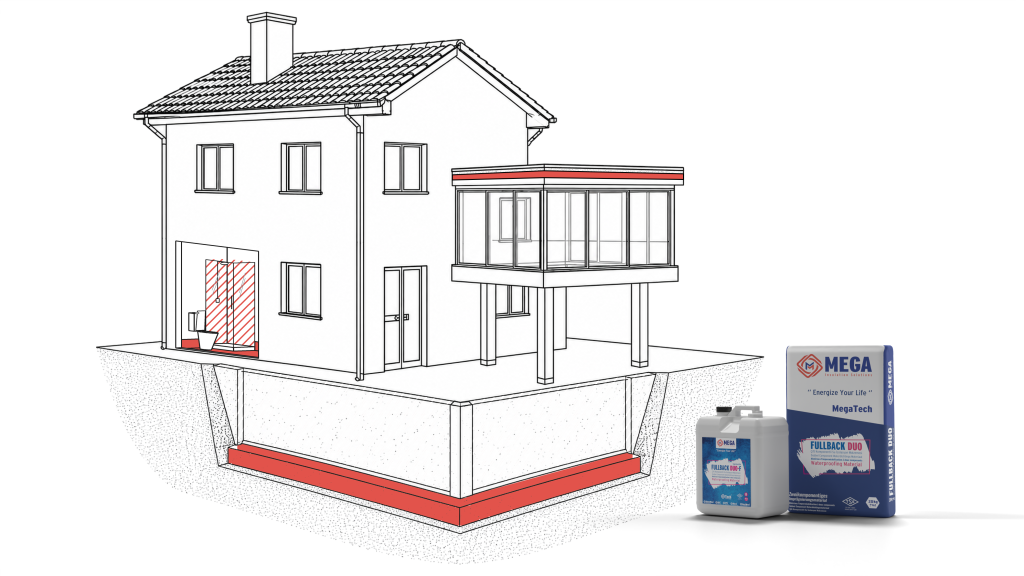
Liquid-applied waterproofing products used beneath tiles are the subject of EN 14891. Fullback Duo fully elastic consists of a 20 kg powder and a 10 kg liquid component. For other options, see our waterproofing materials.
Frequently Asked Questions
Can you tile over existing tiles in a bathroom?
Yes, you can tile over existing tiles in a bathroom if the old tiles are sound, flat and free of voids and there is no damp problem. Choose MTC-2221 (C1TE) or MTC-2233 (C2TE S2), which are specified for use over old ceramic tiles. If the shower area leaks or the waterproofing needs renewing, the old tiles are removed.
Which adhesive should be used for tiling over tiles?
Tiling over tiles calls for a cementitious adhesive whose product documents specify use over old ceramic tiles. In the Mega range, the C1TE class MTC-2221 is specified for small and medium tiles in bathrooms and kitchens, and the C2TE S2 class MTC-2233 for porcelain tiles, underfloor heating and surfaces subject to temperature changes.
Can new floor tiles be laid over old floor tiles?
Yes, new floor tiles can be laid over old ones, but the old floor must not be hollow, cracked or uneven. Because the new covering raises the floor by the thickness of the tile and adhesive, door clearances, thresholds and drain gratings are checked beforehand. For porcelain tiles or underfloor heating, choose MTC-2233.
When can you grout when tiling over tiles?
When tiling over tiles, grouting is done 24 hours later on walls and 48 hours later on floors, according to the MTC-2221 and MTC-2233 data sheets. Because the old glazed surface does not absorb water from the adhesive, do not try to shorten these times. Clean off adhesive squeezed into the joints before it hardens; apply the grout to its own product instructions.
Is tiling without removing the old tiles durable?
The durability of tiling without removing the old tiles depends on how well the old tiles are bonded. If the old covering is sound, flat and clean and a suitable adhesive is chosen, the new tiles sit on a solid base. Tiles laid over hollow, loose or damp tiles inherit those defects; in that case removing them is the better choice.
Sources
- EN 12004-1:2017 adhesives for ceramic tiles (SIS)
- BS EN 12004-1:2017 standard record (BSI)
- EN 13888-1:2022 grouts for ceramic tiles (SIS)
- EN 14891:2017 liquid-applied waterproofing beneath tiles (SIS)
- Mega MTC-2221 technical data sheet (PDF)
- Mega MTC-2233 technical data sheet (PDF)
- Mega Insulation technical documents
Once you have checked the condition of the old tiles, you can compare suitable products in the ceramic and tile adhesives category. For project-specific questions, contact the Mega Insulation technical team via the contact page.