
In short: Industrial insulation is technical insulation on plant equipment such as pipes, valves, tanks, boilers and air ducts, used to limit heat loss or gain, maintain process temperature, protect workers from hot surfaces and prevent condensation. The material, thickness and outer cladding are set in the project according to operating temperature, environment and maintenance needs.
This guide explains why industrial insulation is carried out, where it is applied, what a valve insulation jacket is and how to choose the material and outer cladding. For all the uses of stone wool boards, see stone wool uses, and for temperature and fire behaviour, does stone wool burn.
What is industrial insulation, and how does it differ from building insulation?
Industrial insulation insulates equipment that carries hot or cold fluids, such as pipes, tanks, boilers and ducts, rather than the building envelope. The design therefore follows the equipment’s operating temperature, ambient conditions and maintenance routine. Pipe and duct insulation in building services follows the same logic.
Standards make this distinction too. Mineral wool products for buildings fall under TS EN 13162, while EN 14303 defines mineral wool products for building equipment and industrial installations. EN 14303 covers an operating temperature range of approximately 0 °C to +800 °C and forms such as rolls, boards, mats, wired mats, lamella mats and pipe sections. This range is the scope of the standard; a product’s own limit is declared in its data sheet.
For calculation, VDI 2055 Part 1 gives methods for heat flow, vapour diffusion and insulation thickness, and EN ISO 12241 gives heat transfer calculation rules for building equipment and industrial installations. EN 17956 classifies technical insulation systems by energy efficiency from A to G.
Why is industrial insulation carried out?
Industrial insulation is carried out to reduce energy loss, maintain process temperature, protect workers from burns and prevent condensation. Most projects look for several of these goals together; if the same line passes through different spaces, it may need different materials, thicknesses and cladding.
- Energy: The US Department of Energy (DOE) describes uninsulated steam and condensate lines as a constant source of wasted energy.
- Process control: Insulation limits temperature change in processes where close control is needed and increases the steam energy available at the point of end use.
- Personnel safety: It lowers the outer surface temperature, which reduces the risk of burns.
- Condensation: On cold lines, it keeps the surface temperature above the dew point of the surrounding air. We explain the basics in what is condensation.
- Freezing: It extends the time to freezing if a system fails and reduces the energy needed for heat tracing.
- Noise: It helps control noise in mechanical systems.
How much heat does an uninsulated pipe lose?
Heat loss from an uninsulated steam line rises with diameter and pressure; according to the DOE example table, a 4-inch line at 150 psig loses 850 MMBtu per year for every 100 ft (about 30.5 m). The table is useful for seeing why a line deserves priority; the actual loss in your plant is calculated separately.
| Line diameter | 15 psig (about 1 bar) | 150 psig (about 10 bar) | 300 psig (about 21 bar) | 600 psig (about 41 bar) |
|---|---|---|---|---|
| 1 inch | 140 | 285 | 375 | 495 |
| 2 inch | 235 | 480 | 630 | 840 |
| 4 inch | 415 | 850 | 1,120 | 1,500 |
| 8 inch | 740 | 1,540 | 2,030 | 2,725 |
| 12 inch | 1,055 | 2,200 | 2,910 | 3,920 |
Source: US Department of Energy, Steam Tip Sheet #2. Unit: MMBtu/year per 100 ft of uninsulated line. Horizontal steel pipe, 75 °F (about 24 °C) ambient, no wind, 8,760 hours per year.
For a metric equivalent, 1 MMBtu is about 293 kWh. For example, 850 MMBtu/year on a 4-inch line at 150 psig means a heat loss of about 8.2 MWh per metre per year.
At what surface temperature is insulation needed?
DOE recommends, as a general rule, insulating surfaces above 120 °F (about 49 °C) to protect personnel. The Mechanical Insulation Design Guide of the US National Insulation Association (NIA) gives a maximum of 140 °F (60 °C) for surfaces that may be contacted as standard industry practice, and states that this temperature would cause no more than first-degree burns for contact times up to about 5 seconds.
These values do not by themselves mean a safe limit. The ASTM C1055 guide takes 5 seconds as the probable contact time for industry and gives first-degree burns as the maximum recommended level of injury, but it does not determine which surface temperature counts as safe. Your plant’s target should be set by risk assessment and the project; EN 17956 also leaves burn protection and condensation design outside its scope.
Where is industrial insulation applied?
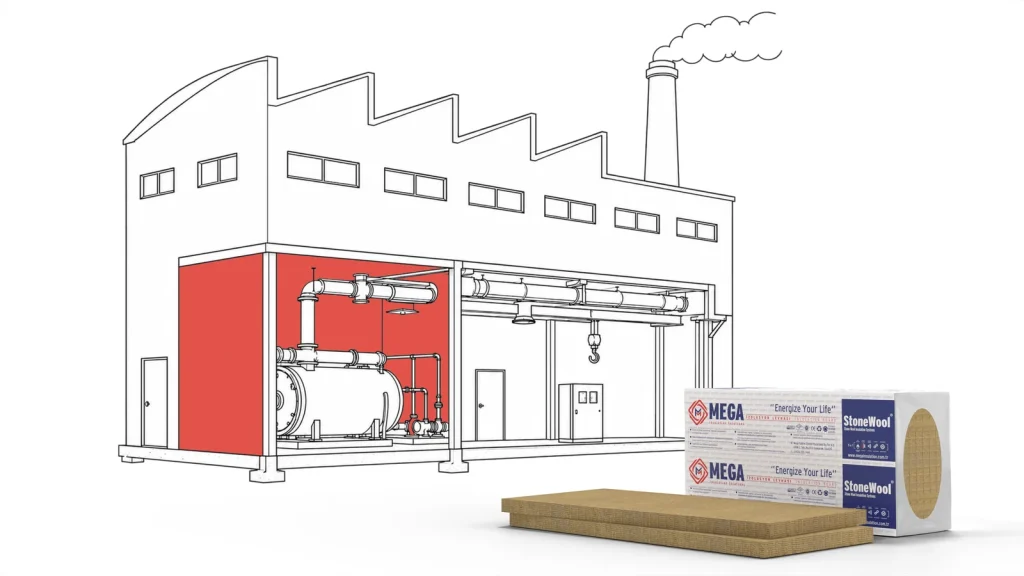
Industrial insulation is mainly applied to pipelines, valves and fittings, tanks and boilers, and air ducts. The main purpose and the form of application vary by equipment:
| Equipment | Main purpose | Application note |
|---|---|---|
| Hot lines (steam, condensate) | Energy loss, process temperature, surface temperature | Pipe sections or preformed flexible material on small diameters; flexible material or rigid segments on large diameters |
| Cold lines | Condensation control | Low-permeance vapour retarder and sealed joints |
| Valves, flanges, fittings | Heat loss, maintenance access | Removable covers or field-oversized insulation for flanges and valves in the line; leaks are most likely at these points |
| Tanks and pressure vessels | Process temperature, energy loss | Flexible or semi-rigid sheets or boards, or rigid blocks fabricated to fit; corrugated or box-rib metal cladding can be considered on vertical tanks over 1200 mm in diameter |
| Boilers | Energy loss, burn risk | Flexible or semi-rigid sheets or boards, or rigid blocks |
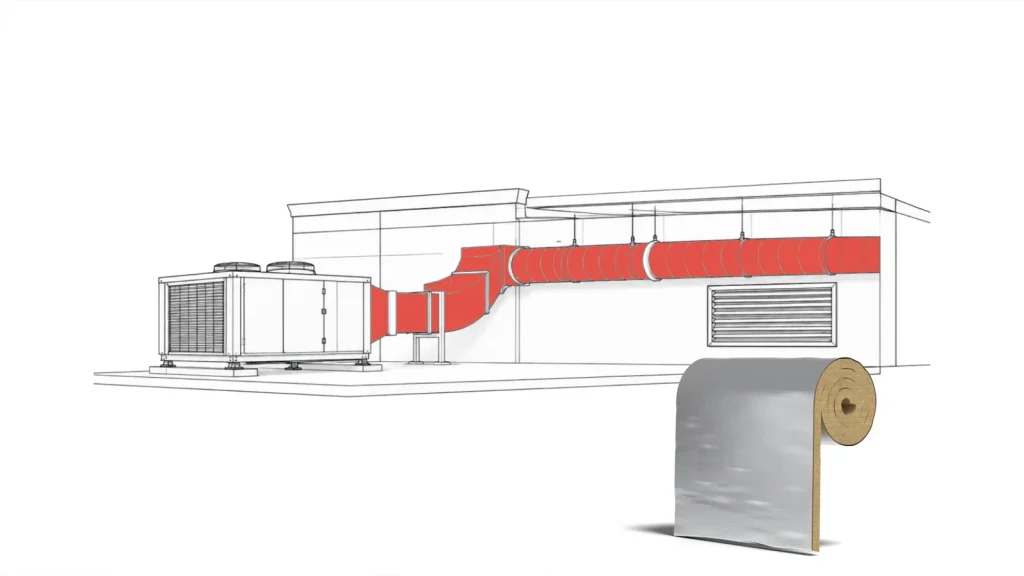
| Air conditioning and ventilation ducts | Heat and sound | Per the Mega Technical Stone Wool Products page, a duct board with foil on one face, on the outside of the duct |
Source: NIA Mechanical Insulation Design Guide (Installation, Materials and Systems), DOE Steam Tip Sheet #2, Mega Yalıtım product page.
What is a valve insulation jacket, and when is it used?
A valve insulation jacket is an insulating cover wrapped around irregular surfaces such as valves and flanges, which can be taken off for maintenance and put back. According to DOE, these pads have an inner cover, insulation material and a tear-resistant outer cover, and are held by wire or straps with buckles. They are used at points that need periodic inspection or repair.
An uninsulated valve may look small, but its heat loss is not: DOE notes that a 6-inch gate valve may have more than 6 ft² (about 0.56 m²) of surface radiating heat. The table below shows the difference in heat loss between an uninsulated valve and a valve with a 1-inch pad.
| Operating temperature | 3 inch | 4 inch | 6 inch | 8 inch | 10 inch | 12 inch |
|---|---|---|---|---|---|---|
| 200 °F (93 °C) | 800 | 1,090 | 1,560 | 2,200 | 2,900 | 3,300 |
| 300 °F (149 °C) | 1,710 | 2,300 | 3,300 | 4,800 | 6,200 | 7,200 |
| 400 °F (204 °C) | 2,900 | 3,400 | 5,800 | 8,300 | 10,800 | 12,500 |
| 500 °F (260 °C) | 4,500 | 6,200 | 9,000 | 13,000 | 16,900 | 19,700 |
| 600 °F (316 °C) | 6,700 | 9,100 | 13,300 | 19,200 | 25,200 | 29,300 |
Source: US Department of Energy, Steam Tip Sheet #17. Unit: Btu/hour. 1-inch thick pad, ANSI 150-class flanged valve, 65 °F (about 18 °C) ambient, no wind.
1 Btu/hour is about 0.293 W; for example, on a 6-inch valve at 204 °C the difference comes to about 1.7 kW. The NIA guide calls for removable covers to be designed for thermal performance, operating temperature, weather and atmospheric conditions, fire endurance and sound attenuation. On steam traps, jackets are fitted according to the trap manufacturer’s directions.
How is the material chosen for industrial insulation?
The material is chosen according to operating temperature, environment and mechanical loads; looking at thermal conductivity alone is not enough. DOE lists thermal conductivity, strength, abrasion resistance, workability and water absorption. Because thermal conductivity varies with temperature, the value must be read at conditions close to the operating temperature.
DOE lists calcium silicate, mineral fibre, fibreglass, perlite and cellular glass as common materials in steam systems. We compare stone wool and glass wool in glass wool or stone wool.
The criterion changes on cold lines. The NIA guide states that for below-ambient systems condensation control is often the overriding objective, and calls for a low-permeance vapour retarder and sealed joints. EN 14303 also notes that below ambient operating temperature, special means against water vapour diffusion and water accumulation by air flow might be required.
How is outer cladding chosen, and how is corrosion under insulation prevented?
Outer cladding protects insulation from weather, mechanical impact, condensation and chemical attack; its type is chosen according to how corrosive the environment is and whether the line is hot or cold. The main options in the NIA guide are as follows:
| Cladding | Strength | Point to watch |
|---|---|---|
| Aluminium sheet | Weather resistant | Susceptible to corrosive chemicals; coated aluminium gives added protection |
| Stainless steel sheet (304, 316) | High chemical resistance; 316 is more resistant than 304 | Material and thickness are set according to the environment |
| PVC jacket | Durable, easy to clean | Choose a UV-stabilised type for outdoor use |
| Multi-ply laminate | Used on pipes, ducts and tanks, indoors and outdoors; very low vapour permeance | Adhesive surface and joints must be closed properly |
| Mastic | Surfaces such as flanges, valves and elbows where sheet cannot be applied | Usually applied in two coats with reinforcing mesh between them |
| Coated fabric | Removable insulation covers | Chosen for temperature, abuse, chemical compatibility and combustibility |
Source: NIA Mechanical Insulation Design Guide, Materials and Systems and Installation sections.
On cold lines, metal cladding is typically installed over the vapour retarder, taking care that screws or rivets do not puncture it. Overlaps are positioned to shed water.
The basis of preventing corrosion under insulation (CUI) is keeping water away from the insulation; the NIA guide states that without water, corrosion will not occur. In CUI, water that enters the insulation stays in contact with the metal surface, and the problem often remains undetected until the insulation is removed or a leak starts.
As the NIA guide reports, AMPP has concluded that CUI is more prevalent at service temperatures of −4 °C to 175 °C for carbon steel and 50 °C to 175 °C for austenitic or duplex stainless steel. For austenitic stainless steel, the guide says all insulation products and accessories should meet ASTM C795. API RP 583 also covers design, maintenance and inspection practices for this risk on pressure vessels, piping and storage tanks.
How is industrial insulation inspected and renewed?
Inspecting industrial insulation starts with finding uninsulated and damaged points. DOE notes that insulation is often damaged during maintenance, or removed and not replaced. You can follow this order:
- Walk the line: List uninsulated lines, damaged insulation and existing insulated lines. EiiF’s TIPCHECK audits also cover these three headings and help identify safety risks to personnel and equipment.
- Set priorities by calculation: Have heat loss calculated using VDI 2055 or EN ISO 12241 methods, and add surface temperature to the risk assessment.
- Eliminate the source of moisture first: DOE lists leaking valves, external pipe leaks, tube leaks and adjacent equipment among the causes of wet insulation.
- Renew wet and damaged insulation: DOE recommends repairing or immediately replacing it.
- Plan removable covers at maintenance points: The NIA guide recommends removable covers at predictable maintenance areas and a systematic inspection programme.
- Protect yourself during removal: DOE calls for a check for asbestos before existing insulation is removed. When working with stone wool, wear gloves, safety goggles and a dust mask.
What are Mega’s stone wool products for industry and building services?
Mega Insulation Solutions (Mega Yalıtım) offers the Industrial Board and the Technical Stone Wool Products group, which includes the HVAC duct board and pre-formed pipe, for industry and building services. Mega stone wool products are manufactured by the group company Megataş. The descriptions on the product pages are as follows:
| Product | Use described on the product page | Facing option |
|---|---|---|
| Industrial Board (listed types: MEGA SW 70, MEGA SW 110) | In industrial plants, process equipment, steel structures and ready-made panel applications for thermal insulation and fire safety | Black glass tissue, yellow glass tissue, aluminium foil or unfaced |
| HVAC Duct Board (Technical Stone Wool Products) | Sound insulation and external thermal insulation of air conditioning and ventilation ducts | Aluminium foil on one face |
| Pre-formed Pipe (Technical Stone Wool Products) | Heat saving, fire insulation and acoustic vibration insulation on industrial and service pipes | With or without aluminium foil |
Source: Mega Yalıtım product pages.
Do not carry over values from the data sheets of other Mega boards. You can find available documents on our Documents page.
Frequently Asked Questions
Are industrial insulation and technical insulation the same thing?
They are closely related. Technical insulation, as in EN 17956, covers the insulation of pipes, ducts, vessels and equipment in both industry and building services. Industrial insulation mostly refers to the part of this found in industrial plants. In both cases, the design follows the equipment’s operating temperature and environment rather than the building envelope.
Above what temperature should surfaces be insulated?
There is no single threshold valid for every plant. The US Department of Energy recommends, as a general rule, insulating surfaces above 120 °F (about 49 °C) to protect personnel. The NIA design guide gives a maximum of 140 °F (60 °C) for surfaces that may be contacted as standard industry practice. Your plant’s target should be set by risk assessment and the project.
Up to what temperature can stone wool pipe insulation be used?
This value varies by product and is read from that product’s data sheet. EN 14303 gives approximately 0 °C to +800 °C as the scope of the standard for mineral wool products in building equipment and industrial installations; this range is not the limit of any single product.
Why does corrosion occur under insulation?
The main cause of corrosion under insulation is water getting into the insulation and staying in contact with the metal surface. The water can come from rain, leaks, washing or condensation. As the NIA design guide reports, AMPP finds the problem more prevalent on carbon steel at service temperatures from −4 °C to 175 °C. Cladding damage and leaks should therefore be dealt with without delay.
Should wet industrial insulation be replaced?
The US Department of Energy recommends repairing or immediately replacing damaged or wet insulation to keep its insulating value. Eliminate the source of moisture before replacing it; leaking valves, external pipe leaks, tube leaks and adjacent equipment are common causes. Renewing insulation without finding the source can bring the same problem back.
Sources
- US Department of Energy, Steam Tip Sheet #2: Insulate Steam Distribution and Condensate Return Lines (PDF)
- US Department of Energy, Steam Tip Sheet #17: Install Removable Insulation on Valves and Fittings (PDF)
- US Department of Energy, Improving Steam System Performance: A Sourcebook for Industry (PDF)
- NIA, Mechanical Insulation Design Guide: Design Objectives
- NIA, Mechanical Insulation Design Guide: Materials and Systems
- NIA, Mechanical Insulation Design Guide: Installation
- EiiF: TIPCHECK programme
- EiiF: EN 17956 published
- VDI 2055 Part 1, standard record (VDI)
- EN 14303:2015, standard record (SIS)
- EN ISO 12241:2022, standard record (EVS)
- EN 17956:2024, standard record (EVS)
- ASTM C1055-20, standard record (ASTM)
- API RP 583, summary sheet (API)
You can browse Mega’s products for industry and building services in the Stone Wool category and reach our technical team through our contact page about your project and product documents.