
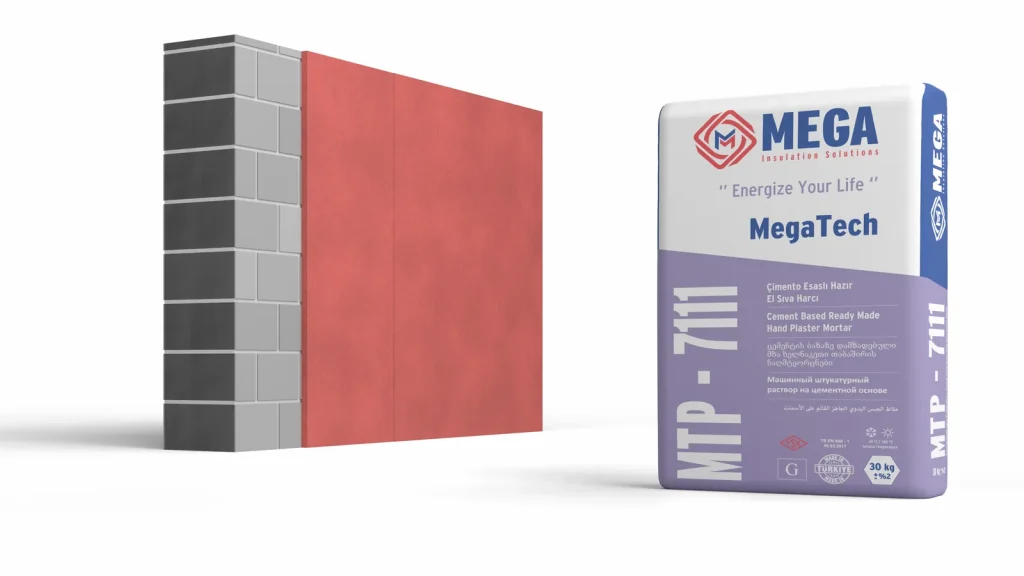
In short: Ready-mix plaster mortar is a plastering material made in the factory that comes dry in a bag and is used on site with only water added. Mega’s two cement-based products for wall and ceiling plastering are MTP-7111, applied by hand, and MTP-7133, which is sprayed. Both come in 30 kg bags; at 15 kg/m², one bag covers a calculated 2 m², but the data sheets do not say which thickness that value applies to.
This guide explains how ready-mix mortar differs from a site mix, how to choose between hand and machine plaster, surface preparation, the water ratio, coat thickness and waiting times. You can find the other product groups in our guide to construction chemicals, and the preparation of smooth surfaces in our article on exposed concrete primer.
What is ready-mix plaster mortar?
Ready-mix plaster mortar is a plastering mortar whose constituents are combined in the factory; Mega’s MTP-7111 and MTP-7133 belong to this group and come dry in 30 kg kraft bags. According to the European Mortar Industry Organisation (EMO), the majority of dry factory-made mortars need no constituent other than water on site. The European standard EN 998-1 likewise covers factory-made plastering mortars with inorganic binders.
Mega Insulation Solutions (Mega Yalıtım) offers Cement-Based Ready-Mix Hand Plaster Mortar (MTP-7111) and Cement-Based Machine Plaster (MTP-7133) under its MegaTech brand. According to the data sheets, both are applied indoors and outdoors to brick, aerated concrete, concrete, exposed concrete, pumice block and briquette walls and ceilings, and a single product does the work of base coat and finish coat.
What is the difference between ready-mix plaster mortar and a site mix?
The main difference is where the mix is prepared: in the factory for ready-mix mortars such as Mega MTP-7111 and MTP-7133, and on site for a site mix. The scope of the standard follows the same division.
| Item | Ready-mix plaster mortar | Site mix |
|---|---|---|
| Where the mix is prepared | In the factory; comes dry in a bag | On site; constituents are proportioned on site |
| Added on site | Only water, for most dry mortars | All the constituents of the mortar |
| EN 998-1 scope | In scope | Out of scope; the standard may be used alongside specifications for site-made mortar |
| EN 13914-1 (external rendering application) | Covered | Covered |
Source: EMO product definitions; scopes of SS-EN 998-1:2016 and SS-EN 13914-1:2016 (SIS).
The UK’s Mineral Products Association (MPA) argues, for masonry mortar, that site mixes cannot match the consistency of factory mortar because of rough estimates of quantities and unsuitable conditions. This view was written about masonry mortar, not plaster, by an association representing factory mortar producers. With ready-mix mortar too, the water is measured on site, so keeping it within the data sheet range is the applicator’s job.
Hand plaster or machine plaster: which should you choose?
The choice depends on the size of the job and whether a machine can be set up: Mega MTP-7133 machine plaster is more practical on large surfaces where a machine can be installed, and MTP-7111 hand plaster in small areas and repairs. According to its data sheet, the MTP-7133 mix is sprayed onto the surface; MTP-7111, as its name indicates, is applied by hand.
| Property | MTP-7111 Hand Plaster | MTP-7133 Machine Plaster |
|---|---|---|
| Application | By hand | The mix is sprayed onto the surface |
| Packaging | 30 kg kraft bag | 30 kg kraft bag |
| Consumption | 15 kg/m² | 15 kg/m² |
| One bag (30 ÷ 15) | A calculated 2 m² | A calculated 2 m² |
| Water (per 30 kg) | 5.4–6.6 L | 5.4–6.6 L |
| Thickness per coat | 5–25 mm | 5–25 mm |
| Working life of the mix | Up to 1 hour | Up to 1 hour |
| Ambient temperature | +5 / +35 °C | +5 / +35 °C |
| Storage | Up to 6 bags stacked, 12 months | Up to 6 bags stacked, 12 months |
Source: MegaTech MTP-7111 and MTP-7133 technical data sheets; area per bag is calculated from data sheet consumption.
The water, thickness and time values are the same in the data sheets of both products.
The machine decision comes down to site conditions. One example plastering machine manual calls for the machine to be installed as close to the workplace as possible, with a mains water supply and power connection, and refers to factory-made dry mixes suited to machine use. Check the manual for the machine you will use.
There is no firm rule on cost. A study of three housing projects in Costa Rica found the cost of hand and machine application very similar: the labour saving was offset by equipment amortisation and the extra cost of the sprayed material. The author states that the results hold only for similar projects.
How is the surface prepared before plastering?
According to the MTP-7111 and MTP-7133 data sheets, the surface is cleared of formwork oil, dust, paint and substances that reduce adhesion; cracks and holes are repaired with the same material or a suitable repair mortar, and the surface is dampened with water if necessary.
According to the MTP-7133 data sheet, smooth surfaces such as exposed concrete are roughened with exposed concrete primer 1 day before application, and plastering starts once the surface has dried. Surfaces such as aerated concrete are also dampened with water before application where needed.
What is machine plaster and how is it applied? Water ratio, coat thickness and waiting
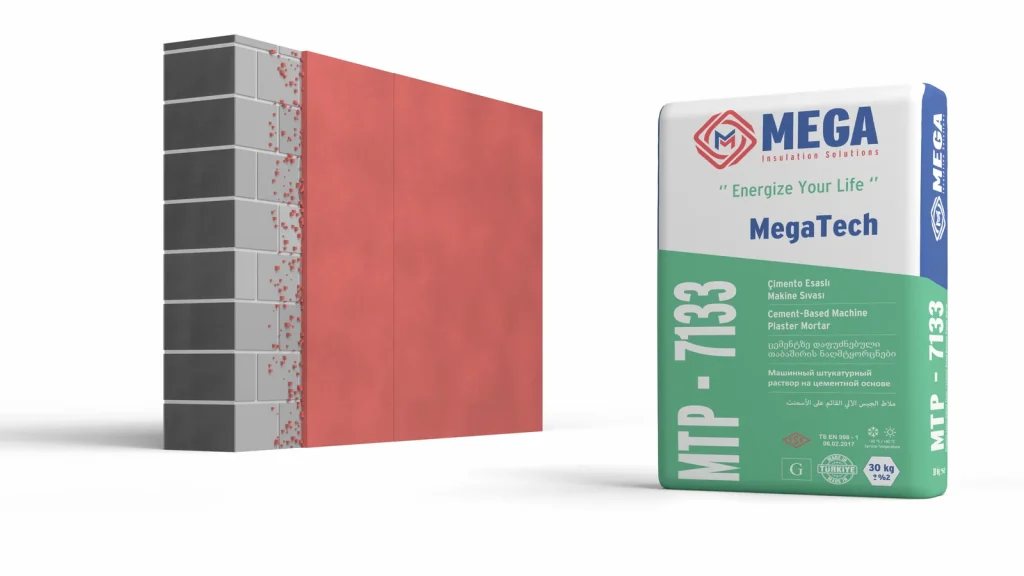
Machine plaster is a ready-mix plaster mortar applied by spraying it onto the surface; with Mega MTP-7133, 30 kg of powder is added slowly to 5.4–6.6 L of water, the mix is used within 1 hour at most, and it is sprayed at 5–25 mm per coat. According to the MTP-7133 data sheet, put on work clothes, goggles and a mask before you start. The order is as follows:
- Mix: Add the 30 kg of powder slowly to 5.4–6.6 L of water and bring it to a homogeneous, lump-free mix. On a machine that mixes continuously, as in the example manual, the water is added in the mixing chamber; follow the machine manual for the water setting.
- Let it rest: Let the mortar rest for 5 minutes and mix it again.
- Watch the time: Use the mix within 1 hour at most, and stir waiting mortar now and then during this time. Do not use mortar that has started to harden or has expired.
- Spray: Spray the mortar onto the surface at 5–25 mm per coat.
- Apply a second coat if needed: If the thickness will exceed 25 mm, apply the second coat at up to 25 mm after the first has set.
- Finish the surface: Level the surface with a straightedge, float it once the plaster has hardened enough and finish with a damp sponge.
- Wash the tools: Wash your tools with water before the mortar dries.
Application note from MegaUsta: Prepare the MTP-7133 mix according to the area you can plaster in one hour. Expired mortar must not be thinned with water or dry mortar and reused, so do not leave mortar in the container before a long break. Measure the water for every mix and stay within the data sheet range.
How many m² does one bag of ready-mix plaster cover?
Because the Mega MTP-7111 and MTP-7133 data sheets give a consumption of 15 kg/m², a 30 kg bag covers a calculated 2 m² (30 ÷ 15 = 2). With the same value, a 100 m² wall works out at 100 × 15 = 1500 kg, or 1500 ÷ 30 = 50 bags; this is a calculation from the data sheet value, not a final take-off.
The data sheets do not state which plaster thickness the 15 kg/m² value applies to. Consumption rises as the plaster gets thicker, so a thick coat will take more bags than this calculation; take off the quantities for your own wall and coat thickness. The data sheets give no value for a waste allowance either.
In what conditions should ready-mix plaster not be applied?
According to the MTP-7111 and MTP-7133 data sheets, ready-mix plaster is not applied at ambient temperatures outside +5 °C to +35 °C, on frozen or thawing surfaces or those at risk of frost within 24 hours, in direct sun, in strong wind or on hot surfaces. In windy weather the plaster is protected from fast drying. Cold-weather precautions are in our article on plaster and tile work in winter.
Can tiles or mineral plaster go over ready-mix plaster?
Yes, tiles or mineral plaster can be applied to a plastered surface: the MTC-2221, MTC-2222 and MTC-2233 tile adhesive data sheets list plaster as an application surface, and the MTC-2221 data sheet requires the surface to be fully cured. According to its data sheet, MTD-3355 decorative mineral plaster is also applied after plastering. For the steps, see how to fix ceramic tiles; for the decorative coating, see what is mineral plaster.
Frequently Asked Questions
How many m² does one bag of ready-mix plaster cover?
The data sheets for Mega’s MTP-7111 ready-mix hand plaster mortar and MTP-7133 machine plaster give a consumption of 15 kg/m², so a 30 kg bag covers a calculated 2 m². The same calculation gives 1500 kg, or 50 bags, for a 100 m² wall. The data sheets do not state which plaster thickness this value applies to, and consumption rises with thickness, so take off the quantities according to coat thickness.
How much water goes into ready-mix plaster mortar?
According to the data sheets for Mega MTP-7111 ready-mix hand plaster mortar and MTP-7133 machine plaster, 30 kg of powder is added slowly to 5.4–6.6 litres of water and the mix is used within 1 hour at most. No foreign material is added to the mixed mortar afterwards.
How thick is machine plaster applied?
According to the data sheet for Mega MTP-7133 machine plaster, the application thickness is 5–25 mm per coat. If the total thickness will exceed 25 mm, a second coat of up to 25 mm is applied after the first has set. The surface is then levelled with a straightedge, floated once the plaster has hardened enough, and finished with a damp sponge.
What is the difference between ready-mix and site-mixed mortar?
Ready-mix mortar is prepared in the factory and comes dry in a bag; according to the European Mortar Industry Organisation, the majority of dry factory-made mortars need no constituent other than water on site. In site-mixed mortar, the constituents are proportioned on site. Factory-made plastering mortars fall under EN 998-1, and site-made mortars are outside its scope. Mega’s MTP-7111 and MTP-7133 are ready-mix mortars.
Where is ready-mix plaster mortar used?
According to the data sheets for Mega’s MTP-7111 and MTP-7133, ready-mix plaster mortar is used indoors and outdoors on brick, aerated concrete, concrete, exposed concrete, pumice block and briquette walls and ceilings. According to the data sheets, both products do the work of base coat and finish coat on their own. Smooth surfaces such as exposed concrete need surface preparation first.
How is ready-mix plaster mortar stored and what is its shelf life?
According to the data sheets for Mega’s MTP-7111 and MTP-7133, the 30 kg kraft bags are kept in a dry, enclosed area away from direct sunlight. Bags must not touch the floor, to protect them from moisture, and no more than 6 may be stacked. Under these conditions the product keeps for 12 months from the production date.
Sources
- MegaTech MTP-7111 Cement-Based Ready-Mix Hand Plaster Mortar technical data sheet (TDS)
- MegaTech MTP-7133 Cement-Based Machine Plaster technical data sheet (TDS)
- SS-EN 998-1:2016, rendering and plastering mortar standard, scope (SIS)
- SS-EN 13914-1:2016, design and application of external rendering standard, scope (SIS)
- Mortar product definitions (European Mortar Industry Organisation)
- Mortar page (Mineral Products Association)
- Mata Abdelnour, E.: labour and material yields of industrialised render mortar (University of Costa Rica journal)
- Example plastering machine operating manual (Mixxmann S8, GBT Machines)
- Mega Yalıtım Documents page: construction chemicals
You can browse Mega’s plaster products in the Plasters category and reach our technical team about the right product for your project through our contact page.