

In short: Ceramic tiles are fixed by spreading cement-based adhesive on a sound, clean surface, combing it with a notched trowel and pressing the tile in with a rubber mallet; the joints are filled once the waiting time is over. According to the MegaTech MTC-2221 data sheet, the tile is placed within 20 minutes, the mortar is used within 5 hours, and grouting follows after 24 hours on walls and 48 hours on floors.
This guide explains the steps from surface preparation to grouting, which MegaTech product is defined for which job, and the times for each product. You can find how many bags you need in tile adhesive coverage, and the products’ class codes in C1TE, C2TE, S1 and S2 classes.
How are ceramic tiles fixed? Step by step
According to MegaTech tile adhesive data sheets, the work consists of surface preparation, mixing, combing, placing the tile, protecting it from water and grouting. Where a step belongs to a single data sheet, the product is named; times that vary by product are in the next table.
- Prepare the surface: According to the MTC-2221 and MTC-2232 data sheets, the surface must be free of dust, dirt and grease, fully cured, sound and even, and porous surfaces must be dampened beforehand. The MTC-2222 data sheet calls for a clean, dry surface with no paint residue, for cracks and voids to be repaired with repair mortar at least 24 hours in advance, and for a dusty tile back to be dampened and wiped.
- Mix the mortar: Put the water into a clean container first, add the powder slowly and mix with a low-speed mixer until homogeneous. According to all four data sheets, let the mortar rest for 5–10 minutes and remix for 1–2 minutes before application. After this stage, do not add powder, water or any other material. According to the data sheets, wear gloves, safety goggles and a mask, and ventilate enclosed areas.
- Spread and comb the mortar: Spread the mortar on the surface with the flat side of the trowel, then comb it with a notched trowel suited to the tile size.
- Place the tile: Set the tile on the combed mortar within the product’s time and press it in with a rubber mallet. If a film has formed on the surface, comb the mortar again; do not place tiles on expired mortar, but scrape it off the surface.
- Protect from water: According to the MTC-2221, MTC-2222 and MTC-2232 data sheets, tiles are protected from direct contact with water for at least 24 hours.
- Fill the joints: Apply grout once the product’s waiting time for grouting is over. After application, wash your tools with water before the mortar dries.
What are the water amounts and times for MegaTech adhesives?
According to MegaTech data sheets, 25 kg of powder takes 6–6.5 L of water with MTC-2221, MTC-2222 and MTC-2232; the MTC-2233 data sheet gives 8.5–9.5 L. The times also vary by product. Do not carry a value over from one product to another.
| Item | MTC-2221 | MTC-2222 | MTC-2232 | MTC-2233 |
|---|---|---|---|---|
| Mixing water (per 25 kg) | 6–6.5 L | 6–6.5 L | 6–6.5 L | 8.5–9.5 L |
| Placing the tile on the mortar | Within 20 min | Within 20 min | Within 20 min | Within 30 min |
| Adjusting the tile’s position | Up to 15 min | At least 10 min | Not stated in the data sheet | Up to 15 min |
| Using up the mixed mortar | Within 5 hours | Within 5 hours | Within 5 hours | Within 5 hours |
| Protection from direct contact with water | At least 24 hours | At least 24 hours | At least 24 hours | Not stated in the data sheet |
| Waiting time for grouting | 24 hours on walls, 48 hours on floors | At least 24 hours | Not stated in the data sheet | 24 hours on walls, 48 hours on floors |
Source: MegaTech MTC-2221, MTC-2222, MTC-2232 and MTC-2233 technical data sheets.
According to the data sheets, the tile placing time can be shorter in high temperatures, low humidity and wind. Expired mortar must not be mixed with water or dry mortar and reused; according to the MTC-2221, MTC-2222 and MTC-2232 data sheets, mortar that hardens in the container is discarded.
Application note from MegaUsta: While laying the first tiles, measure how many you can place within the product’s time (20 minutes for MTC-2221, MTC-2222 and MTC-2232, 30 minutes for MTC-2233) and spread mortar over only that much area at a time. Do not place tiles on mortar with a surface film without combing it again, and scrape off expired mortar. In hot, dry and windy weather, make the area smaller still.
Which adhesive is used for which surface and tile?
In MegaTech data sheets, the choice depends on the type of tile and the place of application: MTC-2221 is defined for small and medium tiles, MTC-2222 for terraces and surfaces with sudden temperature changes, MTC-2232 for granite tiles and large formats smaller than 60×60 cm, and MTC-2233 for underfloor heating systems. Mega Insulation Solutions (Mega Yalıtım) offers these products under its MegaTech brand: MTC-2221, MTC-2222, MTC-2232 and MTC-2233.
| Application | Product defined in the data sheet | Point to watch |
|---|---|---|
| Indoor walls and floors | MTC-2221, MTC-2222, MTC-2232, MTC-2233 | MTC-2221 and MTC-2233 are defined for small and medium tiles. |
| Bathrooms and kitchens | MTC-2221, MTC-2222, MTC-2233 | The MTC-2232 data sheet also lists bathrooms as a wet area. |
| Terraces and balconies | MTC-2222, MTC-2232 | MTC-2232 names both. MTC-2222 names terraces and is defined for horizontal use outdoors. |
| External facades | MTC-2232 | This is the data sheet that names facades. The MTC-2222 data sheet lists only horizontal use outdoors. |
| Granite tiles, large format | MTC-2232 | In large formats, for ceramics with water absorption below 3% and smaller than 60×60 cm. The MTC-2221 and MTC-2233 data sheets also list granite, but they are defined for small and medium tiles. |
| Tiles of 60×60 cm and above | Not defined in the data sheets | Check the tile manufacturer’s instructions. |
| Floors with underfloor heating | MTC-2233 | This is the data sheet that names underfloor heating systems. |
| Pools | MTC-2232, MTC-2233 | The MTC-2233 data sheet lists pools for glass mosaic work. |
| Over old tiles | MTC-2221, MTC-2233 | The condition of the old covering is assessed separately. |
| Gypsum plaster, gypsum board, aerated concrete, exposed concrete | MTC-2232 | The other three data sheets list concrete, plaster and screed as application surfaces. |
Source: MegaTech MTC-2221, MTC-2222, MTC-2232 and MTC-2233 technical data sheets.
According to The Tile Association’s presentation, BS 5385-1:2018 recommends protecting the substrate in areas such as showers and wet rooms with a suitable waterproofing membrane system; choosing an adhesive does not replace this step.
If you are tiling over an old covering, see our article on tiling over existing tiles for the decision to remove it and for cleaning the surface.
How do you choose the trowel size?
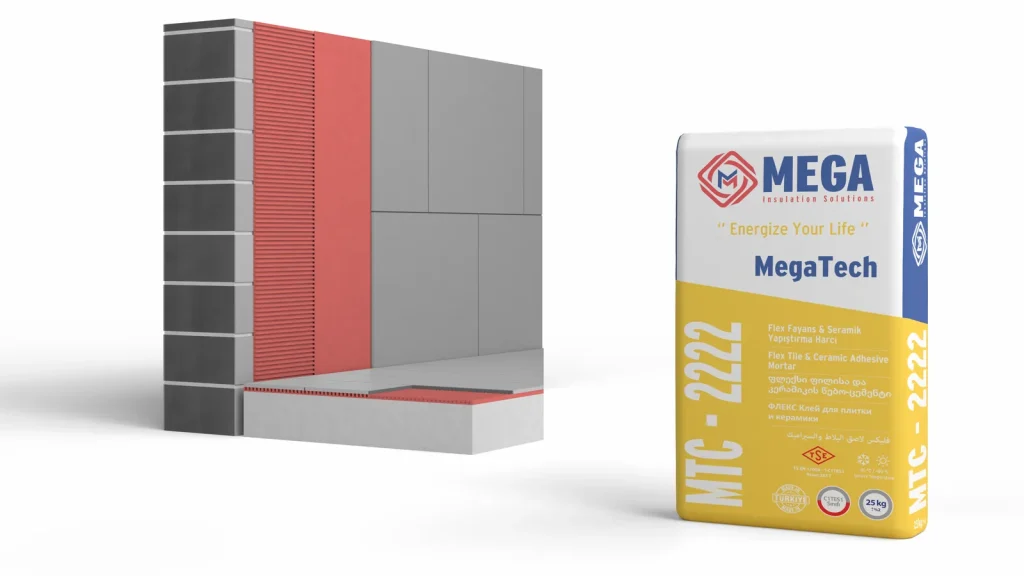
In the MTC-2221 and MTC-2222 data sheets, the trowel size is chosen by tile size: in MTC-2221, the notch of 3 mm for tiles under 5 cm rises to 10 mm for tiles over 40 cm. The other two data sheets give no such match.
| Product | Tile size and trowel size |
|---|---|
| MTC-2221 | Under 5 cm: 3 mm; 5–10 cm: 4 mm; 10–20 cm: 6 mm; 20–40 cm: 8 mm; over 40 cm: 10 mm |
| MTC-2222 | Up to 120 cm²: 6x6x6 mm; 120–500 cm²: 8x8x8 mm; 500–2000 cm²: 10x10x10 mm |
| MTC-2232 | The data sheet gives no trowel size |
| MTC-2233 | 6x6x6 mm and 8x8x8 mm; the data sheet gives no match with tile size and says “suited to the tile size” |
Source: MegaTech MTC-2221, MTC-2222, MTC-2232 and MTC-2233 technical data sheets.
A different trowel size also changes mortar consumption; the per-bag calculation is in our coverage guide.
How are granite tiles fixed, and when is double-sided bonding needed?
According to Mega’s MTC-2232 data sheet, granite tiles are fixed by placing them on the combed mortar within 20 minutes and pressing them in with a rubber mallet; in large formats, the product is defined for ceramics with water absorption below 3% and smaller than 60×60 cm. The steps are the same as for other tiles; the difference lies in the product and the size limit.
In double-sided bonding, the mortar goes on both the surface and the back of the tile. The MTC-2222 and MTC-2233 data sheets give consumption for this method, but no MegaTech data sheet says which tiles need it.
According to a presentation by The Tile Association, the British wall tiling standard BS 5385-1:2018 recommends buttering a thin coat of mortar onto the back of the tile, in addition to the combed bed, for large tiles over 3600 cm² and for tiles with ribbed or deep-keyed backs. The same presentation states that a 50% contact area will not give enough bond for large-format and thin tiles, and recommends solid bedding for tiles of 0.1 m² and above. According to the same presentation, the standard also requires mechanical fixings for tiles over 0.1 m² fixed more than 3 m above floor level; on facades and high walls, settle this in the project specification. The tile manufacturer’s instructions and the specification also govern this decision.
How long should you wait before grouting tiles?
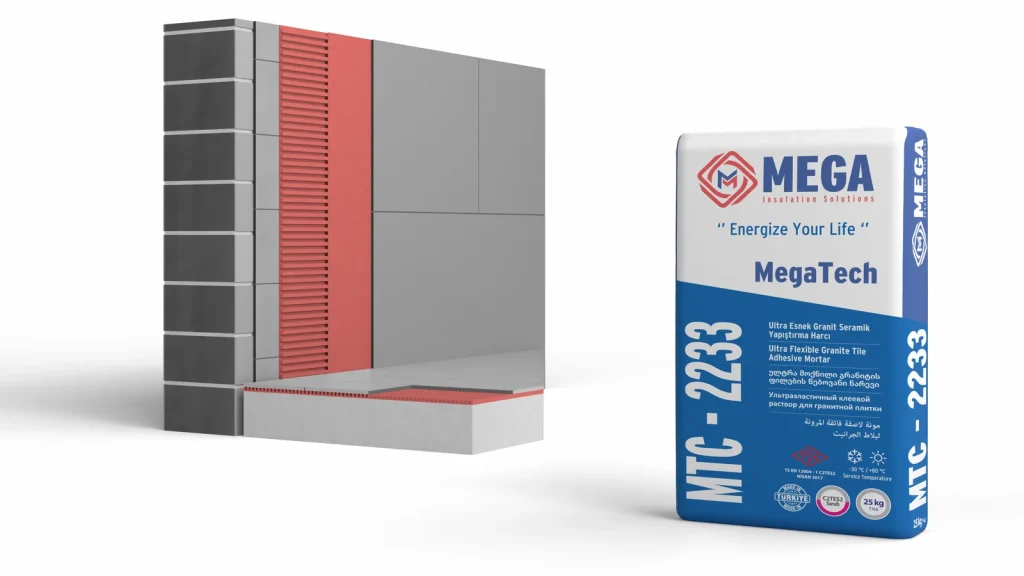
The waiting time for grouting varies by product: 24 hours on walls and 48 hours on floors in the MTC-2221 and MTC-2233 data sheets, and at least 24 hours in the MTC-2222 data sheet. The MTC-2232 data sheet gives no grouting time.
The 24-hour rule in the MTC-2232 data sheet applies to direct contact with water; do not read it as a grouting time. The requirements for grout are defined in a separate standard, EN 13888-1. Because this standard contains no criteria for tile design and installation, follow the instructions of the grout you use.
In what conditions should tiles not be fixed?
According to their data sheets, MegaTech tile adhesives are not applied at ambient temperatures outside +5 °C to +35 °C, on frozen or thawing surfaces or those at risk of frost within 24 hours, in direct sun, in strong wind or on hot surfaces. We cover cold-weather precautions in plaster and tile work in winter.
What are the common mistakes when fixing tiles?
According to the warnings in MegaTech data sheets, the main risks are changing the mix afterwards and exceeding the times. Avoid the following:
- Adding water, powder or any other material to mortar that is already homogeneous,
- Thinning expired mortar with water or dry mortar and reusing it,
- Placing tiles on mortar with a surface film without combing it again,
- Failing to protect the mortar from fast drying in windy weather,
- Expecting full strength before curing has finished.
The European standard EN 12004-1 defines the performance requirements of the adhesive but gives no criteria for tile design and installation. In practice, therefore, the product data sheet and the project specification govern the work.
Frequently Asked Questions
How thick should tile adhesive be applied?
MegaTech data sheets do not give the mortar thickness as a separate millimetre value; the notched trowel you choose sets the bed. The MTC-2221 data sheet lists a notch of 3–10 mm by tile size, and the MTC-2222 data sheet lists 6x6x6, 8x8x8 and 10x10x10 mm. The mortar is first spread with the flat side of the trowel, then combed with the notched side suited to the tile.
How long should tile adhesive rest after mixing?
According to all four MegaTech tile adhesive data sheets, once the mortar is homogeneous it rests for 5–10 minutes and is remixed for 1–2 minutes before application. After that, no powder, water or other material is added. According to the MTC-2221, MTC-2222 and MTC-2232 data sheets, mixed mortar is used within 5 hours.
Within how many minutes must tiles go onto the combed mortar?
According to the MTC-2221, MTC-2222 and MTC-2232 data sheets, tiles are placed on the combed mortar within 20 minutes, and within 30 minutes according to the MTC-2233 data sheet. This time can be shorter in high temperatures, low humidity and wind. If a film has formed on the surface, the mortar is combed again; expired mortar is scraped off the surface.
When is double-sided bonding used?
MegaTech data sheets give consumption for double-sided bonding but do not say which tiles need it. According to a presentation by The Tile Association, the British wall tiling standard BS 5385-1:2018 recommends this method for tiles over 3600 cm² and for tiles with ribbed or deep-keyed backs. Also check the tile manufacturer’s instructions and the specification.
When can newly fixed tiles come into contact with water?
According to the MTC-2221, MTC-2222 and MTC-2232 data sheets, fixed tiles are protected from direct contact with water for at least 24 hours. The MTC-2233 data sheet gives no separate water contact time. A warning shared by the data sheets says the adhesive may not reach its full strength before it has fully cured, so wait for curing to finish before putting a wet area into use.
Can tiles be fixed to gypsum plaster?
Among Mega products, the MTC-2232 data sheet names applications on gypsum plaster, gypsum board, aerated concrete and exposed concrete. The MTC-2221, MTC-2222 and MTC-2233 data sheets list concrete, plaster and screed as application surfaces. In every case the surface must be sound, clean and fully cured. According to The Tile Association’s presentation, BS 5385-1:2018 puts the tile weight gypsum plaster can carry at 20 kg per m², adhesive included, and gypsum plaster is not used in wet areas without a waterproofing system.
Sources
- MegaTech MTC-2221 Tile and Ceramic Adhesive Mortar technical data sheet (TDS)
- MegaTech MTC-2222 Flex Tile and Ceramic Adhesive Mortar technical data sheet (TDS)
- MegaTech MTC-2232 Granite Tile Adhesive Mortar technical data sheet (TDS)
- MegaTech MTC-2233 Ultra Flexible Granite Tile Adhesive Mortar technical data sheet (TDS)
- BS EN 12004-1:2017, adhesives for ceramic tiles standard, scope (BSI)
- SS-EN 13888-1:2022, grouts for ceramic tiles standard, scope (SIS)
- Presentation on changes to BS 5385-1:2018 (The Tile Association)
You can browse Mega’s tile adhesives in the cement-based tile adhesive mortars category and reach our technical team about the right product for your project through our contact page.