
In short: The difference between C1TE and C2TE lies in bond strength. Both codes describe a cementitious (C) tile adhesive with reduced slip (T) and extended open time (E); the digit 1 marks the basic class and the digit 2 the class with improved characteristics. In Mega’s technical data sheets, the tensile adhesion strength is ≥0.5 N/mm² for the C1TE product and ≥1 N/mm² for the C2TE product.
The class codes come from the TS EN 12004-1 standard and are printed on the bag. Anyone who can read the code can tell which bag suits an interior wall and which suits a terrace or an underfloor-heated floor. To see where adhesives sit among the product groups, read our article on what construction chemicals are.
What is the difference between C1TE and C2TE?
The only difference between the C1TE and C2TE codes is the digit after the C: C2 is the class with improved characteristics compared with C1. The letters T and E mean the same in both codes, so both adhesives are classified to hold tiles on a wall without slipping and to stay workable for a while after combing.
Mega’s data sheets show this difference in figures: the tensile adhesion strength, initially and after water immersion, heat ageing and freeze-thaw tests, is ≥0.5 N/mm² for MTC-2221 in class C1TE and ≥1 N/mm² for MTC-2232 in class C2TE. That is why C1TE is sufficient for standard indoor tiles, while C2TE is preferred for porcelain (granite) tiles, outdoor areas and surfaces in constant contact with water, such as pools.
How do you read tile adhesive classes? C, 1, 2, T, E, S1 and S2
Tile adhesive classes describe the type of adhesive, its basic performance and its additional properties with letters and digits. The code is read from left to right: first the type, then the performance class, then the additional properties and, if any, the deformability class.
EN 12004-1, published in Türkiye as TS EN 12004-1, covers cementitious, dispersion and reaction resin adhesives and defines cementitious ones for both internal and external installations. The standard sets performance requirements and classification but gives no criteria for installing the tiling. The class code helps you pick the right product but does not replace good workmanship.
| Code | Meaning (TS EN 12004-1) | MegaTech product |
|---|---|---|
| C | Cementitious adhesive | All four |
| 1 | Normal setting, basic class | MTC-2221, MTC-2222 |
| 2 | Improved characteristics | MTC-2232, MTC-2233 |
| T | Reduced slip | All four; slip ≤0.5 mm in the data sheets |
| E | Extended open time | All four |
| S1 | Deformable (flexible) | MTC-2222 |
| S2 | Highly deformable | MTC-2233; deformability ≥5 mm in the data sheet |
The letter T matters most on walls: a reduced-slip mortar holds the tile in place without it sliding down under its own weight. The letter E shows that tiles can be placed on the combed mortar for longer. If there is no S in the code, no deformability class has been declared; where temperature differences or substrate movement are large, look for an S1 or S2 product.
Which classes do MegaTech tile adhesives belong to?
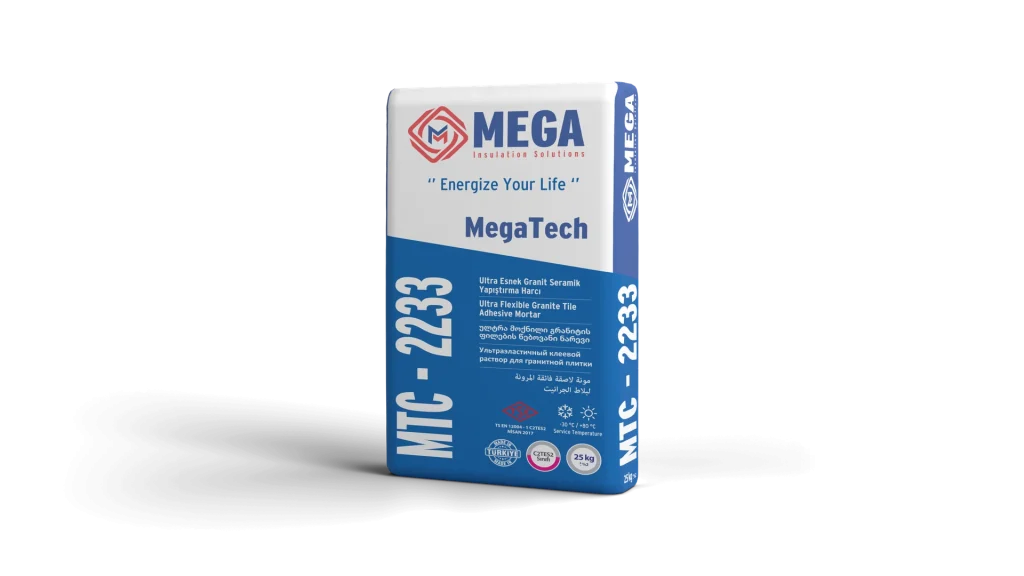
The MegaTech range includes four cementitious tile adhesives, each matching a different class: MTC-2221 C1TE, MTC-2222 C1TE S1, MTC-2232 C2TE and MTC-2233 C2TE S2. All four come in 25 kg kraft bags and are certified under TS EN 12004-1; the certificates are available on the MegaTech technical documents page.
| Product | Class | Tensile adhesion | Slip | Deformability | Main uses |
|---|---|---|---|---|---|
| Wall and floor tile adhesive (MTC-2221) | C1TE | ≥0.5 N/mm² | ≤0.5 mm | Not declared | Small and medium-sized tiles; bathrooms, kitchens |
| Flexible tile adhesive (MTC-2222) | C1TE S1 | ≥0.5 N/mm²; ≥1.5 at 28 days | ≤0.5 mm | S1 | Indoors; outdoors on horizontal surfaces only |
| Granite tile adhesive (MTC-2232) | C2TE | ≥1 N/mm² | ≤0.5 mm | Not declared | Porcelain (granite) tiles; terraces, pools, external walls |
| Ultra-flexible granite tile adhesive (MTC-2233) | C2TE S2 | ≥1 N/mm² | ≤0.5 mm | S2, ≥5 mm | Over existing tiles, underfloor heating, glass mosaic |
Source: Mega technical data sheets and product pages; the tensile adhesion column shows the initial value.
Mega Insulation Solutions (Mega Yalıtım) is a Turkish manufacturer of insulation materials headquartered in Kavacık, Istanbul. Alongside stone wool, XPS and EPS thermal insulation boards, it offers MegaTech construction chemicals, including tile adhesives, and Fullback waterproofing products under the Mega brand.
Which tile adhesive class should you choose for which job?
Three questions decide the choice: where will the tile be laid, what are its size and water absorption, and how much will heat or movement stress the surface? Standard indoor tiles call for C1TE, porcelain tiles and outdoor areas for C2TE, and demanding surfaces for an S1 or S2 class.
Bathrooms and kitchens
In bathrooms and kitchens, the C1TE product MTC-2221 is used for small and medium-sized tiles laid on concrete, render or screed; its product page recommends it especially for wet rooms. The S1 product MTC-2222 is also specified for these rooms and resists surface stresses caused by temperature differences.
In wet rooms, the adhesive alone does not waterproof the surface. In areas in constant contact with water, such as showers, a separate waterproofing material is applied to the substrate before tiling.
Terraces, balconies and pools
Outdoors, tiles are stressed by rain, frost and sun, so the C2TE class comes to the fore. Mega’s data sheet specifies MTC-2232 for terraces and balconies, areas permanently exposed to water such as swimming pools, and external walls. MTC-2222, by contrast, is used outdoors on horizontal surfaces only.
For glass mosaic in wet areas such as pools, Turkish baths, saunas and water tanks, the S2 product MTC-2233 is used. Liquid-applied waterproofing products laid beneath tiles outdoors and in pools fall under a separate standard, EN 14891.
Over existing tiles
When tiling over existing tiles, the adhesive has to bond to a surface with very low absorption. Mega’s product pages specify this use for MTC-2221 and MTC-2233; MTC-2233 is also used over existing granite and marble. The old covering must be sound and free of grease and dirt.
Underfloor heating and sudden temperature changes
On underfloor-heated floors, in cold stores and on surfaces with sudden temperature changes, the tile and the substrate expand at different rates. For these areas Mega recommends the highly deformable S2 product MTC-2233, whose data sheet gives a temperature resistance of -30 / +60 °C.
How much tile adhesive do you need? Notch trowel table
Tile adhesive consumption depends on the tile size, the notch size of the trowel and whether the mortar is spread only on the substrate or also on the back of the tile. In Mega’s data sheets, values start at 2 kg/m² for small tiles and can exceed 8 kg/m² for large tiles bonded on both sides.
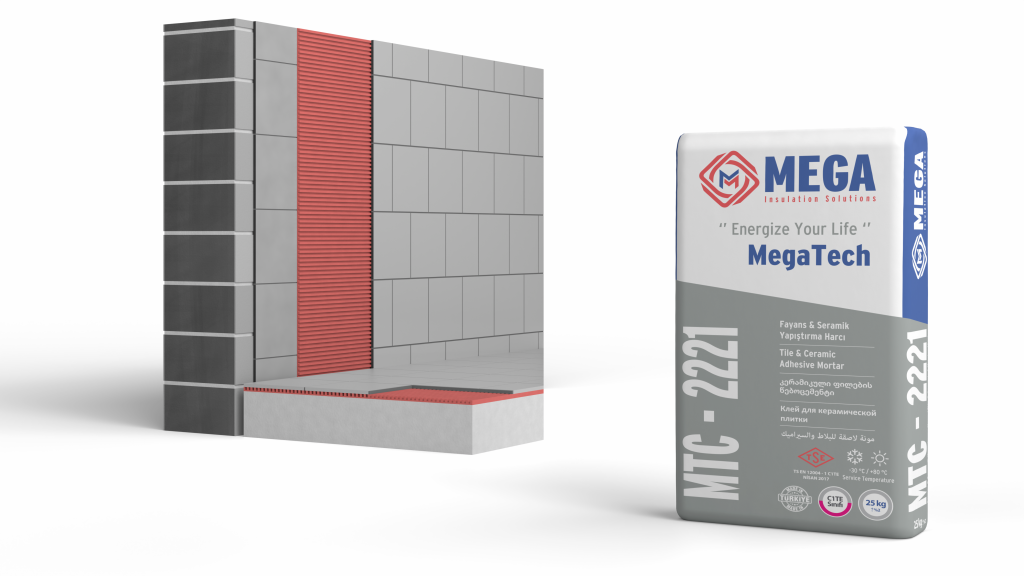
The MTC-2221 data sheet gives consumption by tile size:
| Tile size | Notch size | Consumption (kg/m²) |
|---|---|---|
| Under 5 cm | 3 mm | 2 |
| 5–10 cm | 4 mm | 2–3 |
| 10–20 cm | 6 mm | 4 |
| 20–40 cm | 8 mm | 5–6 |
| Over 40 cm | 10 mm | 7–8 |
The MTC-2222 and MTC-2233 data sheets give separate values by notch size for single-side bonding (on the substrate only) and double-side bonding (on the substrate and the back of the tile):
| Product | Trowel (mm) | Tile area | Single-side (kg/m²) | Double-side (kg/m²) |
|---|---|---|---|---|
| MTC-2222 | 6x6x6 | Up to 120 cm² | 4 | 5–6 |
| MTC-2222 | 8x8x8 | 120–500 cm² | 5 | 6.5 |
| MTC-2222 | 10x10x10 | 500–2000 cm² | 5.5 | 7–8 |
| MTC-2233 | 6x6x6 | Not specified | 4.00–4.75 | 5.50–6.50 |
| MTC-2233 | 8x8x8 | Not specified | 5.50–6.50 | 7.50–8.50 |
For the C2TE product MTC-2232, the data sheet gives a consumption of 4–5 kg/m². Bag quantities follow from these values: taking 5–6 kg/m² for MTC-2221 with 20–40 cm tiles, a 25 kg bag covers about 4–5 m².
How is tile adhesive mixed, and when can you grout?
Water goes into a clean bucket first, then the powder, and the mix is stirred with a low-speed mixer until free of lumps. For MTC-2221 and MTC-2233, grouting waits 24 hours on walls and 48 hours on floors.
- Prepare the substrate: The surface must be sound, fully cured and free of dust, dirt and grease; porous surfaces are dampened beforehand.
- Measure the water: MTC-2222 and MTC-2232 take 6–6.5 litres of water per 25 kg; for other products, follow the ratio on the bag and in the data sheet.
- Mix: Add the powder to the water gradually; once the mix is uniform, let it stand briefly and stir again. Do not add water or powder after this point.
- Comb the mortar: Spread the mortar with the flat side of the trowel and comb it with a notched trowel suited to the tile size; if a skin has formed, comb it again.
- Bed the tiles: According to the MTC-2222 and MTC-2232 data sheets, tiles are pressed in with a rubber mallet within 20 minutes and the mortar is used within 5 hours. In hot, dry and windy weather, the time for bedding the tiles may be shorter.
- Protect from water: According to the same data sheets, the tiles are kept away from direct contact with water for at least 24 hours.
- Grout on time: Wait 24 hours on walls and 48 hours on floors for MTC-2221 and MTC-2233, and at least 24 hours for MTC-2222.
The data sheets share these application conditions: the ambient temperature must be between +5 and +35 °C, and the adhesive must not be applied to frozen or thawing surfaces, to surfaces at risk of frost within 24 hours, in direct sun, in strong wind or on hot surfaces.
Application note from MegaUsta: Touch the combed mortar lightly with a fingertip. If no mortar sticks to your finger, a skin has formed; comb the mortar again instead of pressing the tile onto it. Lifting a freshly laid tile now and then to check its back also shows how well the mortar covers the tile.
What should you watch for with large-format tiles?
With large-format tiles, the first check is whether the chosen adhesive is specified for that size. The data sheet of Mega’s C2TE product MTC-2232 limits its use with large tiles of water absorption below 3% to tiles smaller than 60×60 cm.
MegaTech data sheets specify no use for tiles of 60×120 cm or larger; for these sizes, follow the tile manufacturer’s instructions and the project specification. The larger the tile, the harder it is for the mortar to fill its back without voids; double-side bonding, with a thin layer of mortar also spread on the back of the tile, reduces this risk.
Frequently Asked Questions
What does C2TE mean?
Under TS EN 12004-1, C2TE stands for a cementitious (C) tile adhesive with improved characteristics (2), reduced slip (T) and extended open time (E). The data sheet of Mega’s granite tile adhesive in this class, MTC-2232, gives a tensile adhesion strength of ≥1 N/mm² and slip of ≤0.5 mm. The product is specified for porcelain (granite) tiles, terraces, pools and external walls.
What do the S1 and S2 deformability classes mean?
S1 and S2 are classes that show how much a cementitious adhesive can deform, in other words its flexibility. S1 means deformable and S2 means highly deformable. The data sheet of Mega’s S2 product, MTC-2233, gives a deformability of ≥5 mm. If there is no S in the code, no deformability class has been declared for the product.
How much water goes into a 25 kg bag of tile adhesive?
According to Mega’s MTC-2222 and MTC-2232 data sheets, a 25 kg bag of tile adhesive is mixed with 6–6.5 litres of water. The ratio varies from product to product, so for any other adhesive follow the figure on the bag and in its data sheet. Pour the water in first and add the powder gradually; do not add water or powder once the mortar has been mixed.
How many hours after tiling can you grout?
According to Mega’s data sheets, grouting can start 24 hours after tiling on walls and 48 hours after tiling on floors; these times are given for MTC-2221 and MTC-2233. For the S1 product MTC-2222, wait at least 24 hours before grouting. The MTC-2222 and MTC-2232 data sheets also require the tiles to be kept away from direct contact with water for the first 24 hours.
Which adhesive should be used for porcelain (granite) tiles?
The adhesive Mega recommends for porcelain (granite) tiles is MTC-2232, a C2TE product. Its data sheet specifies it for porcelain tiles, marble and large tiles smaller than 60×60 cm with water absorption below 3%. If the tiles go onto an underfloor-heated floor, a surface with sudden temperature changes or an existing tiled surface, choose the S2 product MTC-2233.
Sources
- EN 12004-1:2017 adhesives for ceramic tiles standard (SIS)
- BS EN 12004-1:2017 standard record (BSI)
- EN 14891:2017 liquid-applied waterproofing beneath tiles standard (SIS)
- Mega MTC-2221 technical data sheet (PDF)
- Mega MTC-2222 technical data sheet (PDF)
- Mega MTC-2232 technical data sheet (PDF)
- Mega MTC-2233 technical data sheet (PDF)
- Mega Yalıtım technical documents
The four adhesives are listed with their data sheets in the tile adhesives category; the board adhesive and renders from the same family are covered in our article on ETICS components. For the right class for your project, contact the Mega Yalıtım technical team via the contact page.