
In short: Elastomeric waterproofing is a general term for polymer-based waterproofing materials that cure to a layer able to stretch like rubber and return to its shape. Liquid membranes form this layer by being applied to the surface. How far a product really stretches is shown by elongation at break and crack-bridging values, not by the label.
This guide covers what the term means, which Mega product it appears on, where liquid membrane is used and how a single-component acrylic product differs from a two-component cement-based one. For the general picture, see what is waterproofing; for applying two-component products, see cement-based waterproofing.
What does elastomeric mean, and what does it describe in waterproofing?
Elastomeric means a material behaves like an elastomer: it lengthens when stretched and returns to its shape when the force is removed. The Polymer Science Learning Center at the University of Southern Mississippi explains elastomers as polymers that can be stretched to many times their original length and return to their original shape without permanent deformation.
The term is not the name of a single chemical. Türkiye’s Regulation on Waterproofing in Buildings (Binalarda Su Yalıtımı Yönetmeliği) also uses “elastomeric” not for a liquid product but for the “elastomeric polymer bitumen sheets” used at moving roof details. So the same adjective can appear on both applied products and ready-made sheets. This is why the material base should be checked first when choosing a product.
Flexibility has a measurable equivalent. The Regulation asks roof materials for tensile strength and elongation at break, and/or crack-bridging ability. A 2001 IIBEC article on ASTM D6083, written in the United States for acrylic roof coatings, reports the minimums at that time as 100% elongation and 200 psi tensile strength. The standard has since been updated (active edition D6083/D6083M-24); these values are only an example and should not be read as a binding threshold for Türkiye.
Which Mega product is called elastomeric?
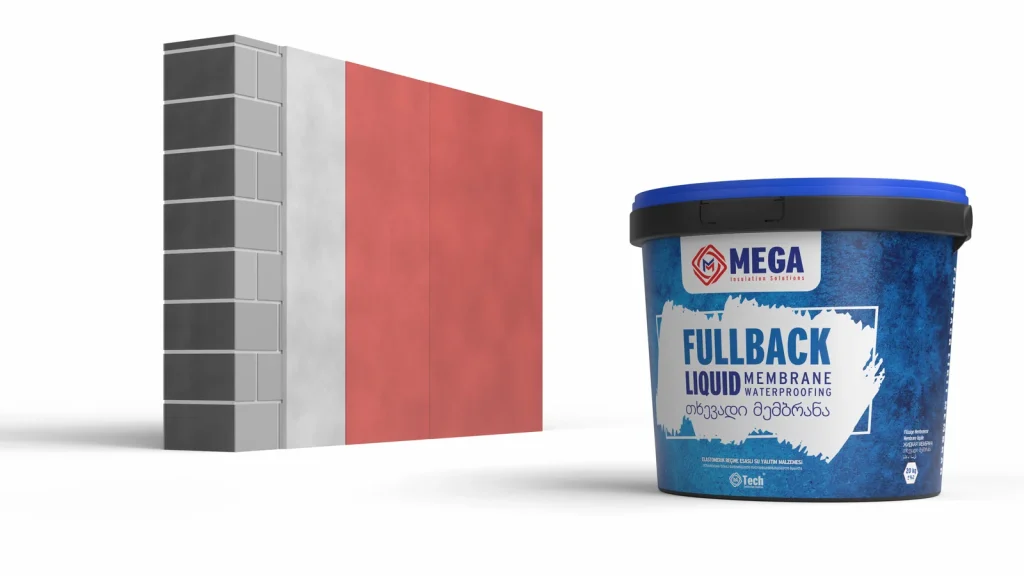
In Mega’s sources, the phrase “elastomeric resin-based” appears in two places: in the name of the Fullback product category and on the label of the single-component Fullback liquid membrane pail. The product pages showing this pail are Fullback Acrylic and Acrylic UV; they describe the product as acrylic-based and single-component, do not use the adjective “elastomeric” and give no numerical flexibility value. The word is not in the product description or packaging images of the two-component Fullback Duo either; for Duo, the phrase appears only in the category name that lists the five products together.
| Source | Product concerned | Wording |
|---|---|---|
| Category name | Five Fullback products | Fullback Elastomerik Reçine Esaslı Su Yalıtım Malzemesi (Fullback elastomeric resin-based waterproofing material) |
| Pail label | Fullback liquid membrane, 20 kg | Elastomerik reçine esaslı su yalıtım malzemesi (elastomeric resin-based waterproofing material) |
| Product page | Fullback Acrylic and Fullback Acrylic UV | Acrylic-based, single-component; UV-resistant in the UV version |
| Product page | Fullback Duo fully elastic and Duo UV | Cement- and acrylic-based, two-component; fully elastic |
| Product page | Fullback Duo semi-elastic | Cement- and acrylic-based, two-component; semi-elastic |
| Packaging | Fullback Duo-F and Duo-S | Two-component waterproofing material; fully elastic or semi-elastic on the canister |
Source: Mega Fullback category and product pages, Fullback packaging images.
Mega Insulation Solutions (Mega Yalıtım) offers Fullback products under the Mega brand. Because the product pages give no numerical value measuring flexibility, this article does not use “elastomeric” as a performance claim and refers to the products by the names on their pages: Fullback Acrylic-Based Liquid Waterproofing and Fullback Duo.
What does resin-based waterproofing mean?
Resin-based waterproofing is a broad phrase for applied products with a polymer binder, and on its own it does not say which chemistry is meant. Annex 1 of the Regulation on Waterproofing in Buildings puts polyurethane, polyurea, hybrid and similar products in the “resin-based” group, while it matches cement-based, dispersion-based and reaction resin applied products to TS EN 14891 on a separate line.
The Regulation also refers to acrylic products as “acrylic (polymer dispersion)”. Because the Fullback Acrylic product page says “acrylic-based”, the phrase “resin-based” in the category name or on the pail should not be read as polyurethane or polyurea.
Where is liquid membrane used?
According to its product page, Fullback Acrylic liquid waterproofing is used to waterproof pitched roofs and terraces, building facades and details such as cracks, eaves and chimney bases. The surfaces the page lists are pitched roofs and terraces in concrete, render, cement board, galvanised steel, zinc, aluminium, PVC, polyester and timber cladding.
- Pitched roof and terrace: Its relationship to thermal insulation, underlay and covering is explained in our guide on how to insulate a roof.
- Facade: The product page lists building facades as a separate use.
- Details: Because it is applied as a liquid, there are no sheet joints as with ready-made sheets, and the same material can continue around shaped points such as eaves and chimney bases.
On balconies and small terraces, the choice depends on what will go on top of the waterproofing; we cover this decision and the definition of liquid membrane in our balcony and terrace waterproofing guide.
What is the difference between single-component acrylic and two-component cement-based waterproofing?
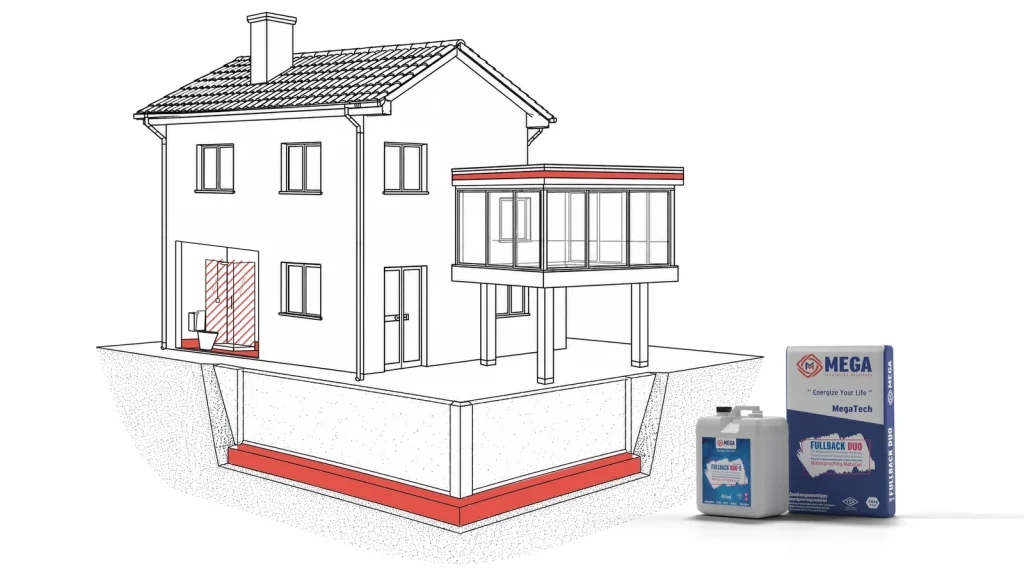
In Mega’s Fullback range, the main difference is this: Fullback Acrylic is single-component and is not mixed with a second component, while Fullback Duo provides waterproofing when its powder and liquid components are mixed. Their uses differ too: the first is defined for roofs, terraces and facades, the second for areas such as wet areas, pools, water tanks and foundations.
| Property | Fullback Acrylic and Acrylic UV | Fullback Duo fully elastic and Duo UV | Fullback Duo semi-elastic |
|---|---|---|---|
| Material base | Acrylic-based | Cement- and acrylic-based | Cement- and acrylic-based |
| Components | Single-component | Two-component: powder and liquid | Two-component: powder and liquid |
| Packaging | 20 kg pail | 20 kg powder + 10 kg liquid | 20 kg powder + 5 kg liquid |
| Flexibility wording on the product page | Not stated | Fully elastic | Semi-elastic |
| UV resistance | Declared only for Acrylic UV | Declared only for Duo UV | Not declared |
| Application surface | Concrete, render, cement board, galvanised steel, zinc, aluminium, PVC, polyester, timber cladding | Surfaces such as concrete, render and screed | Surfaces such as concrete, render and screed |
| Use | Pitched roofs and terraces, facades; cracks, eaves, chimney bases | Indoors and outdoors; pools, water tanks, wet areas, small terraces and balconies; foundation, basement and retaining walls | Indoors and outdoors; pools, water tanks, wet areas, small terraces and balconies; foundation, basement and retaining walls |
| The word “elastomeric” | Pail label and category name | Category name only | Category name only |
Source: Mega Fullback product and category pages, Fullback packaging images.
Can liquid membrane be left exposed to the sun?
Liquid membrane can be left exposed only if the product resists solar radiation; otherwise it must be covered with a protective layer. The Regulation on Waterproofing in Buildings requires roof waterproofing used as the outermost layer to resist solar radiation or to be covered with a layer providing this performance.
In the Fullback range, UV resistance is stated on the product pages for Fullback Acrylic UV and Fullback Duo UV. The pages for standard Fullback Acrylic and non-UV Fullback Duo contain no such statement, so do not plan these products as a final coat exposed to the sun.
In what order is liquid waterproofing applied?
Liquid waterproofing is applied in the order of surface preparation, primer if needed, material preparation, details and main layer. The Fullback product pages do not give the number of coats, thickness, consumption or drying time. The order below is based on the general principles of the Regulation on Waterproofing in Buildings:
- Clean and repair the surface: Remove residues that reduce adhesion, such as dust, loose fill, paint and formwork oil, and close holes, voids and non-structural cracks with repair mortar.
- Apply a primer if needed: Roughen a surface that prevents adhesion mechanically if possible; otherwise use a bonding primer suited to the chosen material.
- Prepare the material: Prepare the product to the manufacturer’s instructions. Fullback Acrylic is single-component; with Fullback Duo, waterproofing is not achieved unless the two components are mixed.
- Resolve the details: Take extra measures at movement joints and corners. On a terrace, continue the waterproofing at least 30 cm above the top horizontal level at parapets, chimneys and vent outlets, and make it continuous with gutters, valleys and drain gratings.
- Apply the main layer: Apply the material so that it forms an even, homogeneous layer on the surface. In new buildings, the thickness and/or consumption is shown in the project details.
Note from MegaUsta: Do not choose the product by the adjective on the packaging; look first at where it will be used, then at the surface. The Fullback Acrylic page lists surfaces clad in zinc, aluminium and PVC, but on light metal roofs the Regulation requires sheets, so the list alone is not enough. For a wet area on concrete or screed, look at the Fullback Duo page. If your surface is not on the list, do not use the product on it.
What are the limits of Fullback products?
Fullback products are defined for the surfaces and areas listed on their pages. In the following cases, the choice should be made according to the project:
- Flexibility values: The product pages give no numerical value for elongation at break or crack bridging.
- Beneath tiles: The Fullback Acrylic pages do not list use beneath tiles.
- Wet area floors: The Regulation does not allow acrylic-based products on the floors of intensively used spaces such as communal showers. The Fullback Acrylic page does not list wet areas either.
- Pressurised water: The Regulation bases horizontal surfaces exposed to pressurised water on sheet materials. The Fullback range has no sheet product. Although the Fullback Duo page lists foundations and basement walls, do not plan such a surface with Fullback.
- Light metal roofs: The Regulation requires reinforced synthetic sheets or elastomeric polymer bitumen sheets at details with heavy roof movement, such as on light metal roofs. Fullback Acrylic is not one of these sheets and the Fullback range has none.
- Drinking water: The Fullback Duo pages list water tanks but contain no statement of suitability for drinking water. The Regulation requires materials in contact with drinking and service water not to impair water quality, not to contain solvents and not to be bitumen-based.
Frequently Asked Questions
Are elastomeric and acrylic waterproofing the same thing?
No. Acrylic describes the material base, while elastomeric describes the behaviour of stretching and returning to shape. An acrylic product can show this behaviour, but the same adjective is also used for polymer bitumen sheets. Mega’s Fullback liquid membrane pail says ‘elastomeric resin-based’, while the product page describes the same product as ‘acrylic-based, single-component’. So the product is an acrylic-based liquid; its pages give no numerical flexibility value.
Is Fullback Duo an elastomeric product?
Mega’s sources do not use the term for Fullback Duo at product level; it appears only in the category name that lists the five products together. The product pages describe Fullback Duo as cement- and acrylic-based and two-component, and state its flexibility as ‘fully elastic’ or ‘semi-elastic’. When choosing a product, look at these descriptions rather than the category name.
Which values are used to check elastomeric waterproofing?
Tensile strength, elongation at break and crack bridging. Türkiye’s Regulation on Waterproofing in Buildings requires materials used on roofs to have the tensile strength and elongation at break, and/or the crack-bridging ability, to cope with deformation effects. The word ‘elastomeric’ or ‘flexible’ on a label is not proof on its own; look for these values on the product’s data sheet.
Can tiles be laid over liquid membrane?
It depends on the product. The Fullback Acrylic product pages do not list use beneath tiles, so the product is not preferred where tiles are planned. For wet areas, balconies and small terraces, look at Fullback Duo, whose uses include these surfaces. Requirements for liquid products used beneath ceramic tiling are set out in EN 14891; the standard gives no application advice.
Can liquid membrane be used on a metal roof?
The Fullback Acrylic product page lists pitched roofs and terraces clad in galvanised steel, zinc and aluminium among its surfaces. However, the Regulation on Waterproofing in Buildings requires reinforced synthetic sheets or elastomeric polymer bitumen sheets at details with heavy roof movement, such as on light metal roofs. Fullback Acrylic is not one of these sheets; do not plan these details from the page’s surface list, and set the sheet type in the project.
What is the difference between resin-based and cement-based waterproofing?
The difference is the binder. Annex 1 of the Regulation on Waterproofing in Buildings lists polyurethane, polyurea, hybrid and similar products in the resin-based group; cement-based and dispersion-based products are on a separate line. Among Mega products, Fullback Duo is cement- and acrylic-based and two-component, while Fullback Acrylic is acrylic-based and single-component according to its product page.
Sources
- Regulation on Waterproofing in Buildings, Official Gazette, 27.10.2017, No. 30223
- Regulation on Waterproofing in Buildings, Annex 1 list of standards (PDF)
- EN 14891:2017, liquid-applied water-impermeable products beneath ceramic tiling, scope (SIS)
- Polymer Science Learning Center, University of Southern Mississippi: Elastomers
- IIBEC: article on the ASTM D6083 acrylic roof coating standard (2001)
- ASTM D6083/D6083M-24, liquid-applied acrylic roof coating standard, scope (ASTM)
- Mega product page: Fullback Acrylic-Based Liquid Waterproofing 20 kg
- Mega product page: Fullback Acrylic-Based Liquid Waterproofing UV 20 kg
You can browse the five Fullback products in the Fullback waterproofing materials category, and reach our technical team through our contact page for the right product and current technical information for your surface.